Gianni Infantino’s $20 Billion Gamble on World Cup Stake
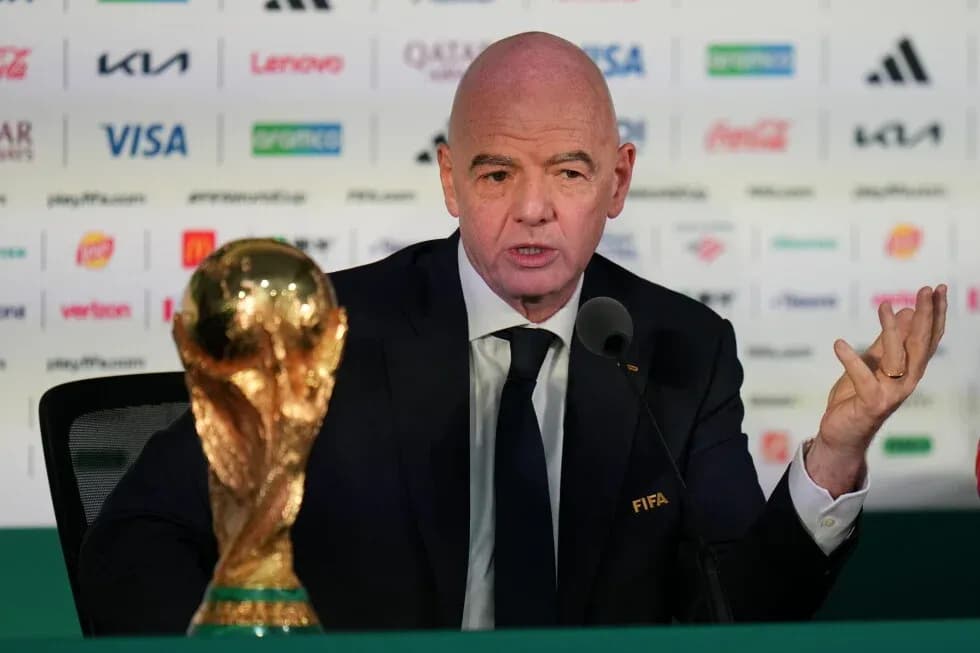
Gianni Infantino has drawn a line in the sand.
From FIFA’s headquarters in Zurich, the president has handed the 211 member federations a stark choice: accept a one-off $20 million payment each and sign up to a 12-year private equity deal for a slice of the World Cup, or walk away with roughly half that money and risk his wrath.
The deadline is Sept. 19. The stakes are far higher than the numbers on the page.
A $20 Billion Gamble
Infantino’s proposal centers on a new FIFA subsidiary, dubbed FIFA Forward Enterprise, that would be valued at $20 billion and 20% owned by private investors. It would run FIFA’s competitions and events — from the men’s and women’s World Cups to expanded Club World Cups — effectively shifting the sport’s crown jewels into a part-privatized vehicle.
The anchor investor is Joshua Kushner’s Thrive Capital, with J.P. Morgan lined up to lead a process to bring in what Infantino calls “a pool of diverse international investors.”
In a letter to member associations, seen by The Associated Press, Infantino framed the project as a “singular and unique funding opportunity” and cast himself as the visionary steward of global football’s future.
“It is my duty and responsibility as FIFA president to present such game-changing opportunities to you, our members,” he wrote.
For many inside the game, the language landed like a warning siren.
UEFA Goes to War
The backlash in Europe was instant and ferocious.
UEFA, which only learned of the plan when it went public on Tuesday, accused FIFA of trying to sell something that does not belong to it. “The World Cup is not FIFA’s to sell,” it declared, as it moved to convene an emergency online meeting of its 55 member federations, likely on Thursday.
The European body, still scarred by Infantino’s previous push to stage the World Cup every two years, is again openly discussing its most powerful weapon: a boycott of FIFA competitions. That threat helped kill the biennial World Cup idea in 2021. It is back on the table.
“The rushed deadline to claim an initial $20 million says everything you need to know about this plan,” UEFA said. “FIFA cannot continue to use our sport to enrich themselves and their friends.”
The influential European Football Clubs group — 850 clubs strong and a joint-venture partner with UEFA on the Champions League — said it “learned about this proposal in the same way as most global football stakeholders — without warning and through the media.”
For Europe’s clubs and federations, it is not just about money. It is about control. A FIFA subsidiary with private investors, tasked with maximizing returns, would inevitably push for more World Cups, more Club World Cups, more teams, more games. That means more pressure on the calendar and more encroachment on competitions like the Champions League, European Championship and Copa America.
Sports governance expert Antoine Duval summed up the concern bluntly: private equity would “incentivize FIFA to further commodify the World Cup,” from more commercial breaks to aggressive ticket pricing.
Asia and CONCACAF Break Ranks
This time, Infantino’s critics are not confined to Europe.
CONCACAF, the confederation for North and Central America and the Caribbean, voiced “deep concern” over the lack of due process. The Asian Football Confederation, based in Kuala Lumpur, said it was “disappointed that a matter of such significance entered the public domain before the AFC family had been afforded the opportunity to examine and discuss it.”
These are not bodies usually eager to confront FIFA in public. Their statements show how far frustration with Infantino’s style of leadership has spread.
For 11 years, he has operated increasingly like a chief executive cutting deals, rather than a consensus-builder presiding over a non-profit. The pattern is familiar: a major commercial project, limited consultation, a tight deadline, and heavy reliance on the loyalty of smaller federations who depend on FIFA money.
He tried it in 2018 with a secretive $25 billion private equity proposal to create new men’s competitions. UEFA pushed back and that plan died. He unveiled a FIFA Peace Prize, then awarded it to Donald Trump at the World Cup draw. He backed Trump’s intervention in the eligibility process that allowed Folarin Balogun to play at the World Cup for the United States.
Now he is back with a bigger, bolder play — and the same method.
The Offer on the Table
The numbers are designed to be irresistible to many of FIFA’s 211 members.
If they approve FIFA Forward Enterprise by majority vote, each federation stands to receive $20 million from the four-year commercial cycle linked to the 2030 men’s World Cup. Over 12 years, Infantino’s letter suggests, the total uplift compared to current commitments would be about $86 million per federation, versus roughly $36 million if they reject the deal and stick with existing funding.
If the plan is rejected, they still get $10 million over the next four years — money already promised.
For dozens of smaller associations, that difference is transformative. Many have national teams that will never reach a World Cup, players who rarely appear in elite club competitions, and domestic leagues that survive on FIFA grants. Their dependence on Zurich is structural, not temporary.
And in FIFA’s one-member, one-vote system, those nations carry the same weight as Brazil, Germany or England. The richest and most powerful football countries on the field can be outvoted with ease in the congress hall.
Infantino knows that. It is how he won power in 2016, with a campaign built on promising more money. It is how he cruised through unopposed re-elections in 2019 and 2023. It is how he has been expected to glide into a fourth and final term through 2031.
This time, though, the opposition is organizing earlier — and louder.
Britain Draws Its Own Red Line
Resistance has also come from a political heavyweight.
British Prime Minister Andy Burnham, whose government is backing a joint bid by England, Scotland, Wales and Ireland to host the 2035 Women’s World Cup, released a pointed video message.
“Football does not belong to investors,” Burnham said. “Once you have sold a piece of (the World Cup), you have sold out. Football belongs to the fans. It always has, and it always will.”
Britain has played this role before. In 2021, threats of legislation from then-Prime Minister Boris Johnson helped crush the European Super League project, which was seen as an existential threat to UEFA’s Champions League and which Infantino had discreetly supported. J.P. Morgan, now set to lead the FIFA investment process, was also the bank behind the Super League.
The message from London is clear: selling a stake in the World Cup will not go unchallenged.
Infantino’s Next Move
Behind the financial engineering and political posturing lies a question about Infantino himself.
His current mandate runs to 2031. Under FIFA rules, that would be his final term as president. Yet some observers have long suspected he wants a longer runway at the top of the sport, perhaps in a different role.
A powerful CEO or commissioner position at FIFA Forward Enterprise — a separate, investor-backed company controlling competitions and commercial rights — would offer exactly that. It would be a structure that could outlast his presidency and potentially sit beyond the reach of traditional football politics.
This week’s storm has complicated that path. Infantino has managed to ignite resistance not just in Europe, but in Asia, North America and key political capitals. The federations have almost four months to decide whether to turn that anger into a formal challenge.
The deadline to enter the presidential race is Nov. 18. The election is set for March 18 in Rabat, Morocco — a staunch Infantino ally and co-host of the 2030 World Cup.
By then, the sport will know whether its leaders are prepared to cash in a piece of the World Cup, or whether they are finally ready to tell FIFA’s president that some trophies are not for sale.