France's World Cup Exit: Deschamps' Final Stand
ARLINGTON, Texas — The end came quietly for France, and then all at once.
They arrived in Texas as the tournament’s gold standard, a squad so deep and so gifted that anything short of the final felt like underachievement. They left the cavernous home of Jerry Jones outplayed, outthought and out of the World Cup, beaten 2-0 by a Spain side that never blinked.
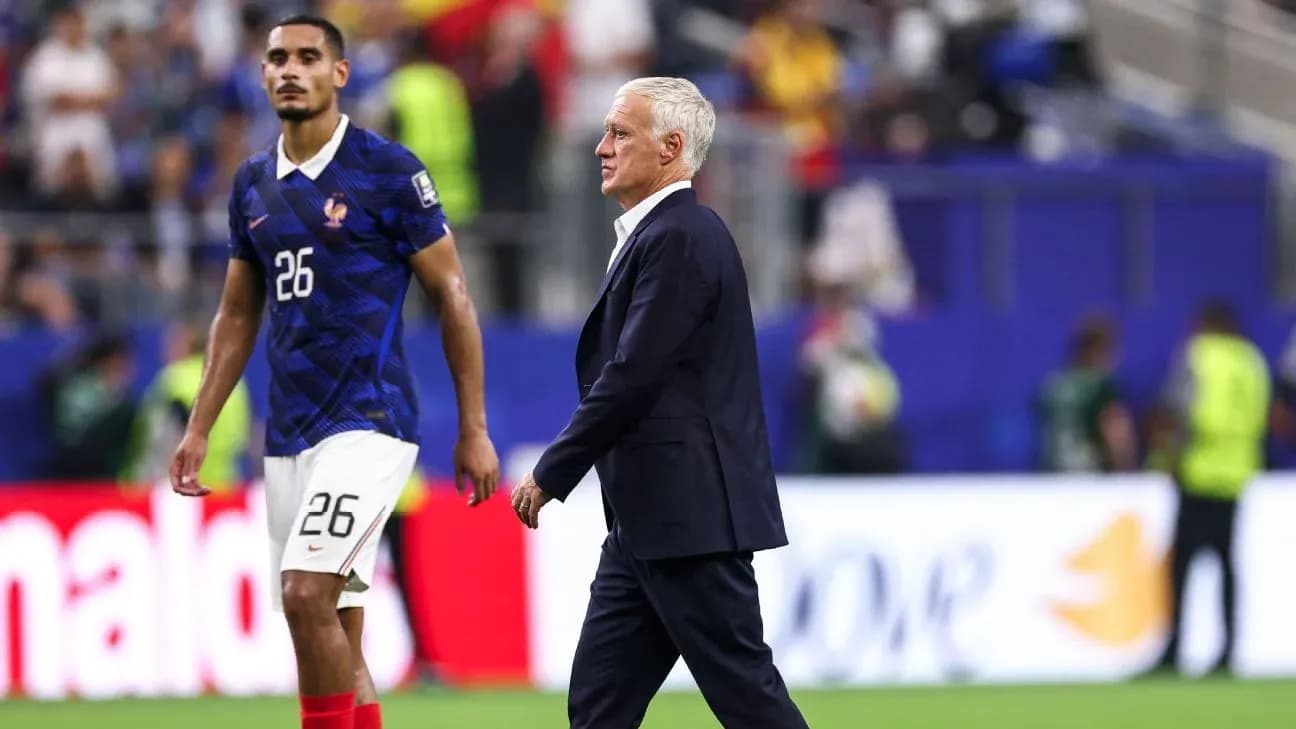
For Didier Deschamps, it was more than a defeat. It was a full stop.
Fourteen years. One hundred eighty-four games. Three major finals and a UEFA Nations League title. A World Cup as a coach to go with the one he lifted as a player. All of it ending not with a furious, last-stand barrage, but with a whimper of a performance that stripped away the aura he had so carefully built.
France had not trailed once in this World Cup until Tuesday afternoon. Once they did, they never looked remotely capable of clawing their way back.
Deschamps’ last stand falls flat
This was supposed to be the most complete France side of his era, maybe of any era: talent stacked from back to front, a front four that on paper could shred any defence in the world. Instead, for 64 numbing minutes, that attack produced 0.04 xG — a number that tells you everything about how toothless they were.
Spain controlled the ball. Spain controlled the space. Spain controlled the tempo. France, the supposed heavyweights, barely landed a jab.
Losing to Spain is no disgrace; they are not far behind France in pure quality. Losing like this is. From the first whistle, Luis de la Fuente’s team looked like they knew exactly what they wanted to do. Deschamps’ side looked like they were waiting for individual brilliance to bail them out.
It was the third time in three years De la Fuente had taken him apart: the Euro 2024 semifinal, the 2025 Nations League thriller that ended 5-4 after Spain led 5-1, and now this World Cup exit. Same matchup, same pattern. Spain coherent, collective, ruthless in their structure. France talented, reactive, and getting progressively worse against the same opponent.
At some point, kryptonite stops being a joke and starts looking like a coaching problem.
The tactical bet that never paid off
Everyone knew how this game would look in broad strokes. Spain would monopolize possession, shuffle the ball, drag defenders out of position and wait for the gaps to appear. The open question was how France would respond.
Adjust to Spain? Add a midfielder to avoid the two-vs.-three France faced in the middle, as Kylian Mbappé himself highlighted? Press higher and try to force mistakes? Or trust the stars, keep the usual shape and dare Spain to cope?
Deschamps backed his talent. He stuck with what had brought him here. He made Spain’s problem France’s plan.
He paid heavily for it.
The logic is understandable. When you have the better players, you expect the game to bend to your will. That belief has underpinned much of Deschamps’ success. Keep the dressing room calm, keep the tactics clear, keep the structure familiar, and let elite players decide matches in the tight margins of a low-scoring sport.
It worked in 2018. It nearly delivered back-to-back World Cups in 2022, a Randal Kolo Muani chance away from history. It worked for him as a player alongside Zinedine Zidane, Patrick Vieira and Thierry Henry in 1998.
But when an opponent takes away both the ball and the space, that model cracks.
Spain denied France possession. They squeezed the pitch. They left no room behind to run into, no easy transitions, no chaos for Mbappé and company to exploit. Deprived of both oxygen sources, even a talent like Michael Olise looked ordinary. At times, less threatening than Michael Scott.
That’s the moment a coach has to intervene, not with cosmetic tweaks but with a real shift. That’s the moment Deschamps has never truly mastered.
His changes on the night summed it up. Manu Koné for Adrien Rabiot. Désiré Doué for Bradley Barcola. Logical, tidy, utterly predictable. The substitutions felt less like bold moves than like the next suggestions on predictive text. On a good day, they keep the system stable. On a night like this, they simply extended the suffering.
His loyalty to certain players followed the same pattern. Rabiot, again, at the heart of it. Olise, left on through a nightmare spell. The same trust that had bound this group together for years suddenly looked like stubbornness.
The very traits that made Deschamps one of the most successful international managers in history ended up dragging him down in his final, most talented cycle.
Enter Zidane, with questions attached
Now the conversation turns to Zidane. It always was going to, sooner or later.
Three UEFA Champions League titles. Two LaLiga crowns. A résumé that glitters. But also five years without a job and no trophy since 2020. A coaching life lived entirely inside the unique ecosystem of Real Madrid, a club that operates on a different planet to international football.
At Madrid, he had daily contact with his players. He could shape training, build rhythm, sense moods. If someone didn’t fit, he could ask for another superstar. With France, he’ll get short windows, scattered camps, and no transfer market to fix what he doesn’t like.
He also built his reputation without leaning on complex tactical schemes. Zidane, like Deschamps, trusted his stars, managed egos, and kept the game simple. It’s tempting to assume he will be a slightly shinier version of the man he replaces.
That might not be a problem. Deschamps’ body of work remains extraordinary, this World Cup exit included. Matching it would already mark Zidane as a success.
But he will have seen what happened in Arlington. He will have seen that there are nights when pure talent isn’t enough, when the opponent’s collective cohesion can smother even the deepest squad in the tournament.
Balance matters. So does the idea that the other side is not just a backdrop for your brilliance, but a machine built to disrupt it. Sometimes you need less flair and more structure. Sometimes you need a Stéphane Guivarc’h up front so that Zidane himself can win you a World Cup from deeper positions. He knows that story better than anyone. So does Deschamps, who was on that same 1998 team.
The lesson for the incoming coach, assuming he takes the job, is stark: when the technical gap is narrow, the team that functions better as a unit usually prevails.
Zidane will inherit a player pool most international managers can only dream of, especially in attack. He has had years to watch this generation grow, to study where it soars and where it stumbles. The tools are there to build something formidable again.
The question now is not whether France will be talented. They always are.
It’s whether the next man in charge can take that talent somewhere Deschamps, for all his medals, ultimately refused to go.