
France vs England: World Cup 2026 Third-Place Playoff Preview
France and England meet again on Saturday in the game no one dreams about but no one wants to lose. The World Cup 2026 third-place playoff – dressed up as a bronze medal match – brings together two heavyweights nursing fresh wounds and awkward questions.
Deschamps’ last stand
When the final whistle went in Dallas, Didier Deschamps knew. Either his stubborn faith in this version of France would be vindicated, or his era would end with Spain tearing up the script. Spain did the tearing.
He had called La Roja the favourites before a ball was kicked. He was right. Mikel Oyarzabal’s nerveless penalty and a crisp finish from Pedro Porro sent Spain to the final against Argentina and left Les Bleus staring at the small print of the tournament brochure: the playoff nobody wants.
The numbers told their own story. Kylian Mbappé and a stacked French attack were reduced to just 0.31 Expected Goals at the Dallas Stadium. The vaunted duel between France’s firepower and Spain’s control never really materialised; Spain’s back line handled it with a calm that made Deschamps’ plan look old, predictable, timid.
On the night he set the record for most World Cup matches managed, his legacy didn’t collapse, but the criticism was fierce. Inside the camp and out. Mbappé himself questioned the tactical approach almost immediately, a rare public crack in a relationship that has defined France’s recent history.
Now, Deschamps bows out in a game he never intended to coach. One last team sheet. One last attempt to squeeze a medal from a campaign that promised more.
History says France know how to handle this fixture. They beat Belgium 4-2 in 1986 to take bronze, and smashed West Germany 6-3 in 1958, when Just Fontaine ran riot with four goals. Only in 1982 did they miss the podium, finishing fourth behind Poland.
This time, it is pride, not history, that needs rescuing.
England’s familiar inquest
Across the bracket, England’s story feels painfully familiar.
Thomas Tuchel walked into Atlanta on a wave of optimism. He left with his methods under the microscope and his future being debated before he’d even reached the tunnel.
England started brightly, smartly. They refused to be dragged into Argentina’s scrap, instead picking at the champions’ weaknesses out wide. Anthony Gordon’s opener rewarded that plan and briefly suggested a statement was coming.
Then they retreated.
England invited Lionel Messi and his supporting cast to solve the puzzle. Messi accepted with a smile, threading assists for Enzo Fernandez and Lautaro Martinez as Argentina turned the match on its head and kept their dream of back-to-back titles alive.
For England, the pattern is becoming a scar. They still cannot clear the final hurdle against the true elite. They have now lost all seven World Cup knockout ties they’ve played against teams ranked inside the world’s top 10. They are also responsible for the only two occasions this century where a team has led a men’s World Cup semi-final and still gone out – Croatia in 2018, Argentina in 2026.
The Football Association’s decision to extend Tuchel’s contract now sits in an uncomfortable light. This squad has talent, depth, and experience, yet the same questions keep circling: game management, mentality, tactical bravery when the stakes spike.
There is a sliver of upside. A win over France would mark England’s second-best finish at a World Cup. Their previous two bronze attempts ended in defeat – 2-1 to Italy in 1990, 2-0 to Belgium in 2018. But a bronze medal here would feel like a trinket, not a turning point, for a group that arrived in the United States talking about the trophy, not the consolation prize.
Recent history against France offers little comfort either. England have just one win in their last nine meetings and still carry the sting of that 2022 quarter-final exit to Deschamps’s reigning champions.
Injuries, changes and one last roll of the dice
Team selection for a third-place playoff can be a guessing game. This one is shaped by injuries as much as emotion.
France suffered a jolt when William Saliba limped off in the first half against Spain, clutching at the back problem that has stalked his season. His own words – “My back is gone, my back is gone” – echoed badly for France and Arsenal alike. An official update has not yet landed, but risking him on Saturday is out of the question.
Maxence Lacroix, who stepped in for Saliba in Arlington, is in line to start. Deschamps revealed he chose Lacroix over Ibrahima Konaté because the Liverpool defender is “not at his best” and not comfortable on the left side of central defence. That could change if Deschamps decides to reshuffle again, with Dayot Upamecano potentially vulnerable after a mixed tournament.
Backup goalkeeper Brice Samba picked up a knock in France’s first session after the semi-final, but Mike Maignan was always going to keep the gloves for Deschamps’s farewell.
England’s defensive problems mirror France’s. Reece James, only just back from a hamstring injury, hobbled off with another muscular issue against Argentina. His rotten luck continues, and Tuchel must again reconfigure his back line.
Jarell Quansah has completed a two-game suspension and returns as an option, but the expectation is that Djed Spence – who has seized his chance this tournament – will switch flanks. That would free Nico O’Reilly to move back to the left side of the defence.
Jordan Henderson remains out with a wrist injury, yet beyond that, England have a full squad to choose from. Tuchel is expected to go strong rather than experiment, chasing a result that might not transform his reputation but could at least soften the edges of the post-mortem.
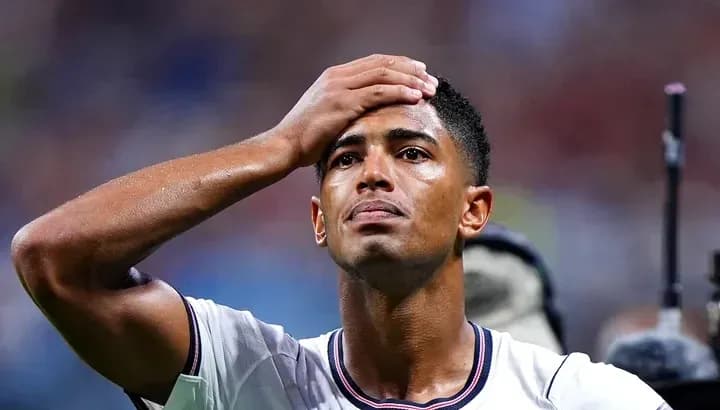
One shadow lingers: Jude Bellingham faces the possibility of disciplinary action after cameras caught him slapping the back of Valentin Barco’s head during Argentina’s celebrations. Any ban would be a significant twist to England’s plans, given how central Bellingham has been to Tuchel’s attacking structure.
Likely lineups and the edge France hold
France are expected to line up with Maignan behind a back four of Jules Koundé, Konaté, Lacroix and Theo Hernandez. In midfield, Youssouf Fofana or Manu Koné could sit alongside Warren Zaïre-Emery, with Rayan Cherki, Michael Olise and Désiré Doué supporting Mbappé in a fluid, dangerous front line.
England should respond with Jordan Pickford in goal, a defence of Spence, Ezri Konsa, Marc Guéhi and O’Reilly, Declan Rice and a partner – likely Elliott Anderson – screening in midfield. Cole Palmer or Alex Scott could feature, but the creative burden again falls on Bellingham, with Gordon and Marcus Rashford or another wide runner buzzing around Harry Kane.
Spain have shown the world how to suffocate this French attack. England, though, have not kept a single clean sheet in the knockout rounds at this World Cup. That defensive fragility, coupled with France’s extra day of rest and the emotional surge of playing for Deschamps’s farewell, tilts the balance.
France 2-1 England feels the likeliest script: a tight, occasionally ragged contest, decided by sharper finishing and slightly cooler heads.
For France, it would mean one last podium for a coach who has defined a generation. For England, another long summer of questions about how a golden pool of talent keeps leaving tournaments with nothing more than what-ifs.





