
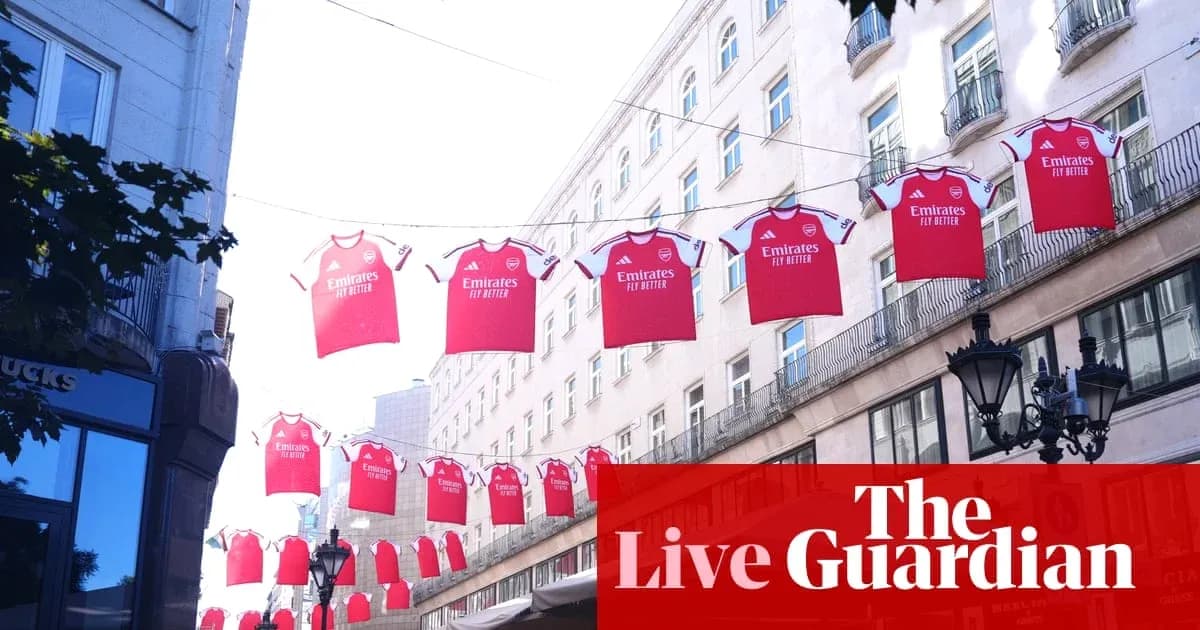
Football's Geopolitical Tensions: Protests, World Cup Gambles, and Arsenal's Challenge
Budapest on the horizon, protests in Dublin, doubt in Los Angeles, and a World Cup tug‑of‑war over a 22-year-old playmaker. Football rarely keeps its stories in neat, separate boxes. It lets them bleed into each other.
Protest, politics and a 1-0 in Dublin
Qatar’s 1-0 defeat to Ireland in Dublin might have been a routine friendly on paper. It wasn’t.
The match unfolded under a cloud of anger over Ireland’s upcoming Nations League fixtures against Israel, with the 4 October game in Dublin drawing particular fire. The Aviva pitch became a stage long before anyone thought about tactics. Protesters repeatedly hurled tennis balls onto the turf during the first half, each marked with the message: “stop the game”.
The interruptions broke the rhythm and underlined the tension. This wasn’t just dissent in the stands; it was a direct challenge to the staging of international football amid geopolitical fury.
Ireland captain Seamus Coleman had already voiced his unease, arguing that coach Heimir Hallgrimsson and the players had been left exposed by decisions taken far above them. After the game, the sense of discomfort lingered.
Hallgrimsson did not hide behind platitudes. “Seamus spoke really well about it the other day. We all don’t agree with what’s going on. Ideally it’s not in our hands. It’s not a nice situation to be put into. Like I said, personally, none of us agree with what’s going on.” The message was clear: the team is carrying the consequences of a call they did not make.
On the pitch, Qatar lost by a single goal. Off it, Ireland’s autumn fixture list suddenly feels like the real contest.
Volpato’s late switch and Australia’s World Cup gamble
While Dublin wrestled with politics, another story unfolded in the boardrooms and inboxes of Football Australia.
Cristian Volpato, the Sassuolo midfielder, is set to make a late and dramatic switch of allegiance from Italy to Australia. The 22-year-old, born in Sydney but long courted by Italy, previously turned down the chance to represent his country of birth at the World Cup in Qatar. Now, four years on, he is trying to reverse that decision at the last possible moment.
It is a race against the clock. Football Australia is still waiting on Fifa to confirm the paperwork in time for Socceroos coach Tony Popovic to name his 26-man World Cup squad by 1 June.
If the green light comes, Popovic gains a creative, Serie A‑hardened option who has already tasted life at the sharp end of Italian football. If it doesn’t, Volpato’s change of heart will stay just that – an intention, not a World Cup ticket.
Pulisic, Pochettino and a career still waiting to explode
Across the Atlantic, Christian Pulisic remains stuck in that awkward space between promise and fulfilment.
Mauricio Pochettino did not sugarcoat his feelings about the forward’s recent choices. “I was disappointed with him [for missing the Gold Cup],” he said in a briefing with the Guardian and other reporters. “I am transparent about that. He was disappointed with our decision not to include him in the two friendly games [against Switzerland and Turkey].”
It was a sharp little exchange, even at a distance. Pulisic is 27 now. For years he has been talked about as the coming man of American football, the standard-bearer for a new generation. At some point, that label expires. You either become the man, or the conversation moves on.
For Pochettino, the bar is simple: availability, commitment, impact. One goal, one tournament, one season – the numbers are no longer theoretical. They have to arrive on the pitch.
Havertz, underdogs and a familiar feeling for Arsenal
Kai Havertz knows what it means to walk into a Champions League final with most of the world expecting you to lose. He has done it before.
The German forward is now looking ahead to Arsenal’s showdown with Paris Saint-Germain in Budapest on Saturday, a game few are tipping in the London club’s favour. It brings back memories of Porto, 2021, when Chelsea – under Thomas Tuchel – faced a Manchester City side sculpted by Pep Guardiola that had just won the Premier League by 12 points. Chelsea had finished fourth, seven points further back, and still found a way.
“We were the underdogs on that day, for sure,” Havertz recalls. “We hadn’t had the best season. But now it is completely different.”
Different team, different role, different city. The echo remains: a side written off, a final against a superclub, and Havertz somewhere near the heart of the story.
Iran, the US and a World Cup fixture heavy with history
The World Cup looms, less than a fortnight away, but one fixture carries a weight that goes far beyond group permutations.
Ever since the US and Israel attacked Iran on 28 February, uncertainty has surrounded the scheduled World Cup meeting between the United States and the Islamic Republic of Iran in Los Angeles. Questions piled up: would Iran allow its national team to travel to the home of a military adversary? Would the US even welcome Team Melli?
With kick-off now only weeks away, the match looks set to go ahead. That does not mean calm. Los Angeles – or “Tehrangeles” to many – has a large Iranian diaspora, including many who fled the 1979 revolution. Protests are likely. So are gestures of defiance from players who understand that every step they take on American soil will be scrutinised far beyond the boundaries of the pitch.
This is not just another World Cup group game. It is football played on a diplomatic fault line.
How Arsenal can live with PSG’s firepower
Back in Budapest, the tactical microscope is already trained on Arsenal’s chances of surviving PSG’s attacking waves.
Jonathan Wilson has framed the contest in historical terms, but his conclusions are firmly rooted in the numbers. PSG have scored more goals from non-penalty set plays than Arsenal in this season’s Champions League – eight to five – yet dead balls may still offer Arsenal their clearest route to a goal.
The bigger danger lies elsewhere. Counterattacks. In Ligue 1, most opponents sink deep against PSG and try to limit damage. In Europe, the French champions have shredded bigger names in transition. The evidence of their wins over Chelsea, Liverpool and Bayern Munich is stark: give them space, and they race through it.
For Arsenal, that means one non-negotiable: Desiré Doué and Khvicha Kvaratskhelia cannot be allowed to run at full-backs in open field. Both are blisteringly quick, fearless on the dribble and relentlessly direct. And full-back is precisely where Arsenal are stretched. Ben White is out with a knee injury, while Jurriën Timber remains doubtful after a groin problem picked up against Everton in mid-March.
Those matchups on the flanks may decide whether Arsenal hang in the contest or get ripped apart.
PSG’s secret weapon: rest
The numbers behind PSG’s season tell a curious story. They have played a lot of football, but their stars have not.
Luis Enrique has repeatedly rotated his key players out of Ligue 1 duty, preserving legs for nights like Saturday in Budapest. Many of PSG’s biggest names have barely featured domestically. Ballon d’Or winner Ousmane Dembélé started only 11 of 34 league games. Neves, Mendes and Fabián Ruiz made 13 starts each. Kvaratskhelia started 18, Doué and Achraf Hakimi 16 apiece, and Marquinhos just 11.
These are not heavy-minute campaigns padded with late cameos either. Not one of those players has logged even half of PSG’s total league minutes.
They arrive in Hungary fresher than most Champions League finalists have any right to be, primed for one last surge.
All roads to Budapest
So it comes to this: the capitals of England and France, decamped to the capital of Hungary, with a Champions League trophy between them. Arsenal, patched up at full-back but defiant. PSG, rested and loaded, chasing another step towards the dominance they have long imagined for themselves.
Around that final swirl stories of protest in Dublin, diplomatic tension in Los Angeles, a late World Cup gamble from Australia, and a 27-year-old American forward still trying to turn potential into legacy.
Saturday in Budapest will not settle all of that. But it will tell us something about where this season, and this era, are really heading.





