
Fantasy Premier League 2026/27 Reclassifications: Key Players to Watch
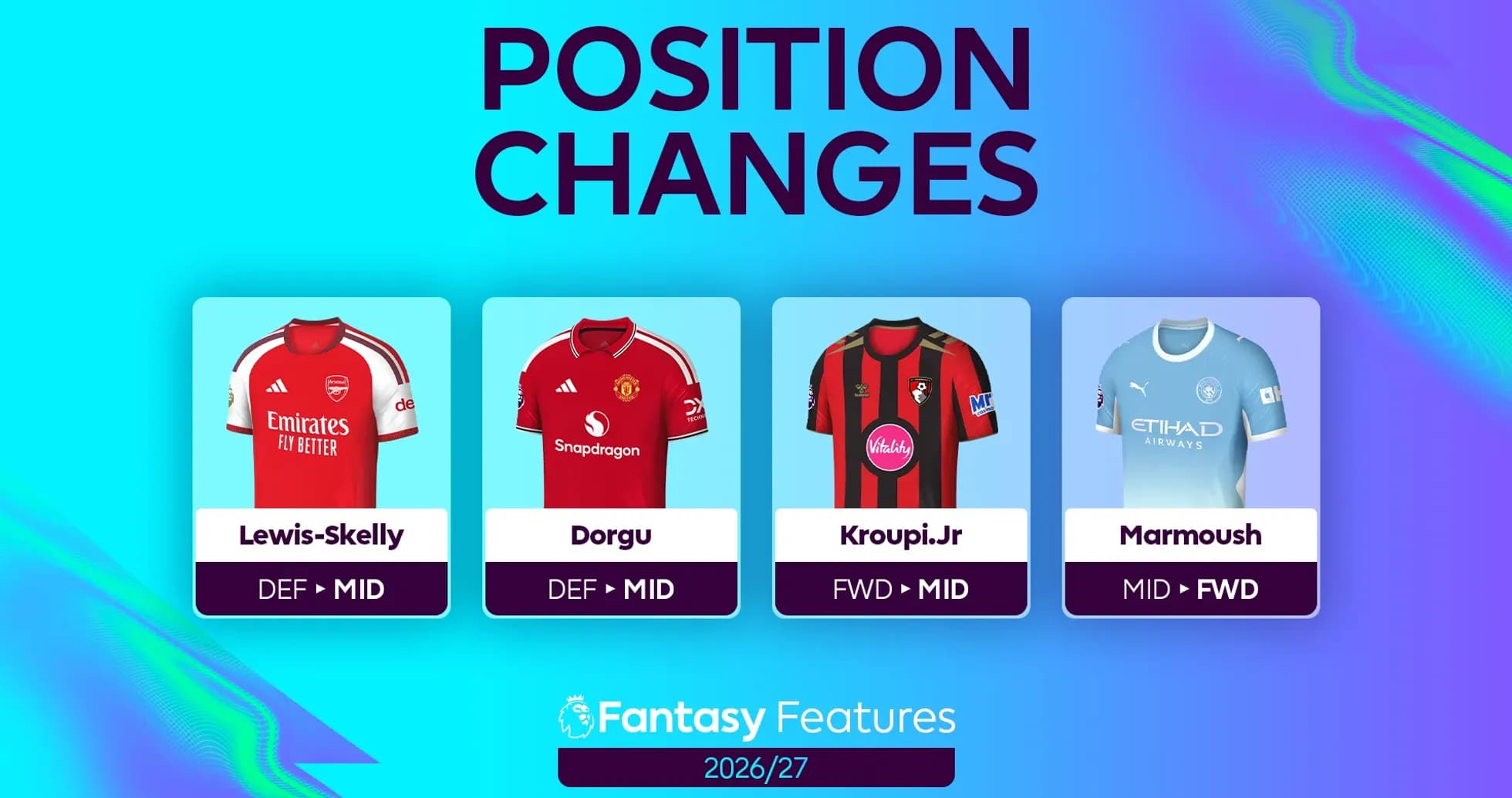
The Fantasy Premier League game board has been shuffled before a ball is even kicked. Eleven players have been reclassified for 2026/27, and among them are three names that could reshape how serious managers build their squads: Junior Kroupi, Patrick Dorgu and Omar Marmoush.
These aren’t cosmetic tweaks. These are role changes that cut straight to the heart of value.
Kroupi: From finisher to Fantasy goldmine
At Bournemouth, Junior Kroupi has gone from forward to midfielder, and that single switch could turn him into one of the most dangerous picks of the new season.
He spent most of last year operating as a No 10, floating behind Evanilson rather than leading the line himself. It suited him. He didn’t just adapt to the role, he exploded in it.
Thirteen goals in 33 appearances in 2025/26 tell one story. The underlying numbers sharpen it. Kroupi scored every 134.0 minutes, a rate that left even his more established peers trailing. Among regular midfield starters, only Antoine Semenyo came close, and even he lagged more than 50 minutes behind with 188.2 minutes per goal.
Now those same goals are worth more.
As a midfielder, Kroupi’s strikes will bring an extra point each, and any clean sheets Bournemouth manage will also drop into his tally. The reclassification doesn’t just reflect where he plays on the pitch; it amplifies his Fantasy output. For managers looking for a high-ceiling midfield option outside the traditional elite clubs, his name will be hard to ignore.
Dorgu: Carrick’s winger gets a new label
At Manchester United, Patrick Dorgu’s shift from defender to midfielder is a direct response to how Michael Carrick used him once he took over in Gameweek 22.
Carrick didn’t throw him straight in. Dorgu only started three matches under the new boss. But when he did, he played high on the left wing and made every minute count.
He scored in all three starts. Arsenal. Manchester City. Brighton & Hove Albion. Big fixtures, big contributions. Against Brighton, he went one better, adding an assist to his goal.
The volume of minutes was modest; the impact was not. When set against midfield colleagues Matheus Cunha and Bryan Mbeumo under Carrick, Dorgu’s attacking output stands up impressively. His 33.2 minutes per shot was the sharpest of the trio. He also matched Cunha’s total of three big chances, despite playing more than 800 minutes fewer than the Brazilian.
As a defender, those attacking numbers felt like a bonus. As a midfielder, the scoring system becomes less explosive for him — no more clean-sheet points, no extra premium on goals. Yet the reclassification underlines something important: Carrick clearly sees him as an attacking weapon, not a full-back.
For Fantasy managers, that means one question: if he keeps that advanced role and finally gets the minutes, can his volume catch up with his efficiency?
Marmoush: Pep’s final No 9 steps into the light
Omar Marmoush has moved in the opposite direction. At Manchester City, he switches from midfielder to forward after Pep Guardiola pushed him up front in his final season in charge.
Guardiola trusted him through the middle, and Marmoush responded with three goals and three assists. It wasn’t a season of headline-grabbing hauls, but it was a clear positional statement from a manager who rarely experiments without purpose.
In Fantasy terms, the change is a double-edged sword. As a forward, he loses the extra point for goals and the clean-sheet upside he enjoyed as a midfielder. But the reclassification clarifies his role: he is now judged in the same bracket as out-and-out strikers.
At City, that matters. Any player leading the line in that side, even for limited minutes, sits in a high-chance, high-quality environment. If Marmoush carves out a reliable place in the rotation, his new tag could quickly feel less like a downgrade and more like an invitation.
The wider reshuffle
Around them, the rest of the reclassified group tells its own tactical story. Arsenal’s Myles Lewis-Skelly and Aston Villa’s Lamare Bogarde both move from defence into midfield, reflecting their more advanced usage. Keane Lewis-Potter at Brentford and Ryan Sessegnon at Fulham also step up from defensive listings into midfield roles.
At Brighton & Hove Albion, Mats Wieffer drops back from midfield to defence, while Georginio Rutter goes the other way, from midfield into a forward berth. Crystal Palace’s Rio Cardines and Nottingham Forest’s Eric Moreira are similarly nudged into positions that better mirror where they actually operate on the pitch.
Each of these changes nudges the meta-game of FPL. Some players lose a little shine as they move away from those precious defender points. Others, like Kroupi, step into a scoring system that suddenly looks tailor-made for their skill set.
The names are fixed now. The prices will follow. And once they do, managers will have to decide: who’s been upgraded on paper, and who’s about to prove it on the pitch?





