Osasuna vs Espanyol: Tactical Breakdown of a 2-1 Defeat
Osasuna’s 2-1 defeat to Espanyol at Estadio El Sadar was a classic example of territorial dominance losing out to structural clarity and penalty-box efficiency. Alessio Lisci’s 4-2-3-1 produced sustained pressure, 68% possession and 24 shots, but Manolo Gonzalez’s compact 4-4-2, plus decisive moments from his wide defenders and forwards, controlled the scoreboard in a La Liga match where Espanyol were content to suffer without the ball and strike at precisely the right times.
Executive Summary
Espanyol executed an away game plan built on defensive density and direct transitions. Osasuna, with 515 passes and an 86% completion rate (515 passes, 442 accurate), tried to progress patiently through double pivots and a narrow three behind Ante Budimir, yet they repeatedly ran into Espanyol’s low-to-mid block. The visitors, with only 7 total shots and 0.79 xG, maximised the value of each attack, while Osasuna’s 1.61 xG translated into just a single goal, underlining issues in final-third decision-making and finishing rather than chance creation.
Scoring Sequence & Disciplinary Log
The game’s tactical tone was set early by Espanyol’s aggression in midfield. At 11', Pol Lozano (Espanyol) received a Yellow Card — Foul, a clear marker of the visitors’ willingness to disrupt Osasuna’s rhythm between the lines.
Espanyol’s first breakthrough came at 27'. From a rare extended spell in Osasuna’s half, left-back C. Romero advanced into an attacking lane and finished a “Normal Goal” (no assist). Tactically, this underlined Espanyol’s intent to use full-backs as surprise runners once the first line of pressure was broken, exploiting the advanced positioning of Osasuna’s wide players.
Osasuna responded after the interval, converting their structural pressure into a leveller at 49'. V. Munoz struck for the home side, assisted by centre-back F. Boyomo. The pattern reflected Osasuna’s emphasis on building with centre-backs stepping into midfield: Boyomo’s progression created an overload, and Munoz’s timing from the left half-space finally pierced Espanyol’s compact 4-4-2 shell.
The parity lasted just four minutes. At 53', K. Garcia restored Espanyol’s lead with a “Normal Goal”, assisted by T. Dolan. Here, Espanyol’s front two showed their value in transition: Dolan broke Osasuna’s counter-press and fed Garcia, whose movement between centre-back and full-back punished a disorganised rest-defence.
The card sequence closed late on. At 83', Iker Muñoz (Osasuna) was booked — Yellow Card — Foul, reflecting Osasuna’s increasing desperation to recover possession quickly after losing the ball. Then at 90', Antoniu Roca (Espanyol) received a Yellow Card with no additionalInfo given, a late incident consistent with Espanyol’s attempts to disrupt tempo and run down the clock.
Final card count: Osasuna 1, Espanyol 2, Total 3.
Tactical Breakdown & Personnel
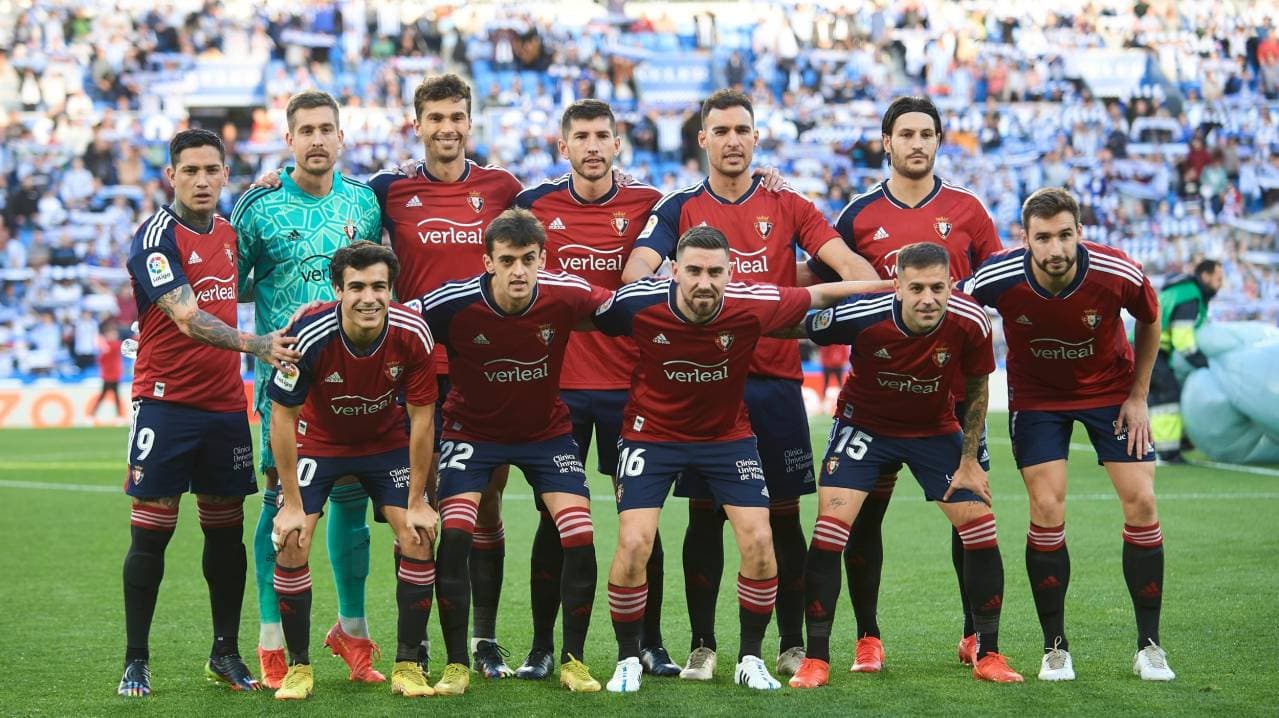
Osasuna’s 4-2-3-1 was built around positional occupation and sustained pressure. S. Herrera, with 1 recorded save, had little to do in terms of shot-stopping; his main role was as a distributor, initiating build-up into the double pivot of L. Torro and J. Moncayola (before changes) and later I. Munoz. The defensive line of V. Rosier, A. Catena, F. Boyomo and A. Bretones held a high average position, which compressed Espanyol but left significant space behind for transitions.
In possession, Osasuna’s structure was clear: Torro and Moncayola provided a two-man platform, allowing R. Garcia, A. Oroz and V. Munoz to occupy the half-spaces and pockets between Espanyol’s lines. Budimir acted as a reference point, pinning centre-backs and enabling lay-offs for late runners. The volume of 18 shots inside the box shows the positional play largely worked up to the finishing phase. However, with 9 shots on goal from 24 attempts and only 1.61 xG converted into a single goal, Osasuna’s attacking problem was execution rather than access.
Espanyol’s 4-4-2 prioritised vertical compactness. M. Dmitrovic, credited with 6 saves, was central to their defensive resilience, repeatedly dealing with crosses and close-range efforts generated from Osasuna’s left. The back four of O. El Hilali, C. Riedel, L. Cabrera and C. Romero stayed narrow, forcing Osasuna to circulate the ball around the block and attack from wide zones rather than straight through the middle.
In midfield, T. Dolan and P. Milla provided width, while U. Gonzalez and Pol Lozano (later replaced by C. Pickel) formed a screening pair in front of the defence. Their remit was to track Osasuna’s No.10 and half-space runners, and to foul when necessary — exemplified by Lozano’s early Yellow Card for Foul. The front pairing of Exposito and K. Garcia worked primarily as the first line of pressure and as transition outlets, with Garcia’s goal at 53' the perfect demonstration of Espanyol’s capacity to convert a small number of attacks into decisive moments.
The substitution wave between 55' and 78' reflected both coaches’ tactical adjustments. Gonzalez’s changes — C. Pickel (IN) came on for P. Lozano (OUT) at 55', F. Calero (IN) for Exposito (OUT) and R. Fernandez Jaen (IN) for K. Garcia (OUT) at 64', followed by A. Roca (IN) for T. Dolan (OUT) and R. Sanchez (IN) for P. Milla (OUT) at 76' — progressively shifted Espanyol from a 4-4-2 into a more conservative shape, with extra defensive legs and fresh forwards to chase clearances and relieve pressure.
Lisci’s triple change at 58' — R. Garcia (IN) for A. Oroz (OUT), I. Munoz (IN) for L. Torro (OUT), and M. Gomez (IN) for J. Moncayola (OUT) — was an attempt to inject dynamism and more vertical running from midfield and the forward line. Later, J. Galan (IN) for A. Bretones (OUT) at 67' and K. Barja (IN) for V. Rosier (OUT) at 78' further tilted Osasuna’s shape towards an attacking 3-2-5 in possession, with full-backs pushing higher and wingers driving the byline. Despite the structural siege, Espanyol’s block and Dmitrovic’s interventions held firm.
The Statistical Verdict
The numbers crystallise the tactical story. Osasuna’s 68% possession, 515 passes (442 accurate, 86%), 24 shots and 9 corners speak of territorial and positional control. Their 1.61 xG suggests they created enough to expect at least a draw. Yet Espanyol, with only 252 passes (174 accurate, 69%), 7 shots and 2 corners, outperformed their 0.79 xG in pure scoring efficiency, turning limited entries into high-impact moments.
Defensively, Osasuna’s goals_prevented figure of -0.23 indicates S. Herrera conceded slightly more than the modelled expectation, while Espanyol’s identical -0.23 for goals_prevented underscores that Dmitrovic’s performance, though numerically below expectation, was contextually decisive given the volume and timing of Osasuna’s chances. Fouls (Osasuna 10, Espanyol 13) and the 3 yellow cards underline Espanyol’s readiness to manage the game through interruptions.
In sum, Osasuna’s overall form in this match, measured by control and chance creation, was strong, but their defensive index — vulnerability in transition and inability to protect key zones after scoring — lagged behind. Espanyol’s compact 4-4-2, disciplined midfield screen and ruthless exploitation of Osasuna’s high line turned a low-possession, low-shot profile into a tactically coherent and clinically executed 2-1 away win.