Everton's Rollercoaster Season: From Hope to Disappointment
For much of last season, Everton were staring at the sky, not the trapdoor.
Jack Grealish’s loan felt like a cheat code. Kiernan Dewsbury-Hall kept deciding tight games almost by force of will. Up front, Thierno Barry and Beto, who had looked lost in the opening months, suddenly found their range.
On 21 March, Chelsea came to town and were brushed aside 3-0. Everton climbed to eighth, three points off the Champions League places with seven games to go. The new Hill Dickinson Stadium finally sounded like a home. Supporters dared to believe this was the start of something.
Then the season fell apart.
Everton did not win another league game. It was their longest winless run since David Moyes returned for his second spell in 2025, and it dragged them from European hopefuls to also-rans. A 2-2 draw at Brentford on 11 April, when they twice let a lead slip, became the hinge point. From that day to the end of the campaign, the form table had them in the bottom three.
Only Burnley and Wolves joined them in failing to win a single game over that stretch. Both of those sides went down. Everton merely felt like they had.
Same place, very different feeling
For all that, there was still a flicker of Europe when Sunderland arrived for the final home game of 2025-26. Angus Kinnear, the club’s chief executive, wrote in his programme notes that he was “happily dissatisfied” with the season. It sounded strange even before kick-off. It sounded worse after a 3-1 defeat.
Promoted Sunderland surged on to finish seventh and reach Europe for the first time in 53 years. Everton, who had once looked set to leave them behind, watched them disappear over the horizon.
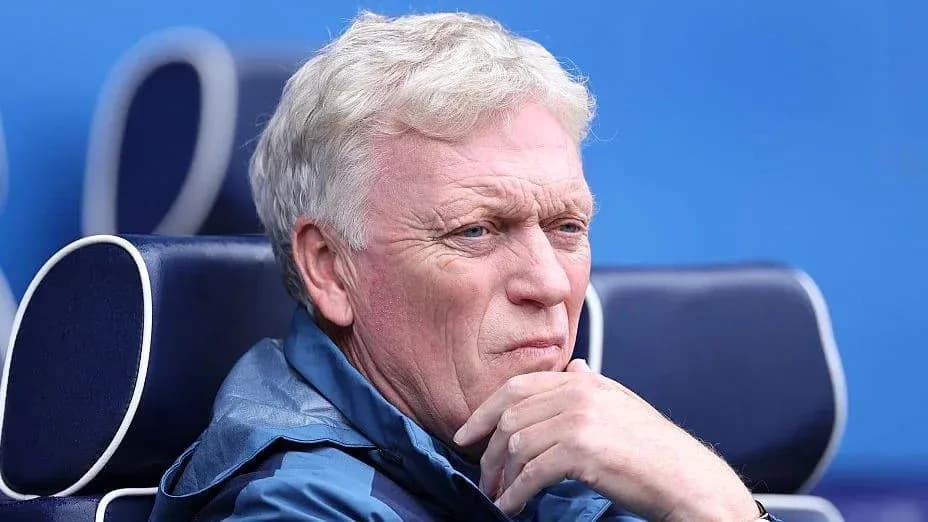
The irony for Moyes is cruel. Two full seasons into his return, Everton have finished 13th twice. Same position, completely different mood.
When he walked back into the club 18 months ago, Everton were one point above the relegation zone and fraying. He dragged them to safety and then some, ending that first campaign 23 points clear of the bottom three. Last summer, backed by a record £97m net spend under the Friedkin Group, he was asked to turn stability into something more ambitious.
He got one extra point. And the same finish.
Former midfielder Leon Osman, who knows both Moyes and the club’s scars, sees progress in the repetition. After years of financial breaches, points deductions and relegation battles, he argues that back-to-back mid-table finishes are a step up.
“When David Moyes first came in, we flew out the blocks and had a great start,” he said. “That continued for well over a year before the first sort of low period, which was the end of last season.
“I still feel that we made progress last season, which is what we wanted, along with stability.”
Moyes, the budget and a broken home
Moyes, now 63, has been blunt about the realities. Everton sit 15th among current Premier League clubs for net spend over the past five years. For a man who once built overachieving sides on thin margins, the gap to the division’s super-spenders is obvious.
But the table offers awkward counterpoints. Bournemouth spent less than anyone last summer, actually banking a profit of £81m, and finished sixth. Brighton made £41m in the market and still claimed eighth.
Everton, by contrast, moved into a gleaming new stadium and promptly turned it into a problem. Their return of 1.2 points per game at Hill Dickinson was the worst home record for any club starting life in a new Premier League ground. Away from home, they were top-seven material. At home, they were a soft touch.
Osman believes context matters. Bournemouth and Brighton, he says, are “further along in their development” than an Everton side still adjusting to a new environment and still recovering from years of turmoil. He also points straight at January, when Grealish broke down with a stress fracture.
The numbers back him up. With Grealish in the side, Everton won 45% of their league games and averaged 1.6 points per match. Without him, the win rate sank to 22% and the points return to one per game.
“David Moyes is an intense manager and by the end of the season, a small squad couldn’t quite last,” Osman said. “Changes take time. No one is thinking about relegation which shows you what Moyes has done. He’s got 12 months remaining and I’d expect him to see that out.”
Grealish on the horizon, Ndiaye in the spotlight
If Bournemouth and Brighton have become models of smart, joined-up recruitment, Everton are still trying to work out what they want to be.
Under Farhad Moshiri, eight players signed for £20m or more walked away for nothing. Years of scattergun spending were followed by a period of enforced restraint. The Friedkin Group then arrived and sanctioned nine signings last summer, with a clear tilt toward youth. The payoff has been mixed.
Grealish and Dewsbury-Hall have justified their fees and their billing. Others have not. Tyler Dibling, a £35m winger from Southampton, started only six league games. Adam Aznou, the young left-back from Bayern Munich, is still waiting for his Premier League debut.
Barry, at 23, won more aerial duels than any other player in his first top-flight season, an impressive feat that underlined his physical presence. But his finishing veered from ruthless to erratic. Merlin Rohl, 24, barely featured before May, then suddenly impressed across four late starts and left supporters wondering why they had not seen him sooner.
There is at least one familiar solution on the way. BBC Radio Merseyside reporter Giulia Bould says Grealish is expected to re-sign on loan towards the end of this window as he continues his rehabilitation. His wages, around £200,000 per week, will again test Everton’s budget.
At the same time, Iliman Ndiaye has been linked with a move to Saudi Arabia, the sort of deal that can transform a balance sheet and rip a hole in a squad.
“I’d welcome Grealish back but only at a price that suits Everton,” Osman said. “Ndiaye, I’d hate to lose him. There may come a point that the price is right and Everton can reinvest in two or three players but I think they should do everything they can to keep him.”
Thin squad, heavy load
That warning cuts to the heart of Everton’s problem. They cannot afford to lose elite quality without a clear plan to replace it.
Moyes used just 22 players in the league last season, fewer than any other manager. His 128 substitutions were at least six fewer than the rest. In an era of five changes and deep benches, Everton went into battle light on numbers and lighter on trust.
The recruitment department continues to lean into youth. Central midfielder Hayden Hackney, 24, has arrived from Middlesbrough for £16.5m. Tyrique George, a 20-year-old winger who spent the second half of last season on loan at the club, has joined permanently from Chelsea for £18m.
There is interest in Celtic’s Alistair Johnston to finally address the long-standing problem at right-back. Arsenal’s 32-year-old midfielder Christian Norgaard is reportedly close, a move that would inject experience into a dressing room that has just lost more than 600 Premier League appearances with the departures of Seamus Coleman and Idrissa Gueye.
The average age of signings in Moyes’ second spell is under 24, including three players aged 20 or younger. Yet those under 21 played only 1,088 minutes in the league last season. That ranked Everton 17th in the division for youth involvement, an awkward statistic for a club investing so heavily in potential.
To complicate matters further, James Garner, a key figure in midfield, is set to miss the start of the season after groin surgery. Moyes may have little choice but to lean on the youngsters he has so far been reluctant to expose.
“They need to show they’re capable and deserve to play,” Osman said. “I’m hoping that a year in, understanding the demands that are required, players like Dibling and George will make that progression and then suddenly our squad looks more trustworthy.”
Grealish’s return, Ndiaye’s future, a thin squad, a demanding manager, a fanbase tired of treading water. Everton stand at another crossroads. The question now is whether this season finally breaks the cycle of “happily dissatisfied” – or simply repeats it with a little less patience.