
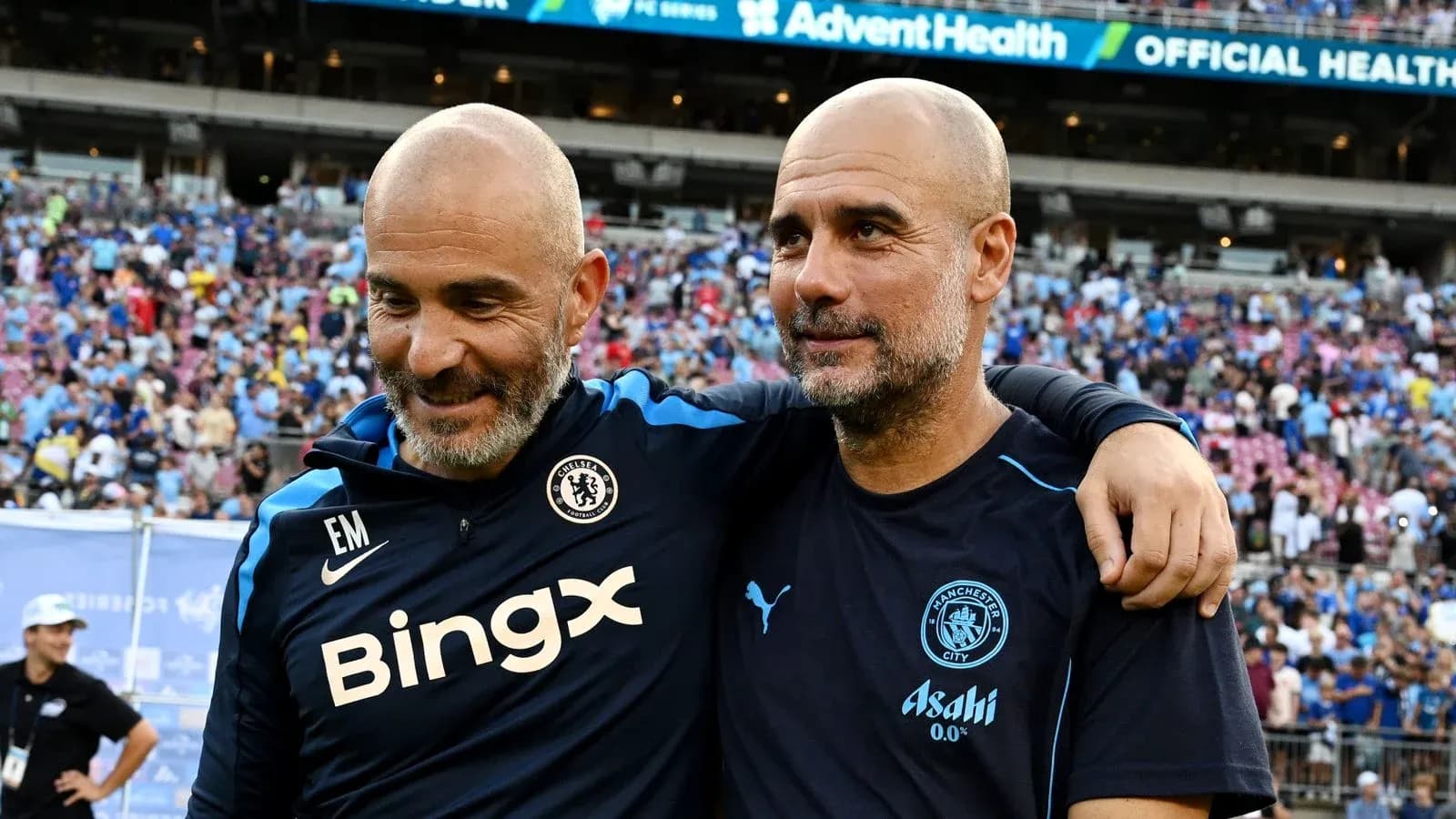
Enzo Maresca Takes Charge at Manchester City: A New Era Begins
Enzo Maresca steps into the light at Manchester City with the same backdrop Pep Guardiola once had: expectation, not hope. This is not a rebuild. This is an inheritance.
Guardiola has gone, the treble architect leaving behind a machine still purring, still terrifying. City’s response is not to rip it up, but to hand the keys to a man who knows the corridors, the training pitches, the rhythms of the place. Maresca is back for a third spell, but this time the safety net has gone. Now he is the one on the touchline when the trophies are handed out – or taken away.
A gentle opening, a ruthless demand
The fixture list has been kind to him. Bournemouth, Crystal Palace and Coventry City as the opening three games is as close as the Premier League gets to a soft landing. It gives Maresca a runway, a chance to imprint his ideas without immediately staring down a title rival.
It also gives his World Cup-scarred squad some oxygen. No one pushed their body closer to the edge this summer than Rodri, the metronome of Spain’s triumph and City’s recent dominance. He played almost everything. If anyone is at risk of breaking down through sheer overuse, it is him.
Those first three matches, though, are ones City should win with or without their midfield general. That allows Maresca to phase Rodri back, to resist the temptation to throw him straight into the fire. On paper, it’s perfect.
On paper, it’s also a trap.
Drop points in that run and the questions start immediately. The margin for error at City is microscopic, and September looms with a very different tone: Manchester United and Liverpool in two of the next three games. Those are not just fixtures, they are temperature checks on a new era. Lose ground early, and the narrative writes itself.
Maresca has already called this a “dream situation” – a ready-made, well-balanced squad, elite depth, a structure Guardiola spent a decade refining. He knows he is walking into privilege. He also knows the job description hasn’t changed: win, and win your way.
The difference? Guardiola always operated on his own terms. His legacy bought him a security Maresca cannot assume. A strong relationship with chairman Khaldoon Al Mubarak helps, but it does not rewrite the rules of a club conditioned to expect perfection.
Same school, different handwriting
Stylistically, Maresca is no stranger to the Guardiola playbook. He grew up in that environment at City, then worked under him during the treble season. Possession, control, aggressive pressing – the pillars remain.
The details, though, will shift.
Under Guardiola, City’s shape often felt liquid. Full-backs stepped into midfield, centre-backs wandered into the No 8 space, wingers drifted inside to overload the centre. Rodri sat at the heart of it all, the fixed point in a constantly rotating system.
Maresca leans towards something more defined. His football is built on a 4-2-3-1 with clearer lines and more traditional roles. Wingers stay high and wide to stretch the pitch, rather than routinely tucking in. The system demands a functioning No 10 who can link everything – the player who connects the midfield’s rhythm with the front line’s incision.
At Chelsea, that was Cole Palmer, the breakout star of Maresca’s brief spell there. At City, he has two natural candidates: Phil Foden, who has long threatened to own that central creative space, and Rayan Cherki, a different kind of technician but one capable of thriving between the lines. How Maresca uses them will be one of the defining tactical calls of his first season.
This is not a copy-and-paste of Guardiola’s masterpiece. It is a variation written by someone who understands the original score but wants to conduct it at a different tempo.
A younger core, a new voice
Behind the scenes, City have already been preparing for transition. Under sporting director Hugo Viana, the club have deliberately driven down the average age of the squad over the past two or three windows – from 29 to just over 25. The future has been brought forward.
The price of that shift is obvious. Leadership has walked out of the door. Bernardo Silva and John Stones followed Kevin De Bruyne in exiting, taking with them years of know-how in decisive moments. Those are not just names on a team sheet; they are dressing-room anchors.
The new hierarchy is forming. Rodri and Ruben Dias are now the natural standard-bearers. Erling Haaland, once just the unstoppable finisher, has been nudged further into a leadership role. Marc Guehi and Josko Gvardiol bring experience and stability at the back, while Mateo Kovacic adds maturity and nous in midfield. The spine remains formidable.
Recruitment has been expensive, but calculated. Elliot Anderson has arrived from Nottingham Forest for huge money, a move aimed at adding robustness and long-term security in midfield. Jeremy Monga has been taken from Leicester as another piece of the future puzzle.
City still want more. A right-back and a winger sit high on the list, while Lille’s teenage midfielder Ayyoub Bouaddi, outstanding for Morocco at the World Cup, is being monitored closely. Arsenal like him too, which tells its own story about his ceiling.
To balance the books and the squad, several players could be moved on if offers match City’s valuation: Savinho, Omar Marmoush, Nico Gonzalez, Jack Grealish, Tijjani Reijnders and Rico Lewis are all in the bracket of potential outgoings. With the World Cup now over, the market around City is expected to move quickly.
The first great unknown of the Abu Dhabi era
For all the planning, this is uncharted territory for City’s ownership. Since the Abu Dhabi takeover, the long-term vision has been almost singular: build a club attractive enough, powerful enough, and structured enough to lure Guardiola and dominate with him.
Mission accomplished. Now what?
The culture Guardiola helped entrench is ruthless. City do not simply chase trophies; they treat them as a minimum requirement. The Etihad crowd arrives expecting to be entertained, but above all, they expect to win. Sustained failure – by their standards – is not part of the brief.
That tension between style and substance is where Maresca’s Chelsea tenure frayed. His ideas were clear, but the balance between control, risk, and results never fully settled. At City, the room for that kind of learning curve is far smaller.
He does, at least, enter a league in flux. He is not the only new face at a superclub. Andoni Iraola has walked into Liverpool, Xabi Alonso has taken charge at Chelsea, and Michael Carrick is trying to impose his ideas at Manchester United. All of them carry question marks. All of them are trying to reshape giants in their own image.
This is an era without a fixed hierarchy. That volatility is dangerous, but it is also an opening. Whoever adapts fastest, whoever imposes their identity with the least turbulence, can seize control of a changing Premier League.
Sink or swim is not a cliché here; it is the landscape.
The shadow of 115 charges
Hovering over all of this, unavoidably, are the 115 Premier League charges that still hang above the club. They are not Maresca’s doing, but they will be his problem.
Guardiola handled that scrutiny with a mix of defiance, experience and sheer force of personality. Years in charge of Barcelona, Bayern Munich and City had taught him how to manage a press room, how to confront, deflect or shut down lines of questioning he did not want to indulge.
Maresca has faced criticism before, particularly at Chelsea, but largely on footballing grounds – tactics, selections, results. This is different. This is legal, political, reputational. How he navigates those press conferences, how he carries himself when the questions turn away from the pitch, will shape perceptions of his authority in his first year.
If a verdict lands within the next 12 months, the impact on his debut season could be seismic. If it does not, the constant drip of speculation will remain a backdrop he cannot control but must live with.
Maresca walks into a club that still expects to win everything, still believes it has the best squad in the country, and still operates under a cloud no one inside the dressing room can clear. He has the talent, the structure and the platform to succeed.
Now comes the only test that matters at Manchester City: can he turn all of that into a new era of trophies, without ever being allowed to feel like a mere successor to Guardiola?





