
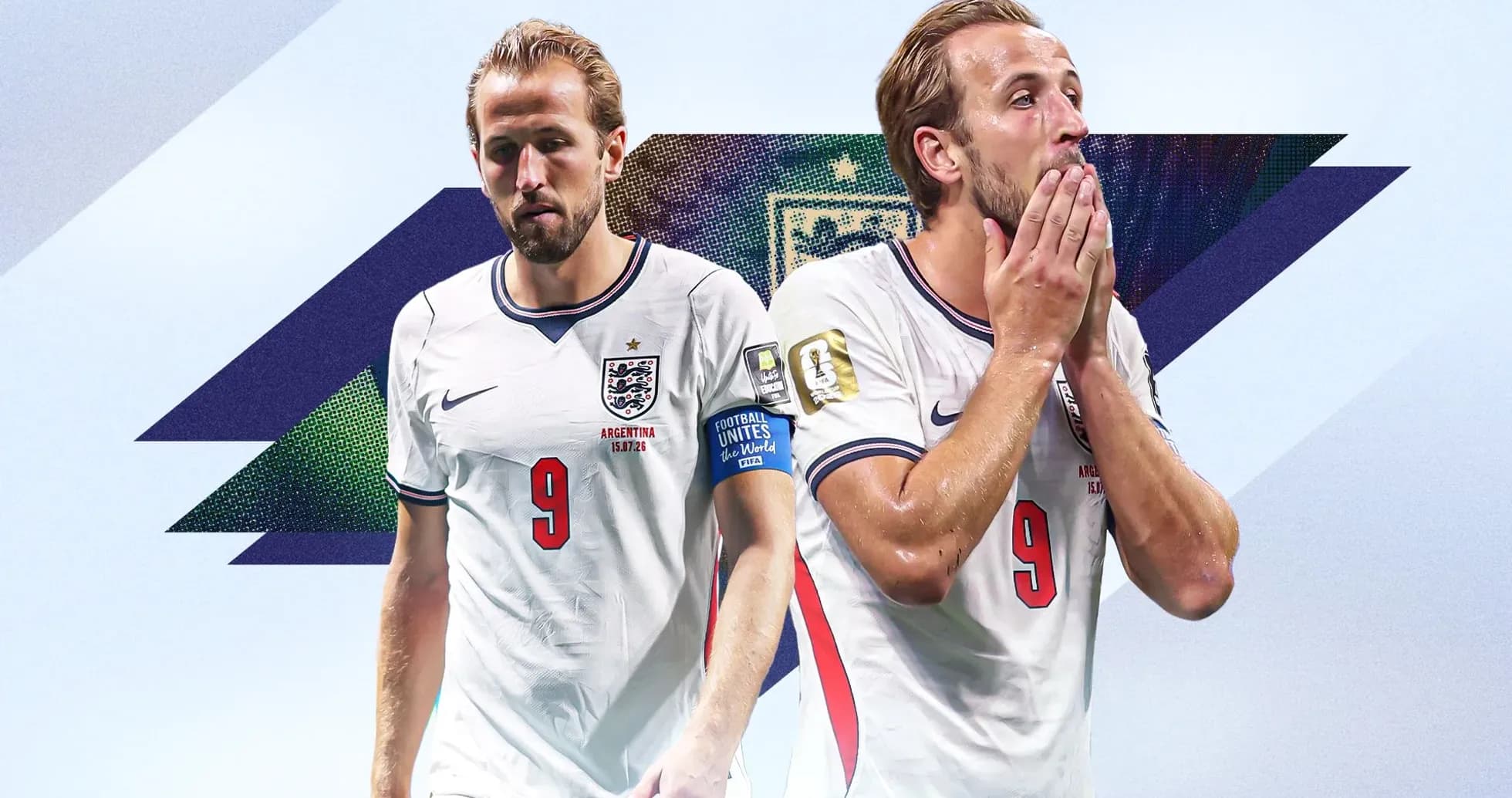
England's World Cup Semi-Final Struggles Against Argentina
For an hour in New Jersey, England went toe-to-toe with the world champions and looked like they belonged. Thomas Tuchel’s team did not dominate Argentina, but they matched them stride for stride, tackle for tackle, nerve for nerve. When Anthony Gordon swept home in the 55th minute, it didn’t feel like a smash-and-grab. It felt like the first clean punch in a proper fight.
Everyone inside the stadium assumed another was coming. From Argentina. From England. From somewhere.
It never came from Kane.
England retreat, Argentina smell blood
The game flipped the moment England scored. Instead of stepping up, they sank back. White shirts retreated towards their own box, as if dragged by a magnet. Argentina, liberated from any lingering caution, poured forward.
Lionel Scaloni later said his side “smelled blood in the water”. Tuchel might as well have been tipping buckets of chum off the side.
In that chaos, Harry Kane became a strange, almost ghostly presence. The numbers are brutal: 26 touches, nine completed passes, one blocked shot, no touches in Argentina’s penalty area. On paper, it reads like a disappearing act.
The truth was more complicated. This was a scrappy, bitty semi-final, and Kane embraced the ugliness early on. In the first half he was in the thick of it, clattering into duels, contesting more challenges than Lisandro Martínez and Alexis Mac Allister. He threw himself into tackles that bordered on reckless, putting his body in places it had no right to be.
When the match was a fight, that edge had value. When it needed to become a football match again, it didn’t.
The conundrum Tuchel never solved
Gordon’s goal presented Tuchel with a tactical fork in the road. Sit in, as England had so heroically done at the Azteca in the quarter-final against Mexico, or push up and try to turn Argentina?
Context mattered. England had just come off that monumental rear-guard in Mexico City, a defensive stand that will live long in folklore. Kane had lasted 89 minutes that night, scrapping, kicking, fighting, dragging his legs through thin air and thick tension.
Four days later, he was asked to do it all again.
On Wednesday, he still wanted England to push higher.
“For one reason or another, we struggled to be on the ball, we struggle to put pressure on the ball and it allowed them to create more momentum and created more attacks for them in our final third,” Kane said afterwards.
The irony is obvious. Kane was part of the solution England needed, but also part of the problem they couldn’t fix.
What Tuchel’s team cried out for was an outlet, a striker who would pin one of Argentina’s centre-backs, give them something to worry about, hold the ball and draw fouls. Kane can do almost everything as a No 9. The one thing he does not have is pace. So he did what he has done for years: he dropped deep, trying to stem the tide, trying to help.
It was a firefighter with a watering can facing a forest blaze.
Wave after wave of sky-blue pressure broke on the edge of England’s box. Kane was no longer a threat in behind, no longer a presence in the area. This was not his game anymore. Tuchel should have taken him off.
Instead, he stayed on and watched the collapse unfold in front of him.
A season of superhuman numbers, and one brutal night
In isolation, this semi-final might feel like a harsh way to judge Kane. In context, it’s a crushing full stop on a season that had threatened to redefine his career.
For Bayern Munich, he was extraordinary. He scored 58 goals in all competitions, the most ever by a Bundesliga player in a single season. His 36 league goals topped every striker in Europe’s top five leagues. He became the fastest Bayern player to reach 100 goal contributions. Bayern won the title by 16 points, easing off before the finish line.
These were numbers that Robert Lewandowski never hit in Bavaria. They nudged into Messi-Ronaldo territory. On statistics alone, the Ballon d’Or argument for Kane was strong. Very strong. The first English winner since Michael Owen no longer felt fanciful.
But Bayern’s season in the biggest competitions clipped his wings. They traded blows with eventual Champions League winners PSG yet failed to overturn a first-leg deficit, losing 6-5 on aggregate in the semi-finals. The World Cup, then, became a reset button.
Kane knew it. He admitted as much before the tournament.
“I’d be one of the favorites, definitely,” he said. “Given the trophies I’ve won this season and the number of goals I’ve scored, I’d be in the running. Especially as, should England win the World Cup, one could imagine the trophy going to an English player.”
For five games, he played like a man chasing history. Two goals against Croatia. One against Panama. Two more against Congo. An assist at the Azteca. He and Jude Bellingham set the tempo; everyone else filled in around them.
The Golden Boot loomed into view. Heading into the semi-final, he trailed Lionel Messi and Kylian Mbappé by two. Logic said England would need him to close that gap to reach the final.
He never got close.
Failing to score against Argentina has almost certainly ended his Golden Boot hopes. Even if he were to hit a hat-trick against France in a third-place game he should probably sit out, nobody seriously expects Messi to draw a blank against Spain in the final.
Kane will fly back to Germany without the Golden Boot and without a World Cup final to prepare for. His Ballon d’Or case has slipped through his fingers.
The rebirth, and the reality of international football
The sadness cuts deeper because this World Cup felt like the culmination of Kane’s second act. His move to Bayern was a rebirth, a chance to prove that the years at Tottenham – brilliant as they were – had not dulled his edge.
In hindsight, he stayed at Spurs too long. He was magnificent there, year after year one of the Premier League’s finest. But the supporting cast was rarely good enough, the investment rarely sufficient. The irony that Tottenham have finally opened the chequebook now will not be lost on him.
Munich changed the narrative. Two seasons in, his output has been a statement of legitimacy. Kane can still dominate at the very top. He may even be better than ever. He has talked about studying other sports, other athletes, how they stretch careers and defy age. He wants to fight off Father Time. At club level, he looks capable of doing exactly that.
International football is a different beast. There is no long arc, no time to tweak, no run of games to play yourself into rhythm. There are no quiet weeks to manage minutes or rotate aching legs. England’s World Cup camp was stretched as far as possible, but it still barely brushed two months. After a long, punishing club season, this was a sprint.
When the gun went off, Kane ran hard. When the finish line appeared, he stumbled.
A legacy that refuses to settle
If this proves to be the last great shot at a World Cup for Kane, his England legacy will be one of the strangest in the nation’s history.
On the numbers, he is unmatched. He is surely England’s greatest pure striker. If he stays fit, he will breeze past 100 international goals. Peter Shilton’s record of 125 caps is within reach; Kane is already on 121. No player has scored more penalties at World Cups. He won the Golden Boot in 2018.
Yet the major tournaments keep leaving scars. He was ineffective at Euro 2024. He missed a pivotal penalty in Qatar in 2022. At the 2018 World Cup and Euro 2021 he played in weaker England sides, but even then he never quite seized a tournament by the throat in the way his talent suggests he could.
The roll call of record-breaking scorers at international level – Messi, Ronaldo, Pelé, Maradona, Henry – all have a major trophy to hold up. Kane does not.
That absence will hang over everything.
England’s own problem
And still, England cannot easily move on.
Look at the depth chart at centre-forward and the picture is stark. Tuchel took a 30-year-old Ollie Watkins and a 30-year-old Ivan Toney to this World Cup. There is no obvious young heir, no prodigy banging down the door. Kane, even at 33, remains the reference point.
Forcing him out will be almost impossible. So England will likely roll on with him leading the line at Euro 2028. They will probably be competitive again. But by then, Kane will be edging down the far side of the hill, and the alternatives may still not be ready.
Kane, for his part, has no intention of stepping away.
“The national team is my pride and joy,” he said. “It’s what I love to do most more than anything. Obviously four years is a long way away, I’m 33 this summer but it never ended with Leo [Messi] there, he’s still performing at the highest level. I never want to put a limit on these things.”
He will fight on. He always has.
But tournaments like this do not come around often, and England have already watched a few slip past with him at the helm. This one, with the season he had behind him and the stage set in front of him, feels like the biggest miss of all – and the question now is whether he, or his country, will ever get a better chance to answer it.





