
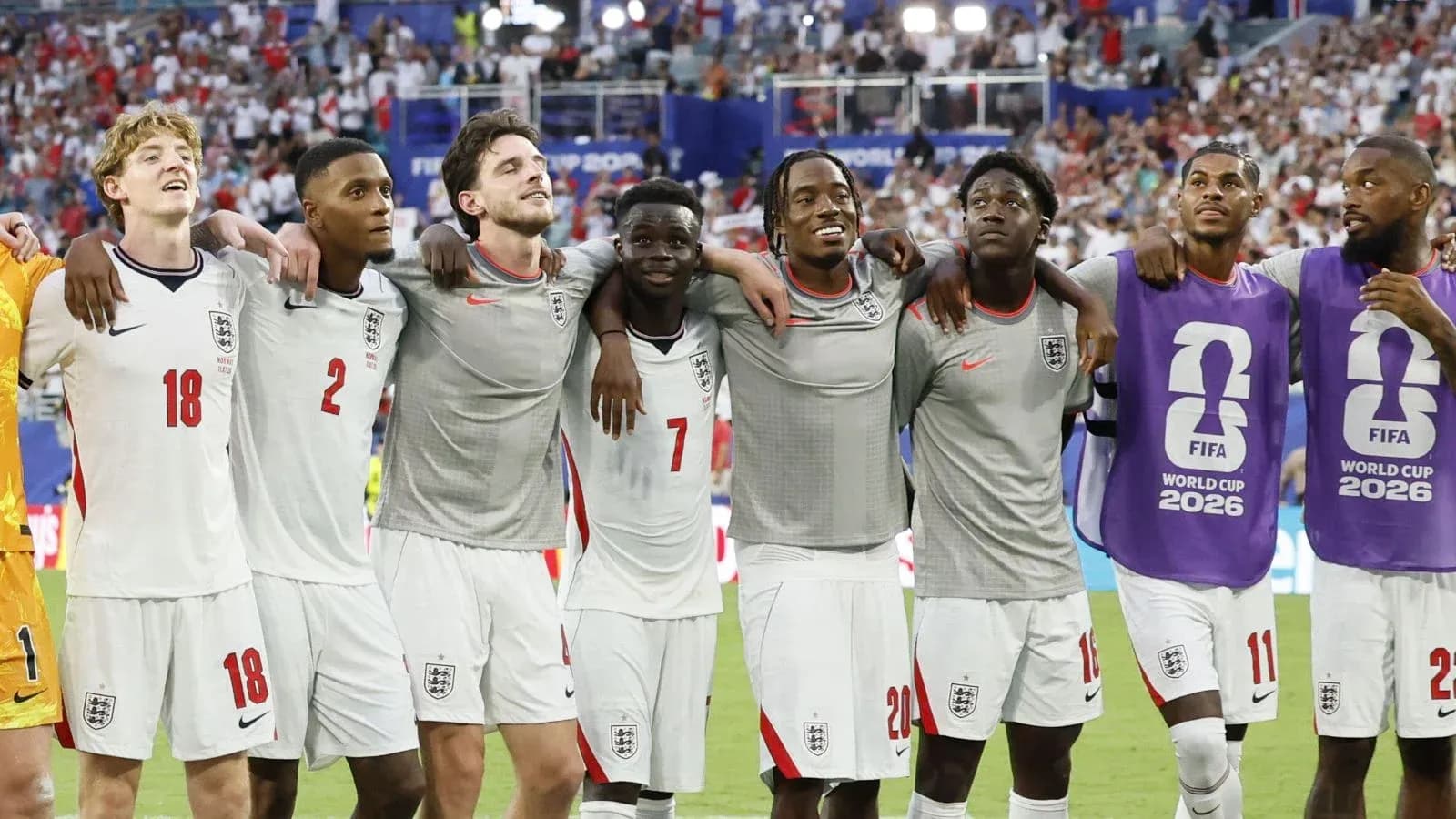
England's World Cup Journey: Second-Best Performance Yet
Here’s the awkward truth for England: it still probably isn’t coming home.
That’s not fatalism, just cold maths. The odds say it’s more likely England finish fourth after losing to Argentina and France than that they run the gauntlet and beat Argentina and Spain to lift the World Cup.
And yet, whatever happens in Atlanta against Lionel Messi and company, this is already England’s second-best men’s World Cup of all time. That feels like it’s slipping under the radar.
For a squad that carried the familiar scent of a classic England campaign – a laboured quarter-final, a national scapegoat, a summer of what-ifs – they’ve already kicked through the ceiling of expectation. This was meant to be the usual story. It isn’t.
It hasn’t been flawless. Far from it. The football has veered from controlled to scruffy to downright stodgy at times. But that’s true of everyone at this tournament. You just see every misplaced pass and every laboured build-up more clearly when it’s England, when it’s your nerves, your history, your noise.
Spain were worse against Cape Verde than England have been at any point. France served up an hour of pure misery against Senegal and dragged that same lethargy into an entire semi-final. England have flirted with that level only in flashes, never for a full game.
And look at Argentina. They have walked a smoother knockout path than England. They have needed fewer questions answered, fewer storms ridden out, to get to the same stage.
For this campaign to be recast as a failure of the old, familiar kind, England would need to be dismantled by Messi and his supporting cast. Properly taken apart. There is little in the last three decades to suggest that’s on the cards.
England do embarrassing defeats. They do maddening defeats. They do penalty defeats, referee defeats, woodwork defeats. What they almost never do is the sort of full-scale humiliation that has you checking the clock after half an hour and wishing for the final whistle.
Strip out the third-place play-off – that strange, ghostly fixture that exists only for television schedules and FIFA’s medal table – and the record is startling. Since 1988, England have lost one major tournament match by more than a single goal.
One.
And even that – the 4-1 defeat to Germany in Bloemfontein at the 2010 World Cup – comes with an asterisk the size of Frank Lampard’s disallowed shot. At 2-1 down, the ball crashed off the bar and clearly over the line. It should have been 2-2 at half-time. Instead, the goal that never was became the spark for a technological revolution that football is still wrestling with.
Across 17 major tournaments since 1990, England have not missed many. They’ve failed to qualify for just two. They have not won any of them. But only once have they been genuinely dumped out, the result obvious long before the end.
That resilience sits awkwardly with the current mood. This does not feel, instinctively, like England’s second-best World Cup. There’s been too much angst, too much tactical debate, too many nervy finishes for that kind of easy nostalgia.
Yet by any reasonable measure, that’s exactly what it is.
Reaching a semi-final outside your own confederation is harder than doing it at home or in familiar surroundings. This is the furthest England have ever travelled in a World Cup held beyond Europe’s borders. On conditions alone, this trumps 1990 and 2018.
Perhaps the perception has been warped by the noise from north of the border. Four tournaments in a row, Scotland have watched their own journey end early while England keep walking. The frustration is understandable.
But the narrative that England have somehow been handed a soft run while Scotland drew the short straw is a distortion of how seeding actually works.
Scotland did get a brutal group. Brazil and Morocco is a brutal group for anyone. That’s what happens when you start in the lower pots: you’re more likely to be thrown in with the sharks.
The real misfortune lies with the seeded side that pulls another top-10 nation. Brazil had that problem. England did not. That isn’t conspiracy; it’s probability.
Look at the draw with a clear head. At the time of the draw, Croatia sat 10th in the FIFA rankings. Panama were the highest-ranked team England could have faced from pot three. Only Norway were higher, and the rules meant Norway couldn’t be in the same group as both England and Croatia.
So yes, England have not yet faced a team officially ranked in FIFA’s top 10. But the way people weaponise those rankings is revealing. When they make England look fortunate, they’re gospel. When they don’t, they’re dismissed as nonsense.
Croatia are a top-tier opponent in everything but name. Mexico at the Azteca is a test as fierce as anything the rankings can capture. Norway, right now, are playing at a level that would not look out of place in any top-10 list.
There is no honest way to paint England’s path as unusually soft. They have taken the route expected of a seeded nation that tops its group. Group winners face a third-placed side in the last 32. The last 16 brought Mexico, exactly as the bracket suggested it might.
The bracket itself has behaved almost too neatly. The top four seeds have reached the semi-finals. In that context, Norway’s win over Brazil – achieved not with chaos or fluke, but with structure and clarity – stands as one of the few genuine jolts of the knockout rounds, alongside Paraguay’s ambush of Germany.
So here England are. On the brink of something enormous, yet with the odds stacked against them. To win this World Cup, they must first outlast Argentina’s tournament-hardened stubbornness, then break down Spain’s club-level cohesion and control. Back-to-back. Under the brightest lights.
It is unlikely. It may well end, again, in a kind of glorious failure.
But this time the glory would be real, not manufactured in hindsight. This would be the most impressive failure of the lot, the highest point in six decades of hurt that have rarely looked so close to turning.
If it doesn’t come home from here, it won’t be because England shrank. It will be because they fell, finally, at the very top of the mountain.





