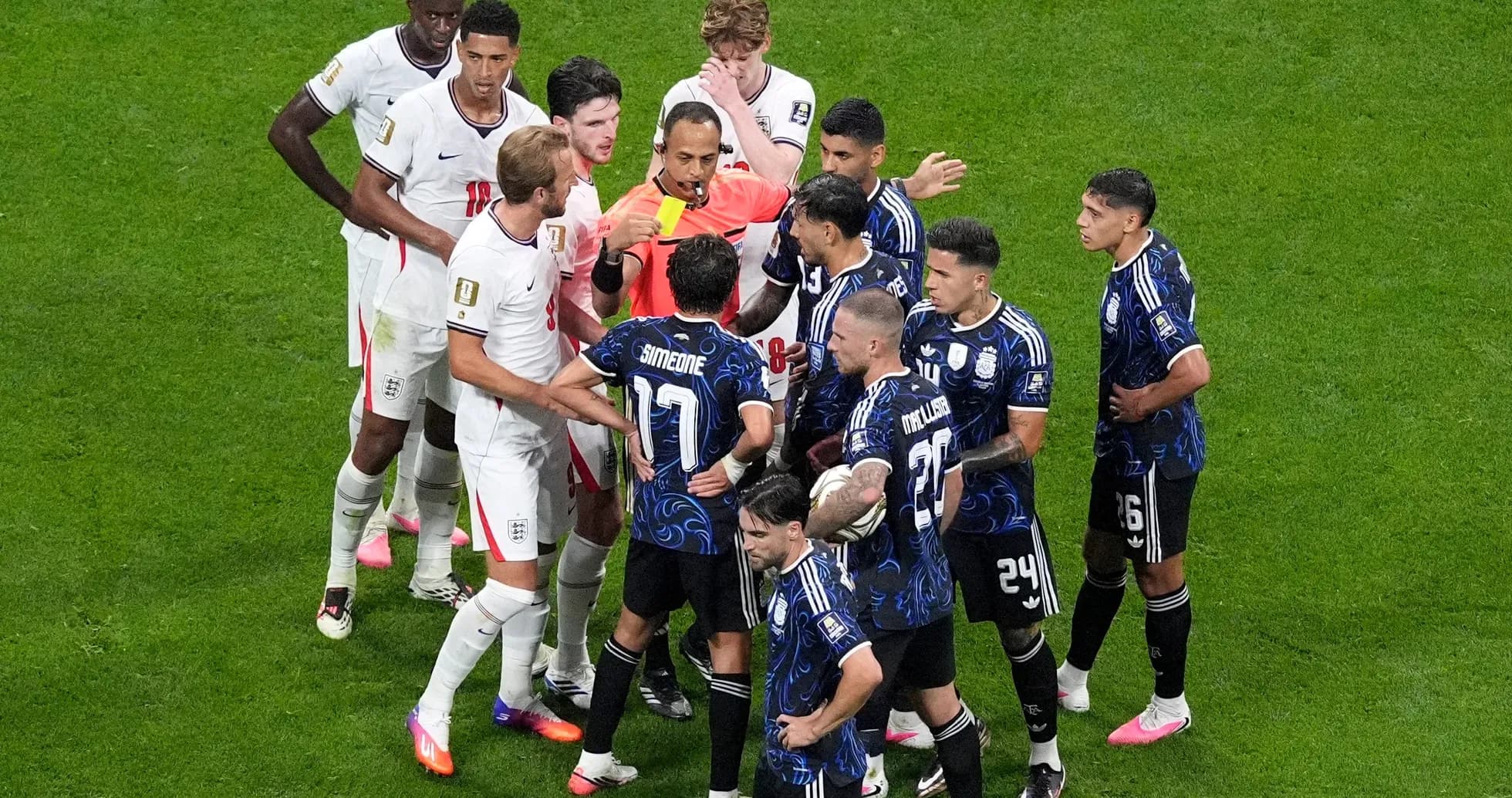
England vs Argentina: World Cup Semi-finals Clash
Under the closed roof of Mercedes-Benz Stadium, this World Cup Semi-finals clash between England and Argentina carried the feel of a final in everything but name. By the end of 90 breathless minutes, the scoreboard read England 1–2 Argentina, and a tournament that had seen both sides march through their groups as leaders now split into triumph and heartbreak.
I. The Big Picture – Two Perfect Arcs Collide
Heading into this game, both nations had carved out distinct tournament identities.
England arrived as group winners from Group L, top of their section with 7 points and a goal difference of 4 (6 scored, 2 conceded). Across the whole campaign, they had played 7 matches, winning 5, drawing 1 and losing just 1. Their attacking profile was steady rather than explosive: overall they averaged 2.0 goals per game, built on 1.8 at home and 2.3 on their travels. Defensively, they conceded 1.1 goals per match overall, with 1.3 at home and 1.0 away. It was the record of a side that could control games and win them without chaos.
Argentina, though, arrived as the tournament’s juggernaut. They topped Group J with a perfect 9 points and a goal difference of 7 (8 scored, 1 conceded), then kept winning. Across 7 matches in total, they had 7 wins from 7, no draws, no defeats. They scored 19 goals overall – 2.7 per match – with 2.8 at home and 2.5 away, while conceding just 7 (1.0 per game both home and away). Where England’s form line read WDWWWWL, Argentina’s was a relentless WWWWWWW.
The tactical tension was obvious: England’s controlled 4-2-3-1 under Thomas Tuchel against an Argentina side that had mostly alternated between double-striker systems but chose a 4-1-4-1 here, Lionel Scaloni pushing his team into a more flexible, Messi-centric structure for the biggest night.
II. Tactical Voids and Discipline – England’s Missing Edge
Even before kick-off, England carried a quiet handicap. J. Quansah was suspended through a sports court decision, a defender with both height and aggression removed from Tuchel’s options on a night when aerial duels and last-ditch defending were always going to matter. His absence forced clarity in the back line: J. Stones and M. Guehi as the central pairing, flanked by R. James and D. Spence.
Discipline had been a subplot of England’s tournament. Their season card profile showed yellow cards spread fairly evenly but with two pronounced spikes: 25.00% of their yellows arriving between 31–45 minutes and another 25.00% between 61–75. The red-card story was sharper: a single red, and it had come between 46–60 minutes. That pattern hinted at a side that sometimes lost emotional control in transition phases either side of half-time.
Argentina’s disciplinary map was stranger and more ominous in its own way. They were relatively calm in normal time, with only 11.11% of their yellows in each of the 31–45, 46–60 and 76–90 ranges. But once games slipped into added periods, their aggression spiked: 44.44% of their yellows between 91–105 and another 22.22% between 106–120. In other words, they were comfortable walking the line in extended, high-stress situations – a trait that often bends knockout football their way.
III. Key Matchups – Hunter vs Shield, Engine vs Engine
The marquee duel was never in doubt: L. Messi against England’s defensive structure and the shield of D. Rice.
Messi entered this Semi-finals as the tournament’s most devastating individual. Across 7 appearances (6 starts), he had scored 8 goals and provided 4 assists, with a rating of 9.07. He had taken 28 shots, 18 on target, and completed 24 of 35 dribbles. With 314 passes and 26 key passes at 81% accuracy, he was not just a finisher but the architect. Yet beneath the brilliance lay a crack: from the penalty spot this campaign, he had missed 2 penalties and scored none. For all Argentina’s dominance, their overall penalty record was fragile – 3 awarded, only 1 scored, 2 missed, a 33.33% conversion rate. In a Semi-finals, that matters.
England’s answer was collective, anchored by Rice. Across 6 appearances and 481 minutes, he had not scored but had provided 1 assist and served as the passing metronome: 240 passes at 91% accuracy, with 15 key passes from deep. Defensively, he had 4 tackles, 2 blocks and 2 interceptions, and he carried a disciplinary edge with 2 yellow cards and a place among the tournament’s top carded players. Rice’s job was to narrow the space Messi loves between the lines, while also protecting Stones and Guehi from Messi’s combinations with J. Alvarez and A. Mac Allister.
Higher up, England’s attacking axis was built around J. Bellingham and H. Kane, supported by A. Gordon.
Bellingham, starting again as the central figure in the line of three, had 6 goals and 1 assist from midfield, with 15 shots (11 on target) and 21 attempted dribbles, 13 successful. He had also drawn 16 fouls and committed 9, operating on the emotional edge that often tilts big games. His duels – 84 contested, 44 won – underlined how much of England’s territorial gains flowed through his ability to win contact.
Kane mirrored Bellingham’s scoring output with 6 goals and 1 assist, but in a different way. He had 18 shots, 12 on target, and had scored 2 penalties from 2 taken, a perfect personal record that contrasted sharply with Messi’s misses. Kane’s 3 blocked shots highlighted his defensive contribution from the front, and his 5 key passes from 106 total passes spoke to the dual role he played: finisher and facilitator. In a match where margins would be thin, his calm from the spot and his ability to drop off the line to link with Bellingham and Gordon were England’s clearest route to goal.
Gordon, with 1 goal and 3 assists in 412 minutes, gave England verticality. He had 25 dribble attempts (8 successful) and 63 duels contested, winning 24. His capacity to run at N. Molina and stretch Argentina’s right flank was designed to create the isolations Kane and Bellingham thrive on, while his 6 key passes showed he could be the final ball as well as the runner.
On Argentina’s side, the support cast around Messi was deep. E. Fernandez and A. Mac Allister offered the energy and passing to break England’s double pivot, while J. Alvarez, nominally listed as a midfielder here, threatened to become a second striker whenever Argentina tilted into a 4-1-3-2 shape in possession. Behind them, C. Romero and L. Martinez formed a centre-back pairing tasked with containing Kane’s movement and Bellingham’s late surges.
IV. Statistical Prognosis and Tactical Verdict
From a pure numbers lens, Argentina carried the sharper attacking edge. Their 2.7 goals per game overall, with 19 scored and 7 conceded, painted a picture of a side happy to trade chances because they backed their firepower. England’s more conservative 14 scored and 8 conceded overall suggested a team that preferred control and structure.
Defensively, both conceded around 1 goal per match, but the context differed. Argentina had never failed to score in any of their 7 games; England had failed to score once. Clean sheets were balanced – 2 each overall – but Argentina’s came largely from suffocating opponents while still attacking, whereas England’s were built on compactness and game management.
The card distributions hinted at a game script: England needing to survive their vulnerable windows around half-time without disciplinary damage, Argentina likely to push the tempo later and trust their resilience in extended minutes. The penalty data set a subtle trap: if the Semi-finals turned into a spot-kick narrative, Kane’s 2 from 2 and England’s 100.00% team record (2 scored from 2, none missed) stood in stark contrast to Argentina’s 66.67% miss rate from the spot.
On the night, though, Argentina’s attacking depth and Messi’s enduring influence bent the contest their way inside regulation time. England’s structure, their double pivot of Rice and E. Anderson, the creative weight on Bellingham and the finishing burden on Kane – all were finely calibrated for a long, controlled Semi-finals. But against a side riding a 7-match winning streak and scoring 2.7 goals per game overall, control alone was never likely to be enough.
Following this result, the numbers and the narrative aligned: Argentina’s relentless offensive profile and capacity to ride out disciplinary turbulence in high-pressure phases carried them into the final, while England’s admirable balance and star power fell just short against a side that has turned winning into a habit.