
Declan Rice's Impact on England's Midfield
Aaron Cresswell calls Declan Rice a “freak of nature”. It sounds like a throwaway line, the sort of dressing‑room compliment players toss around. It isn’t. Not when you look at the numbers.
Since the start of the 2020‑21 season, Rice has played 360 games for club and country. Three hundred and sixty. West Ham’s European runs, England’s tournament cycles, Arsenal’s charge through the Premier League and Champions League. Season after season, competition after competition, he has been the constant. Managers change, systems evolve, squads turn over. Rice plays.
But on Wednesday in Yokohama, in England’s wild 4-2 win over Croatia to open their World Cup, that relentless schedule finally seemed to leave a mark. This was his 63rd appearance of the 2025‑26 campaign. For once, he looked like a man who had spent the last few years carrying everyone else’s load.
England’s midfield cracks
From the opening minutes, something felt off. England’s midfield shape, usually anchored by Rice’s sense of danger and timing, frayed badly. The gap between him and Elliot Anderson yawed open in the first half, a chasm Croatia were only too happy to stride into.
Rice dropped too deep, then got dragged out by Luka Modric’s movement. England’s structure bent with him. When the vice‑captain loses his bearings, the whole plan shakes.
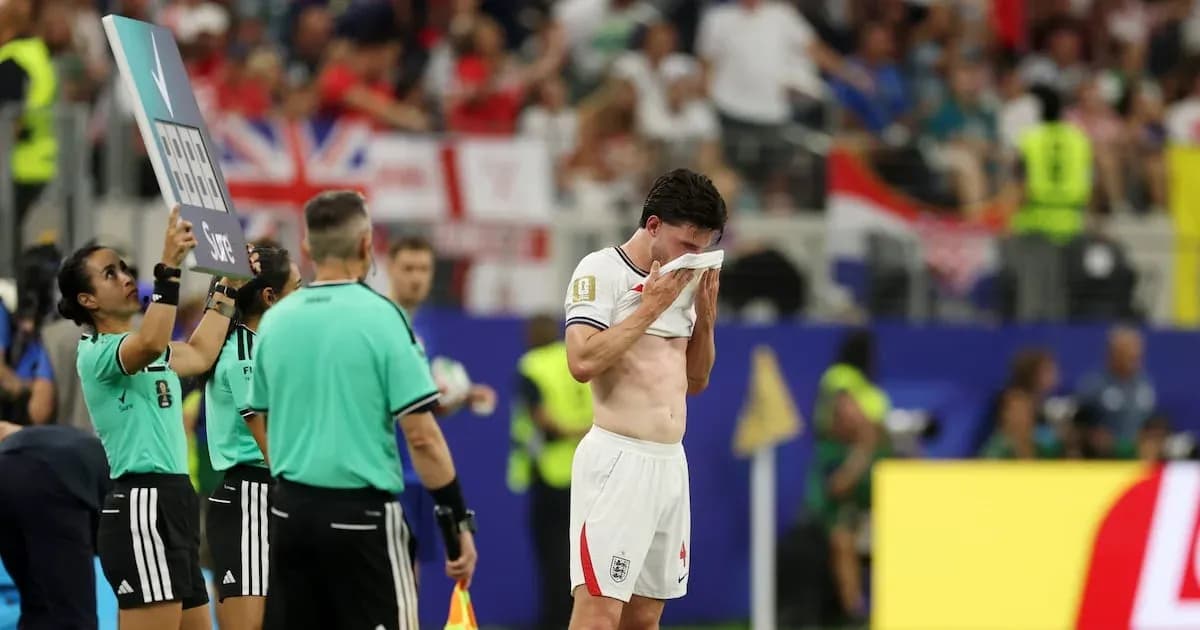
Thomas Tuchel will tell you those tactical creases can be pressed flat before Ghana on Tuesday. Perhaps they can. The more urgent concern came in the 72nd minute, with England clinging to a 3-2 lead, when Rice signalled he could not continue.
This is the moment that jolts a dugout. Rice does not come off in those situations. Not when England are under pressure. Not when there are crosses to head away and counters to break up. Yet off he went, feeling discomfort in his lower back and upper hamstring.
Tuchel called it precautionary. Rice insisted he will be ready for Ghana. Both messages were calm. The underlying reality is not.
No like‑for‑like Rice
The fear for England is simple: there is no second Declan Rice in this squad. There never has been in the past six years.
Tuchel admitted as much in his own way after the game. “Declan had some unusual ball losses,” he said, choosing his words carefully. Even below his usual level, Rice remained central to everything England tried to do. Remove him entirely and the problem becomes bigger than one position.
Kobbie Mainoo offers composure and imagination, but not Rice’s frame, his aerial dominance, his set‑piece threat. Jordan Henderson brings experience, but at 36, Tuchel did not turn to him when England were trying to keep the tempo high against Croatia. The options exist; the obvious solution does not.
Tuchel’s first instinct when Rice departed was to drop Jude Bellingham deeper. On paper, it sounds tempting. In reality, it almost cost England their lead. Croatia surged through the middle, Bellingham’s instincts pulling him towards the ball, not the spaces behind it. The experiment lasted eight minutes.
Then came the adjustment that may yet define England’s tournament.
Reece James, the unexpected 6
Djed Spence entered for Bellingham. Reece James stepped away from right back and into midfield, into a role he has quietly been perfecting at Chelsea.
This was not an improvisation drawn up in a panic. James played in midfield on loan at Wigan in 2018‑19. He has spent most of his senior career at right back or right wing back, but Enzo Maresca’s arrival at Chelsea changed the picture. Over 18 months, Maresca pushed James into midfield, took the heat for the early doubts, and was rewarded with some of the best football of the defender’s career.
The Club World Cup final last year told the story. Chelsea beat Paris Saint‑Germain, James imposing himself in the centre of the pitch. That performance was followed by a dominant display alongside Moisés Caicedo in a 3-0 win over Barcelona last November, then a commanding outing against Rice himself when Arsenal visited Stamford Bridge five days later.
Tuchel, who once insisted he saw James strictly as a right back for England, has had to adjust his own thinking. Naming his World Cup squad, he left out Adam Wharton and Alex Scott and justified it bluntly: “Reece James can play in the 6 because he does on a high level for Chelsea.”
He is right. James is a physical presence, an organiser, a sharp tackler with a clean passing range. He reads danger, but he also sees the forward pass early. Against Croatia, once he moved inside, England looked less fragile. Not secure, but less open, less frantic.
If Rice’s minutes have to be managed, James is the most credible answer.
The risk behind the solution
There is, of course, a catch. James’s own body has been as much an opponent as any winger he has faced.
Hamstring injuries have stalked his career. The latest came in March, costing him almost two months for Chelsea. He has to be monitored, his workload calibrated. Chelsea have learned that the hard way. England are learning it now.
Tuchel’s squad was already stretched at right back. Tino Livramento’s calf injury forced a late call‑up for Trevoh Chalobah. James is first choice on that flank, but he cannot start every game. Asking him to double as Rice’s understudy in midfield risks overloading a player whose muscles have repeatedly rebelled.
Tuchel has built his squad around versatility to hedge against exactly these scenarios. If James moves into midfield, Spence can step in at right back. So can Ezri Konsa or Jarell Quansah. One possible configuration would see Konsa tucking in as a third centre back alongside John Stones and Marc Guéhi, with Nico O’Reilly surging from left back, giving England an asymmetrical back line and a platform for James to patrol the middle.
On the tactics board, it works. On the pitch, it depends on bodies holding together.
A brutal schedule, a looming bill
Tuchel worried about fitness long before a ball was kicked in Japan. The decision to take England early to Florida for a warm‑weather camp was rooted in conditioning, in trying to give weary legs a final top‑up before the most intense month of the year.
Even then, Rice arrived late, his season at Arsenal stretching all the way to the Champions League final. He simply kept going, because that is what he does. West Ham needed him, England needed him, Arsenal needed him. The temptation to lean on a player like that is constant.
At some point, the bill arrives.
If England go all the way to the final and Rice is not given a proper rest, he will finish this season on 70 appearances for club and country. Seventy. For a midfielder asked to press, screen, tackle, lead, and still arrive on the edge of the box.
Tuchel cannot ignore that number. He cannot ignore the sight of Rice, usually indestructible, asking to come off with a one‑goal lead to protect. He cannot ignore James’s medical history either.
England’s head coach has built a squad rich in flexibility and personality. Now the World Cup is here, and the margins are thin. Somewhere between Rice’s iron will and James’s fragile hamstrings, Tuchel must find a way to keep his midfield intact.
If he miscalculates, England’s World Cup could hinge not on tactics or talent, but on the limits of the human body.





