
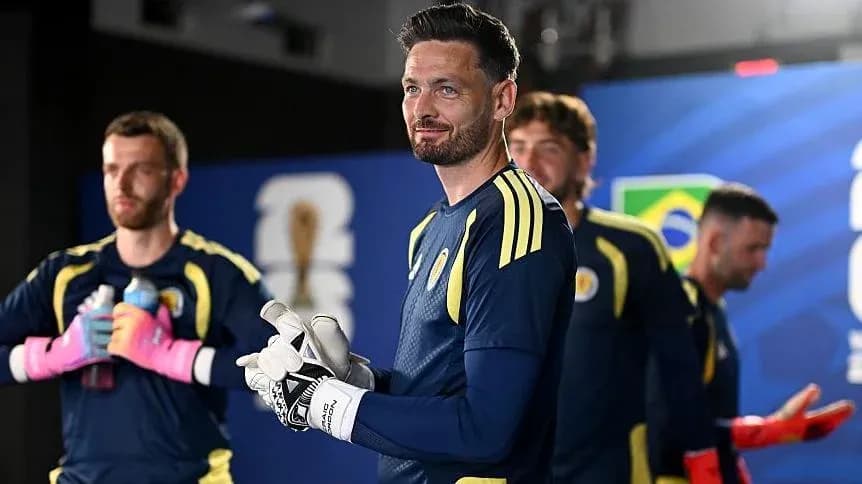
Craig Gordon’s Remarkable World Cup Farewell
Craig Gordon walked away from international football this summer having done something that, by any measure, borders on the outrageous. Four years on from a double leg break that would have finished most careers stone dead, he made it all the way back to a World Cup with Scotland. Then he called time.
For Rory Loy, speaking on the BBC’s Scottish Football Podcast, that achievement hits a little harder than it does for most. He has lived the same nightmare.
The former striker suffered the same horrific injury as the ex-Celtic, Hearts and Sunderland goalkeeper. He knows the sound, the shock, the long nights that follow. He also knows the difference age makes.
“I did the same thing, but I did it when I was 20, 23,” Loy said, reflecting on Gordon’s journey. Gordon’s break came at 39. That contrast matters. At 23, your body still bounces back. The horizon is long, the motivation almost automatic. At 39, the clock is loud. Every decision is heavier. Every setback feels final.
To drag yourself through that at the tail end of a career is something else entirely.
Loy did not sugar-coat the reality. The shin bone, he explained, “just snaps basically”. It has to heal, of course, but the real story starts after the cast comes off. The body you knew is gone. The way you walk changes. The way you move changes. Every step, every jump, every dive has to be relearned.
Your biomechanics are rewritten.
Loy needed orthotics in his boots just to adapt to the new version of his own body. That’s the level of detail, the constant tinkering, the invisible grind that sits behind a headline like “Gordon returns from double leg break”.
This is where Gordon’s comeback takes on its full weight. He wasn’t a kid fighting to launch a career. He was a veteran goalkeeper, already decorated, already admired, already with nothing left to prove. Yet he chose the hardest road again. Chose to lean into the pain, the doubt, the lonely rehab sessions, just to stand in goal for his country one more time on the biggest stage.
“For him to go through that type of thing at the age he was at and still have the motivation to come back and play football just sums up the type of mindset he had,” Loy said. It’s a line that lands with authority, because it comes from someone who has tried to climb the same mountain.
The physical battle was brutal. The psychological one, arguably worse. Fear of contact. Fear of landing. Fear of that one challenge that might send you back to the beginning. Many never clear that hurdle. Gordon did, and he did it under the glare of elite football, where every mistake is replayed, every sign of weakness exposed.
Yet Loy was keen to make one thing clear: this story is not only about survival. It’s about standards.
“But, away from all of that,” he added, “the level of goalkeeping and saves he had was incredible.”
That’s the crux. Gordon didn’t just return. He returned as Craig Gordon – the same towering presence, the same elastic saves, the same authority in his box. Not a sentimental pick. A top-level goalkeeper, right to the end.
So when he bowed out with Scotland at a World Cup, it wasn’t a soft farewell. It was a full stop delivered on his own terms, after a comeback that even those who have walked in his boots can barely get their heads around.
For a player whose career has already spanned glory, setbacks and reinvention, this last chapter might be the one that lingers longest.





