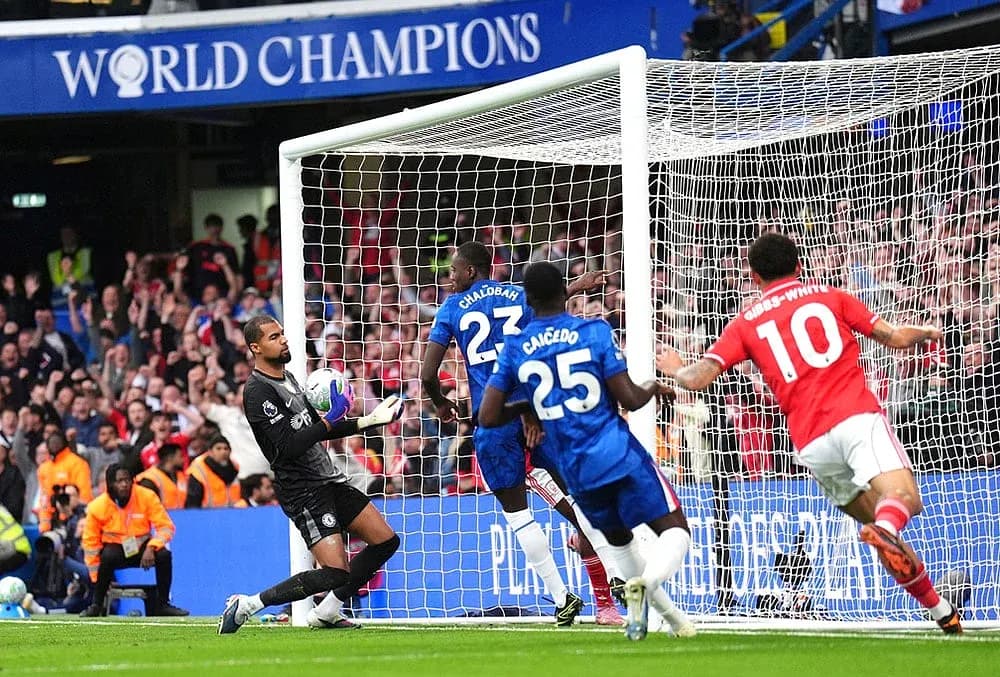
Chelsea vs Nottingham Forest: Tactical Analysis of the 3-1 Defeat
Stamford Bridge had the feel of a crossroads fixture, and following this result the table underlines just how sharply the paths of these two sides are diverging. Chelsea, 9th in the Premier League on 48 points with a goal difference of +6 (54 scored, 48 conceded overall), were beaten 3-1 at home by a Nottingham Forest side that arrived in London sitting 16th with 42 points and a goal difference of -2 (44 for, 46 against overall). Over 90 minutes, Forest’s clarity of structure and mentality cut through a Chelsea team whose season-long numbers already hinted at fragility: at home they average 1.3 goals scored and 1.3 conceded per game, a balance that again tilted the wrong way.
I. The Big Picture – Structure vs. Streaks
The formations told an early story. Chelsea stayed loyal to their season’s default 4-2-3-1, a shape they have used in 30 league games, with Robert Sánchez behind a back four of Malo Gusto, Trevoh Chalobah, Tosin Adarabioyo and Marc Cucurella. Romeo Lavia and Moisés Caicedo formed the double pivot, with Cole Palmer, Enzo Fernández and J. Derry supporting Joao Pedro as the lone forward.
Forest, by contrast, stepped away from their usual 4-2-3-1 (used 29 times this season) into a more direct 4-4-2. Matz Sels was shielded by a back four of Z. Abbott, Cunha, Morato and L. Netz, with a narrow midfield of D. Bakwa, Ryan Yates, Nicolás Domínguez and J. McAtee behind a front pair of Igor Jesus and Taiwo Awoniyi.
Chelsea came into the game on a brutal run – five straight league defeats, as that “LLLLL” form line in the standings starkly shows. Forest, conversely, carried momentum, unbeaten in four with three wins and a draw. The first half, which ended 2-0 to Forest, simply played out those trajectories: Forest confident, vertical and ruthless; Chelsea brittle and reactive.
II. Tactical Voids – Absences and Discipline
Both squads were stretched in ways that shaped the tactical landscape. Chelsea’s attacking depth was thinned by the absence of M. Mudryk (suspended) and wide options like A. Garnacho and J. Gittens listed as inactive or injured. P. Neto was also unavailable. Without those runners, the 4-2-3-1 became heavily dependent on Palmer’s creativity between the lines and Cucurella’s width from deep. It left Joao Pedro often isolated against Forest’s centre-backs.
Forest were missing a spine of experience: O. Aina, W. Boly, Murillo, D. Ndoye, I. Sangaré and N. Savona were all out through various injuries. Callum Hudson-Odoi and John Victor were also sidelined. That forced Vitor Pereira to lean into youth and energy, particularly at the back with Morato and Cunha, and on the flanks with Bakwa and Netz. The risk was cohesion; the reward was athleticism and a hunger that showed from the opening whistle.
Season-long disciplinary patterns framed the tone. Chelsea are a card-heavy side: their yellow cards spike late, with 22.35% coming between 76-90 minutes and a further 15.29% in added time (91-105). Their reds are spread across the match, with a notable 28.57% between 61-75 minutes. Forest’s yellows peak in the middle third, with 23.21% between 46-60 and another 23.21% between 61-75, and their solitary red card this season came in the 31-45 window. That backdrop suggested a contest that could turn scrappy as legs tired – exactly the sort of chaos that favoured Forest once they had a lead to protect.
III. Key Matchups – Hunter vs Shield, Engine Room Battles
The headline duel was the “Hunter vs Shield”: Joao Pedro, one of the league’s most productive forwards, against a Forest defence that, on their travels, concedes 1.4 goals per game. Joao Pedro’s season numbers are elite: 15 goals and 5 assists in 33 appearances, 48 shots with 28 on target, and 29 key passes. He is also among the league’s top assisters, underlining how much of Chelsea’s attacking identity runs through him.
Forest’s back line, however, were supported by a compact midfield screen. Yates and Domínguez sat tight in front of Morato and Cunha, closing central pockets where Joao Pedro likes to receive. With Chelsea’s wide threat reduced by absences, Forest could narrow their block without being constantly punished on the flanks. The result was that Joao Pedro was forced into deeper zones, becoming more of a linker than a finisher, which suited Forest’s plan.
In the “Engine Room”, the clash between Caicedo and Forest’s central pair was decisive. Caicedo’s season is defined by defensive volume and edge: 83 tackles, 14 successful blocks and 56 interceptions, but also 10 yellow cards and 1 red, placing him among the league’s top carded players. His job here was double: protect a back four that, overall, concedes 1.4 goals per game, and initiate Chelsea’s build-up.
Forest’s answer was collective rather than individual. Yates and Domínguez alternated pressing Caicedo’s first touch, while Awoniyi and Igor Jesus curved their runs to block passes into Lavia. With Enzo and Palmer marked tightly between the lines, Chelsea’s possession became sterile, and turnovers fed Forest’s transition game. The 2-0 half-time scoreline was the tactical manifestation of that midfield squeeze.
IV. Statistical Prognosis – Why Forest’s Plan Held
Across the season, Chelsea’s overall scoring rate of 1.5 goals per game is offset by their 1.4 conceded; they live on a fine margin. At Stamford Bridge specifically, 24 goals for and 24 against in 18 matches underline that this is no fortress. Forest, meanwhile, are more dangerous away than at home: 26 goals scored and 25 conceded in 18 away fixtures, averaging 1.4 for and 1.4 against. They are comfortable in open, end-to-end contests.
In a notional xG frame, Chelsea’s territorial dominance would usually generate a slight edge, but Forest’s structure and transition threat tilt the balance. Forest have nine clean sheets overall, five of them away, and have failed to score on their travels only five times. That profile – disciplined enough to survive, dangerous enough to strike – is exactly what unfolded in this 3-1 away win.
Following this result, the numbers and the narrative converge. Chelsea’s reliance on Joao Pedro and Palmer, combined with a leaky, card-prone defensive unit, leaves them exposed whenever the first goal goes against them. Forest, despite their injury list, showed that their 4-4-2 can be a ruthless away weapon: compress the middle, spring quickly into the spaces behind an adventurous full-back like Cucurella, and trust the front pair to finish.
On this afternoon at Stamford Bridge, the statistics did not just describe the game; they predicted it. Forest arrived as one of the league’s more efficient away sides and left with a performance – and a 3-1 scoreline – that fully matched their underlying profile.