Celtic's Triumph and Martin O’Neill's Return: A New Era
The photograph on the phone is time-stamped 4.47pm, May 16th. Celtic Park. Early evening light, empty stands, one man in an old-school tracksuit minding goal while a couple of kids toe‑poked shots at him from close range.
Martin O’Neill. Seventy-four years old. Supposedly the interim manager of Celtic, now just a grandad in specs laughing as his grandchildren try to beat him at the same end where, a couple of hours earlier, Scottish football had been turned inside out.
Scroll back to the previous image.
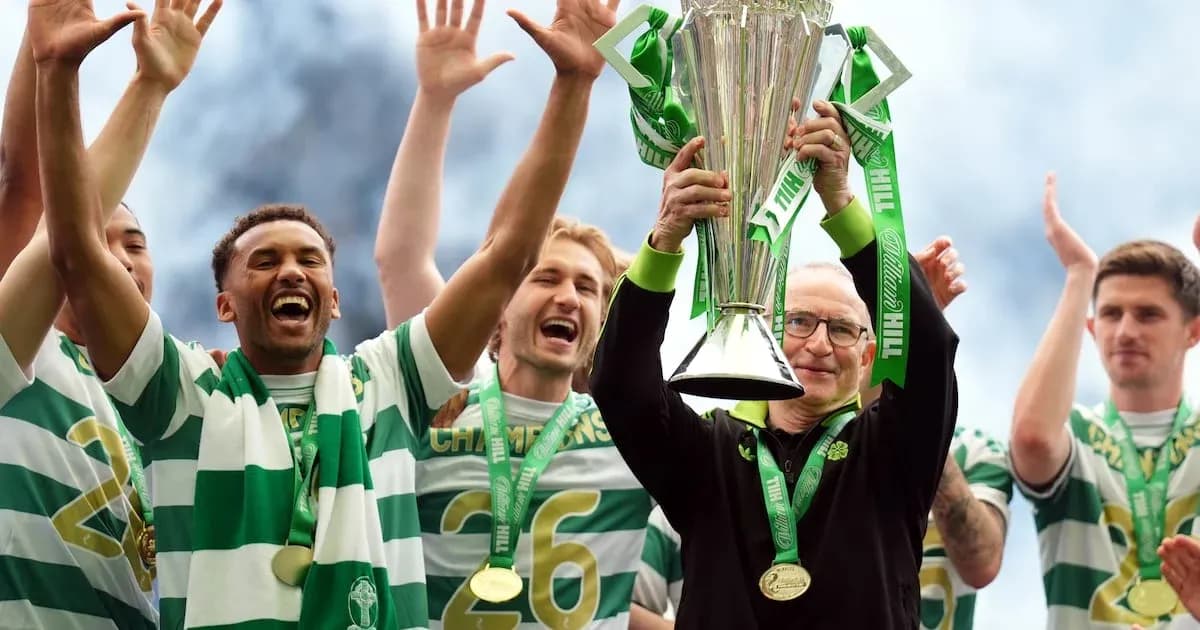
Same goalmouth. Same patch of grass. Different world. It’s 2.30pm and Callum Osmand has just rammed in Celtic’s third against Hearts to seal the Premiership title. The picture barely shows him – he’s somewhere in a heaving mass of players, staff and supporters who have poured on from the stands, some stripped to the waist, all swallowed by the moment.
Hearts’ players are the counterpoint. On their knees, or frozen where they stand, hands on heads, staring at the delirium in front of them. Sixty-six years without a title, three minutes from history, three minutes from what 2026 would christen a Mayo moment. Then Daizen Maeda decided the script needed a twist.
Celtic’s 14th title in 15 seasons sounds routine on paper. It was anything but. Hearts’ improbable charge, Celtic’s managerial hopscotch from Brendan Rodgers to O’Neill to Nancy and back to O’Neill, Rangers stumbling around in their own fog – the whole campaign felt unstable, alive.
And in the middle of it all, there was O’Neill, dragged in front of microphones to talk about “fairytales”, about chasing a double in the Scottish Cup final against Dunfermline and Neil Lennon a week later. Everyone assumed that would be his Celtic farewell.
The chaos that followed Osmand’s goal was never his to police. No final whistle, no sense of line or distance, just unfiltered celebration in the faces of Hearts players who promptly left the stadium still in full kit, too raw to even change. Celtic apologised formally the next day; most people moved on. O’Neill was allowed to soak in the achievement. He called it “a reason to live”. People were already musing about a statue.
Yet the whistle had not sounded on his Celtic story either. Twenty-six days later, the club confirmed him as permanent manager on a one-year deal with a one-year option. The reaction was as fractured as the club itself: amazement, delight, and a weary shake of the head at what looked like another short-term fix. Celtic and its support live in a permanent argument with themselves, which is why O’Neill hammered home the value of unity on that title-clinching afternoon.
Thirty-seven days on, Celtic were back at Parkhead for the first time since Hearts, a pre-season run-out against Middlesbrough. In his programme notes, O’Neill called that last visit “dramatic and thrilling”. The echoes were faint. The sun was still out, O’Neill was still in the tracksuit, but only around 6,000 home fans bothered to turn up.
There were reasons – there always are – yet disillusionment with the club’s direction sat near the top of the list. This at a club where, only three weeks earlier, it had been reported that 99.5 per cent of season ticket holders had renewed. The seats were paid for. The appetite to watch a low-key friendly was another matter.
Missing from the cast were some of the men who had dragged Celtic over the line. Kelechi Iheanacho, scorer of the season-shaping, highly debated 90+9th-minute penalty at Motherwell three days before the Hearts game, had headed to Bursaspor in Turkey’s second tier rather than sign on again. Maeda was on his way to Ipswich Town.
For Rodgers, the departures carried a familiar ring: Kyogo Furuhashi, Nicolas Kühn, Adam Idah – key forwards gone or going. Many supporters heard the same tune and bristled, even if plenty accepted why the club balked at Iheanacho’s wage demands. This is Glasgow, so within days a rumour was doing the rounds that Celtic’s recruitment strategy had given O’Neill himself a reason to walk away.
He didn’t. There he was last Saturday, back on the touchline, as more than 20,000 watched Celtic face AC Milan in their final pre-season friendly. And there, too, was Camilo Duran, the new Colombian striker from Qarabag, the one who scored against Benfica in last season’s Champions League and had already found the net against Middlesbrough. Three pre-season games, three goals. A small but welcome comfort for a manager who knows what a cold summer can feel like.
A few days later, another forward arrived: Kasper Høgh, signed for around €13m, roughly matching the fee banked for Maeda. Høgh’s reputation is burnished by those two goals for Bodo/Glimt in a 3-1 Champions League win over Manchester City last season. If he and Duran can trouble that level of opposition, then, on paper at least, they should fancy themselves against Dundee on Monday night, and then Kilmarnock, Falkirk, Aberdeen and St Mirren in the weeks after. None of those sides finished in Scotland’s top five last term.
It’s a gentle start, the kind that should give Celtic room to breathe and to plan around a Champions League qualifier, home and away, in the middle of next month. They have stumbled at this stage before – Kairat Almaty last year still grates with Rodgers – and selling remains woven into the club’s economic fabric. If projected exits such as Arne Engels are matched by serious incomings, early-season momentum is there to be claimed.
That mood – cautious optimism, wary hope – feels a long way from last October and the “toxic atmosphere” Dermot Desmond referenced. Yet the distrust in how Celtic is run will not vanish on the back of one title. Not now. Not until a squad proves it can do more in Europe than simply turn up, salute the anthem and fly home with regrets.
All of this is being written with a month of the transfer window still to run, the deadline of August 31st looming. Across the city, Rangers have been busier and, after last season’s lurching inconsistency, the assumption is they cannot afford another campaign of drift.
The symmetry is striking. Hearts’ manager on that raw May afternoon at Parkhead was Derek McInnes. He is now at Ibrox. Hearts’ captain and goalscorer that day, Lawrence Shankland, has joined him. So has Cammy Devlin, their midfield heartbeat and player of the season. A maroon spine has been transplanted into blue, a trio expected to add some much-needed steel to a club that has gone trophyless in three of the last four seasons.
McInnes is Rangers’ sixth permanent manager in five years, their third in 12 chaotic months. Russell Martin and Danny Röhl never quite looked or felt right, but McInnes is a former Rangers player. He understands the club’s weight. He fits, on paper. Reality is less forgiving. Expectation is heavy and immediate, and he must start marching from the first whistle at Tannadice on Friday night.
His departure from Hearts opened the door for Wouter Vrancken at Tynecastle. The Belgian has had a brutal introduction: two games, two defeats, both to Sturm Graz in a Champions League qualifier. Matching last season’s ferocious energy will be a serious test – for him, for a club that dragged neutrals into Scottish football’s orbit by refusing to go away.
Hearts pushed Celtic until the final week. They pushed the league into relevance far beyond its borders. The calendar says May 16th, 2027, will once again be the final day of the season.
Somewhere, O’Neill’s grandchildren might want to circle it and keep their boots handy.