
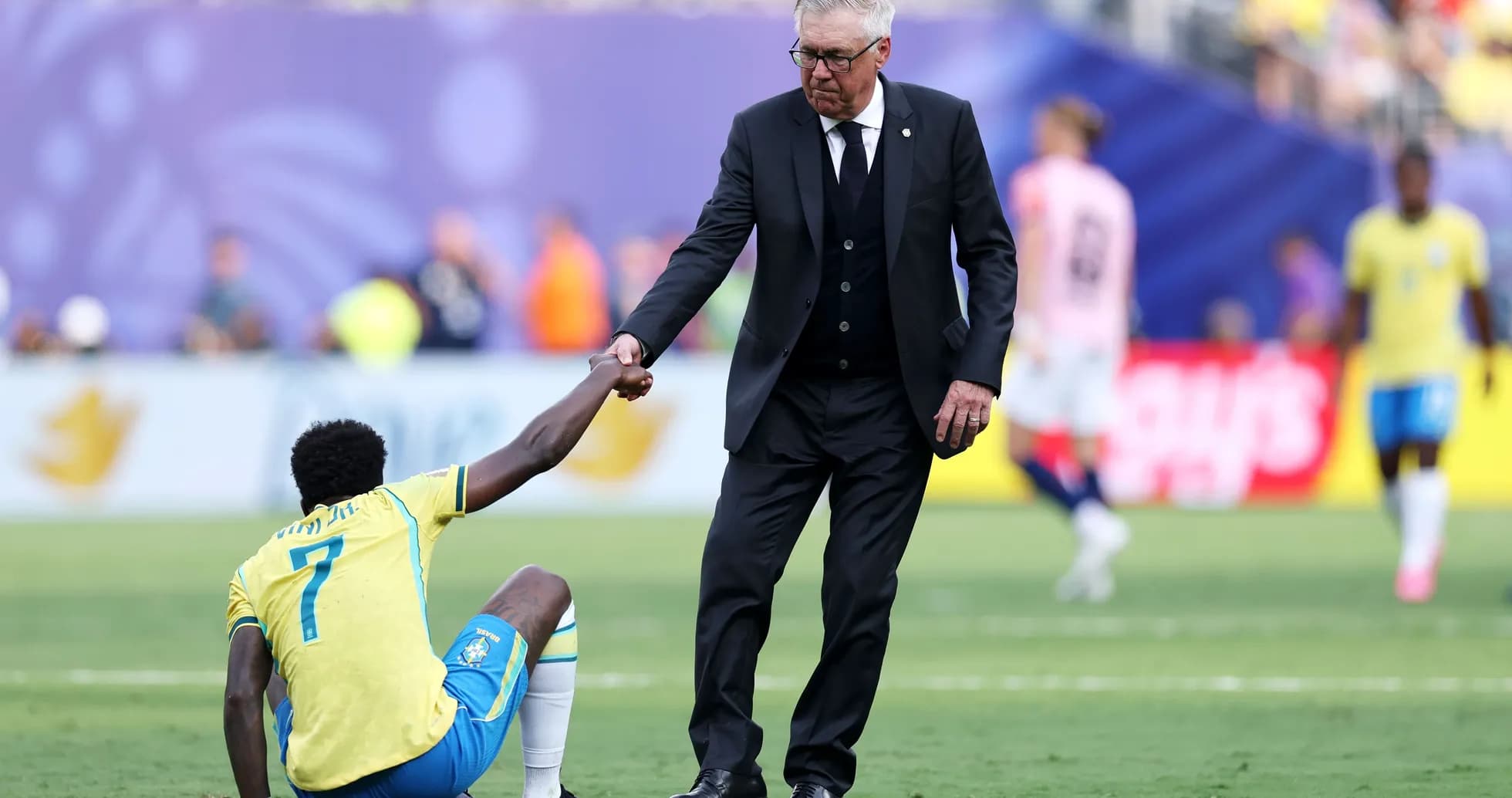
Carlo Ancelotti Reflects on Brazil's World Cup Exit to Norway
Carlo Ancelotti has lived too many nights at the sharp end of elite football to hide behind clichés. When he looks back at Brazil’s World Cup exit to Norway, he doesn’t talk about destiny, referees or luck. He talks about a water break.
In his mind, that pause in the second half of the round-of-16 defeat is where Brazil’s World Cup slipped away.
“We lost the World Cup during the water break”
Brazil fell 2-1 to Norway, a result that extended the country’s wait for a world title to at least 24 years, the last crown still that 2002 triumph. Ancelotti, now in charge of the Seleção, had spent a year building what he believed was a coherent, well-prepared side. On the surface, everything was in place.
“In general, I think the work done over a year was excellent,” he told ESPN. The Italian stressed how well Brazil had been set up off the pitch – hotel, stadium, training ground – and how the squad had responded. “I think the players' performance throughout the year was positive. I also think the 26 players who were called up were the most suitable to be there.”
Then came the erosion of that plan: injuries, one after another.
Militão, Rodrygo, Estêvão, Wesley before the tournament, Raphinha during it. “The plan drawn up last year changed slightly because of injuries,” Ancelotti admitted. The adjustments were constant, the margins ever thinner.
Still, against Norway, he felt Brazil were managing the contest. Until the pause.
“I think we lost the World Cup during the water break against Norway,” he said. “Why? Because the team was in control of the flow of the match until that moment.”
Ancelotti looked at the pattern of play and saw danger where, in hindsight, he believes there was none. Norway had the ball, a lot of it, often in their own half. They had done something similar against England, circulating possession, slowing the rhythm, trying to dictate tempo without necessarily cutting teams open.
“It is also true that Norway had possession of the ball, and had a lot of it in their own half... Norway played the same way against England. They controlled the match, but in the end, they could have beaten England.”
The Italian read that control as a shift in momentum. He reacted. And that, he now suggests, is where he went wrong.
“Perhaps my mistake was here, when I thought the team had lost control of the match when that was not the case. I made some changes to the line-up, then we had the problem of Erling Haaland's goal.”
Once Haaland struck, deep into the second half, Brazil were chasing the game. “In the World Cup, when they score a goal against you in the thirtieth minute (of the second half), it is very difficult to recover,” Ancelotti said. “But we did have a chance to recover.”
The Neymar decision under the spotlight
Those final minutes sparked the fiercest debate. Ancelotti’s call to introduce Neymar late on drew heavy fire, with critics claiming the substitution “upset the balance” of the team at the very moment Brazil needed clarity and structure.
He rejects that idea outright.
No, when Neymar came on at that moment, I took off Ryan and brought on Endrick as a right winger, thinking that Neymar was capable of creating a goal, or showing his skills at that moment, in the 70th minute,” Ancelotti explained. It was not an improvised gamble; it was a scenario he had already considered. “That is what I intended to do against Japan.”
The plan for the Japan match underlined his thinking. “Why did I bring on Gabriel Martinelli against Japan? Because the team was completely in control of the match. Japan relied only on counter-attacks. The aim was not to score a goal, rather I was thinking of bringing on Neymar in extra time against Japan.”
Against Norway, the context changed. The tension rose. The clock ticked faster. Ancelotti went earlier with his star.
“I brought Neymar on a little early to regain control of the match,” he said. Those are the moments when even the most decorated coaches feel the strain. “You also have to think about the decisions you have to take... I heard Thomas Tuchel say he came in for heavy criticism, and the truth is that you have to make a very difficult decision. It is a moment full of tension, and you do not always get it right.”
Yet on one point he is unwavering: Neymar had to play.
“I think Neymar should have been brought on, he had to come on at that moment because he was performing well, trained well, and prepared well. I liked his sporting spirit. I think he helped the team. But, with him coming on, there was no need to change the structure of the team.”
That final line hangs in the air. The regret is not about trusting Neymar, but about what shifted around him. A misread water break, a tactical tweak, a Haaland goal, a nation sent home.
For a coach who has spent a career mastering small details on the biggest stages, the question now is simple: how do Brazil turn that lesson into the edge they have been missing since 2002?





