Canberra United's New Era: Owners Commit to Men's Team by 2028
The uncertainty is over. After two years of nervous waiting, Canberra United finally has what every professional club craves: security, ambition and people willing to spend serious money to prove it.
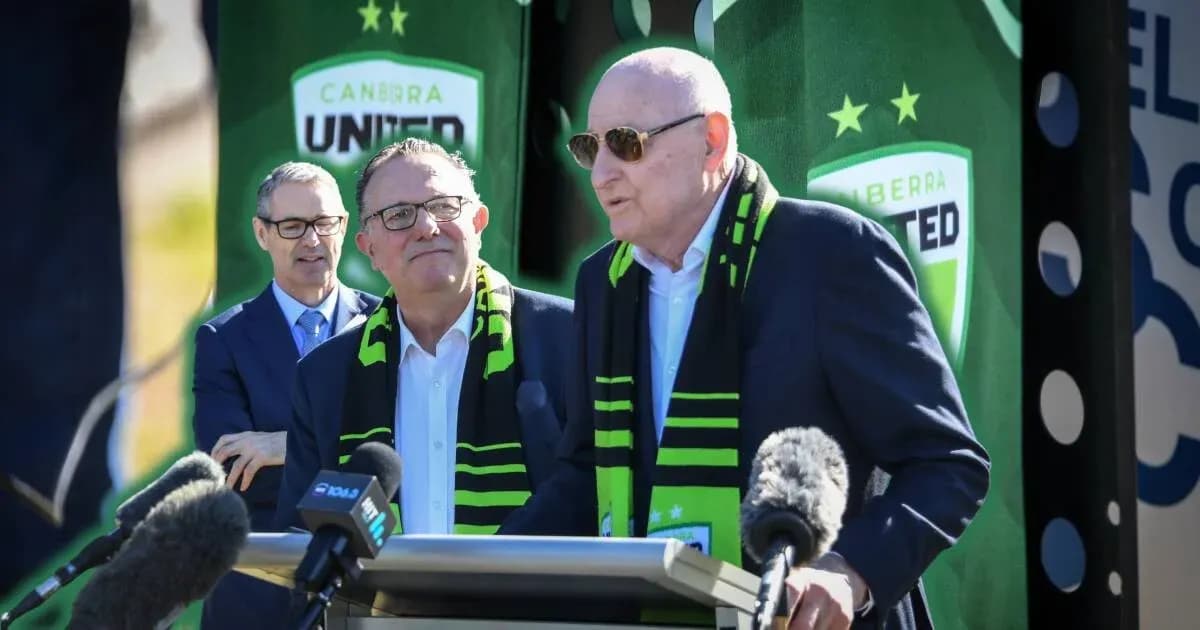
On Friday, Australian Sports Group (ASG) was unveiled at McKellar Park as the club’s new private owner, stepping in where Capital Football could no longer afford to tread. The deal secures Canberra United’s place in the A-League Women for the 2026-27 season and lays down a clear marker: a men’s team is targeted for the 2028-29 A-League Men campaign.
ASG’s chief executive, Theo Fotopoulos, and chairman, Morris McAlister, fronted up at United’s traditional home to confirm the takeover and sketch out their plans. They declined to spell out the licence price, but it’s understood the overall arrangement is worth about $15 million, covering both women’s and future men’s operations, with an immediate commitment to underwrite the women’s side to the tune of up to $3 million over multiple years.
For a club that has lived hand-to-mouth in recent seasons, that’s a fundamental shift.
McKellar at the heart of the vision
The first message was simple: Canberra United is staying home.
Fotopoulos made it clear McKellar Park remains the club’s match-day base, its “spiritual home”, and the focal point of ASG’s infrastructure push. The group is actively exploring the creation of a dedicated training base on the six-hectare site, with an office to be established next door at the Belconnen Soccer Club, which he described as a “strategic partner”.
The idea is not new. Capital Football and the ACT government once had grand plans for a high-performance base at the Throsby Home of Football, only for the project to collapse when the federation’s finances could no longer sustain it. This time, ASG believes the numbers can work at McKellar.
“It’ll come down to what we can get approved in terms of the facility here,” Fotopoulos told The Canberra Times, pointing to the rare advantage of a privately owned football ground in the capital. He has already spoken to key stakeholders and says the early signs are “very positive”.
The intent is clear: build a permanent home, not just rent one.
“Football needs a home and it'd be great to be able to develop that here,” he said.
Coaching, continuity and a tight clock
Off the field, the ownership question is settled. On the field, there’s no time to waste.
Pre-season is due to start in six weeks. The A-League Women draw drops next month. The new regime needs a coach signed, a squad locked in and a program up and running before October 16, when the season is scheduled to kick off.
ASG has already sat down with current coach Antoni Jagarinec, who has guided United to the finals in each of the last two seasons. Fotopoulos did not rubber-stamp his reappointment on the spot, but the direction of travel is obvious.
“It's never a no-brainer, but yeah, look, I think [Jagarinec's] results speak for themselves,” he said. “We're looking for continuity and consolidation. We'll have those announcements out pretty soon.”
The players are next. The Professional Footballers Australia (PFA) is working with the squad, and ASG wants contracts sorted quickly.
“That is our priority to get that finalised,” Fotopoulos said. “We feel very confident with the reaction we've had so far from the players that that will happen in haste.”
The message to the dressing room is stability and ambition, not a short-term rescue job.
Men’s team: option now, deadline set
The headline that Canberra has craved for almost two decades came with a small but crucial asterisk.
ASG does not yet hold an A-League Men licence. What it has is an option: a pathway agreed with the A-Leagues to introduce a men’s side in 2028-29. After 18 years of false starts, broken bids and shifting goalposts, the idea of waiting another three seasons will grate on some in the capital.
Fotopoulos, though, was emphatic. This is not a token clause.
“Well, we're here today, so that's your best guarantee,” he said. “That is part of our twin strategy. When we started speaking to the APL ... that was part of our mix. We believe the strength comes from both. It would be almost discriminatory not to work with the men. It's always been part of our plans.”
The timeline is firm. ASG has two years to build out the structure, funding and infrastructure required to launch a men’s side and turn the option into a fully-fledged licence. After years of lobbying, Canberra bid leader Michael Caggiano, who has pushed tirelessly for a men’s team over the past eight years, finally has a concrete horizon to point to.
APL chair Steve Conroy acknowledged what it means for the territory.
“Following a competitive process, we're excited to announce the Australian Sports Group as the new owner of Canberra United – securing the future of the women's team and establishing a pathway to introduce a new A-League Men's team in Canberra,” he said. “This is an exciting next step for professional football in the ACT and highlights the growth opportunity for the A-Leagues and football in Canberra.”
United name stays, nickname up for grabs
One thing ASG will not touch is the core identity.
Canberra United will remain Canberra United – for women now and for men when they arrive. The brand carries 18 years of history and some of the strongest support in the A-League Women. Fotopoulos has no interest in wiping that clean.
“You've got 18 years of Canberra United. Why would you change it?” he said. “Unless somebody or the general public have got a negative view towards the team – I don't think that's the case.”
What he does want is a nickname, and he wants the city to choose it. Fotopoulos floated the idea of a public campaign, potentially run through The Canberra Times, to find a moniker that sticks. The Cosmos, Arrows, Greens, Lakers, Green Machine – the suggestions will come thick and fast.
“If the Canberra community want a nickname for their team, Green Machine, whatever they come up with, we're happy to look at that and we'll run a public campaign, possibly through your paper,” he said.
It’s a small detail, but it speaks to a broader approach: keep the club’s soul, modernise the shell.
Who’s backing the project?
Behind the promises sit two men with long histories in Australian football and business.
ASG chairman Morris McAlister comes from a commerce background. He is governing director of Petron Plus 7 Australian and New Zealand, which supplies engine and machine products such as lubricants and grease, and serves as senior consultant at MEC Team Consultants, linking Australian companies with Chinese markets.
Fotopoulos, ASG’s public face in Canberra, is a marketing executive and chief executive of FOS Group Australia. On the football side, he and McAlister have been around the block: they were involved with Sydney Cosmos, where Fotopoulos served as chief executive, and with the Newcastle Breakers in the old NSL. Fotopoulos also previously held the chief executive role at Sydney Olympic.
This is not a group learning the sport on the fly.
Pathways, infrastructure and a reset for Capital Football
For Capital Football, the sale marks the end of an era. The federation has run Canberra United since the club’s birth in 2008, but the financial strain became too heavy. Last season was its final campaign at the helm. Without a buyer, the women’s team faced the very real prospect of disappearing from the national stage.
Now, the model flips. United becomes a privately owned club for the first time, and Capital Football is freed from a burden it could no longer afford. The A-Leagues will formally announce ASG as the club’s new owner, locking in the ALW side for 2026-27 and beyond.
Fotopoulos is not stopping at first teams. He has committed to re-establishing Canberra’s academy pathways, three years after Capital Football controversially shut down United’s academy. That decision left a hole in the development ladder for local boys and girls, and ASG is keen to fill it.
“We're excited to be part of growing the A-Leagues and building a strong club focused on community engagement, football excellence, commercial growth, new infrastructure and strengthening the football development pathways for boys and girls in the territory and the capital region,” Fotopoulos said.
The academy, the training base, the men’s team – they’re all strands of the same project.
A football city finally gets its chance
For so long, Canberra has been the nearly club of Australian football. Preferred location, but not selected. Strong bid, but not quite strong enough. While Auckland joined the competition and went on to become champions, the nation’s capital stayed on the outside looking in.
Friday’s announcement doesn’t instantly fix that imbalance, but it does something almost as important: it gives Canberra a roadmap and a group with the money and experience to walk it.
On the terraces at McKellar, the reaction was simple. Relief that Canberra United has been saved. Excitement that a men’s team is no longer a vague promise but a pencilled-in date. Curiosity about what a privately run, fully integrated club can become in a city that already turns out in big numbers for its women’s side.
“Canberra is home to a thriving football community – a huge participant and passionate supporter base who have made Canberra United one of the most strongly supported A-League Women teams for the last 18 years,” Fotopoulos said. “We're thrilled to be leading the next generation of professional football in Canberra… progressing towards an integrated professional club with the introduction of an A-League Men's team in season 2028-29.”
The questions now are no longer about survival. They’re about scale.
How quickly can ASG turn plans on paper into concrete and grass at McKellar? How strong will the new academy be? And when the men finally walk out alongside the women under the Canberra United banner, what kind of club will this football city have built for itself?