
Canada's Historic 6-0 Victory Over Qatar — A New Era in Soccer
Canada did not just win a World Cup match on Thursday night. It ripped up a chapter of its sporting identity and started writing a new one in bold red ink.
A modest win over Qatar would have been enough for most fans. A quiet, competent start. Instead, Vancouver got a 6-0 demolition, the country’s first-ever men’s World Cup victory, and a night that looked and sounded like a nation finally deciding football belongs alongside its beloved winter games and hardwood triumphs.
It felt like a party. It also hurt.
A nation dressed in red
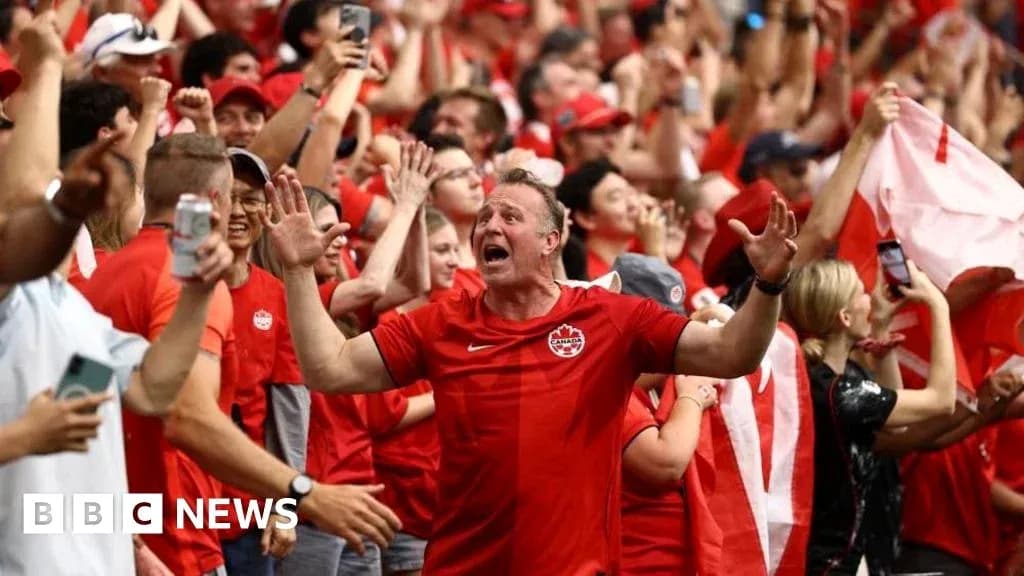
Hours before kick-off, the city moved as one. Thousands of supporters poured along the “last mile” to the stadium, swallowed by clouds of red smoke. The 52,000-seat arena filled to the rafters, a sea of red and white shirts, flags and scarves, the noise building in waves.
Across the country, the same colours flickered on screens. Granville Street in downtown Vancouver turned into a street-long fan zone. In Toronto, small neighbourhood bars that once reserved their biggest roars for Stanley Cup runs and NBA Finals games tuned in to Les Rouges instead.
In one of those Toronto bars sat Dave Di Cola, a longtime believer in a team that for decades struggled to convince the rest of the country it was worth the emotional investment. He went into the night with what he called “reserved optimism,” fully aware that football can turn on a bad bounce or a single mistake.
The game refused to entertain that kind of caution for long.
A rout with a cost
Canada struck early, struck often, and never really let Qatar breathe. Three goals before half-time turned the occasion from a tense opener into a celebration. Qatar’s misery deepened with two red cards, and by the final whistle the scoreboard read 6-0, a blowout that felt almost surreal in its ease.
Jonathan David, already the face of a new generation of Canadian talent, walked away with three of those six goals. Somewhere in the crowd, a fan in a Connor McDavid hockey jersey had taped over the “Mc” with a homemade “J” to honour him — a simple, clever gesture that captured the mood of the night. A hockey nation, borrowing from its first sporting language, was spelling out its new one.
For Di Cola, this was not just a win. It was validation.
“Canada soccer has always been kind of a joke. It’s always secondary,” he said, the weight of years of irrelevance and underfunding packed into that sentence. Watching the stands in Vancouver, and the reaction from coast to coast, “nearly brought a tear” to his eye.
The joy, though, came with a sharp edge.
Midfielder Ismaël Koné, a key piece of Canada’s midfield structure and rhythm, left the pitch with a broken leg, his tournament over almost as soon as it had begun. The stadium’s roar dropped to a hush. On the field, teammates rushed to him, forming a protective ring as medics worked.
Ottawa-born Koné has become central to how this team plays and how it feels about itself. Coach Jesse Marsch has called him “a big part of the heart of our team,” and on this night that heart took a heavy blow.
Nathan Saliba, sent on to replace him, answered in the only way a footballer can. He scored Canada’s fourth goal, then lifted Koné’s jersey high in tribute, a raw, simple image that cut through the noise of the scoreline.
For Di Cola, that moment changed the tone of the night.
“If that didn’t happen, I would have been running up and down the avenue yesterday,” he admitted. The win still meant everything. Koné’s injury meant it could not be pure joy.
A country watches — and listens
By the time the players reached the dressing room, the scale of the night had already spread far beyond the stadium. Celebratory scenes flooded social media: crowds in city squares, kids in oversized Canada shirts, adults who grew up thinking this team would never matter suddenly singing at the top of their lungs.
TSN reporter Matthew Scianitti, walking through the delirious crowds in Vancouver, put words to a feeling many fans had carried in silence for years. “As a Canadian, to sit there and watch it all, I will live in that forever,” he said, the kind of line that tends to get remembered when people look back on where it all began.
Even in the aftermath of Koné’s injury, the team’s response drew praise from the highest office in the land. Prime Minister Mark Carney addressed the players in the locker room, not about tactics or technique, but about character. He told them they had shown “a level of character that some people never achieve” in the way they rallied around their stricken teammate, and that they had done it with “the entire country and a good part of the world” watching live — and many more catching the highlights.
Koné, fresh from surgery, added his own voice on Friday morning, posting a message to his teammates on Instagram: “What you guys did yesterday will stay with me forever.” The result will define his tournament, even if he cannot kick another ball in it.
Finding their place in Canadian sporting lore
Canada’s sporting memory is already crowded with iconic snapshots: Sidney Crosby’s golden goal in Vancouver in 2010, the Toronto Raptors toppling the Golden State Warriors in 2019, the women’s football team climbing to the top of the podium at the Tokyo Olympics in 2020.
Thursday night does not sit on that top shelf. Not yet. Di Cola is the first to say it. This is a group-stage win over Qatar, not an Olympic final or an NBA championship.
He is also the first to point out what it represents.
For decades, the men’s national team existed on the margins, overshadowed by hockey, basketball’s rise, and the women’s football program’s success. On this night, in front of 52,000 in Vancouver and countless more in bars and living rooms, that changed. The team looked like it belonged on the main stage. The country treated it that way.
Canada still has, in Di Cola’s words, “a long way to go.” One emphatic win does not make a dynasty, and losing a midfielder as influential as Koné will test the squad’s depth and resolve as the tournament grinds on.
But momentum is a fragile, powerful thing in football. Right now, Canada has it.
Next up is Switzerland — a step up in pedigree, a different kind of examination. The noise from Thursday will not help them complete a single pass in that match. What it might do, though, is convince a group of players, and a country behind them, that this is no longer a novelty act.
This is a soccer nation now. The question is how far it wants to go with that new identity.





