Burnley vs Wolves: Tactical Analysis of a 1-1 Draw
Burnley’s 1-1 draw with Wolves at Turf Moor unfolded as a clash of contrasting game models: Burnley’s structured, possession-heavy 4-2-3-1 against Wolves’ compact, transition-oriented 3-4-2-1. Across 90 minutes, the numbers underline that Burnley controlled territory and tempo, but Wolves repeatedly threatened to punish them in open spaces.
From the outset, Wolves’ plan was clear. With three centre-backs and a four-man midfield line, Rob Edwards’ side sought to compress the central lane and spring quickly into depth. The early VAR intervention at 4' for a “Penalty confirmed” on Ladislav Krejčí set the tone: Wolves were prepared to be aggressive in duels and runs into the box. A. Armstrong converted the penalty at 5', giving Wolves a 1-0 platform perfectly suited to their low-possession blueprint.
Burnley, under Mike Jackson, built in a classic 4-2-3-1 with Florentino and L. Ugochukwu as the double pivot. Their 70% ball possession was not sterile; it was backed by 558 passes, 488 accurate (87%), and a clear attempt to progress methodically through the thirds. The back four of K. Walker, A. Tuanzebe, B. Humphreys and Lucas Pires provided a broad base, pushing high to lock Wolves in and allowing the three advanced midfielders – L. Tchaouna, Hannibal Mejbri and J. Anthony – to occupy half-spaces and wide pockets.
The shot profile reflects this territorial dominance but also hints at structural issues. Burnley produced 16 total shots, 8 on goal, with 7 from inside the box and 9 from outside. The high number of efforts from range suggests that Wolves’ central block, anchored by Y. Mosquera, S. Bueno and Krejčí, often succeeded in protecting the prime finishing zones, forcing Burnley to settle for lower-quality looks. Their xG of 1.06, almost exactly matching their single goal, underlines that while Burnley got volume, they struggled to consistently generate premium chances.
Second Half
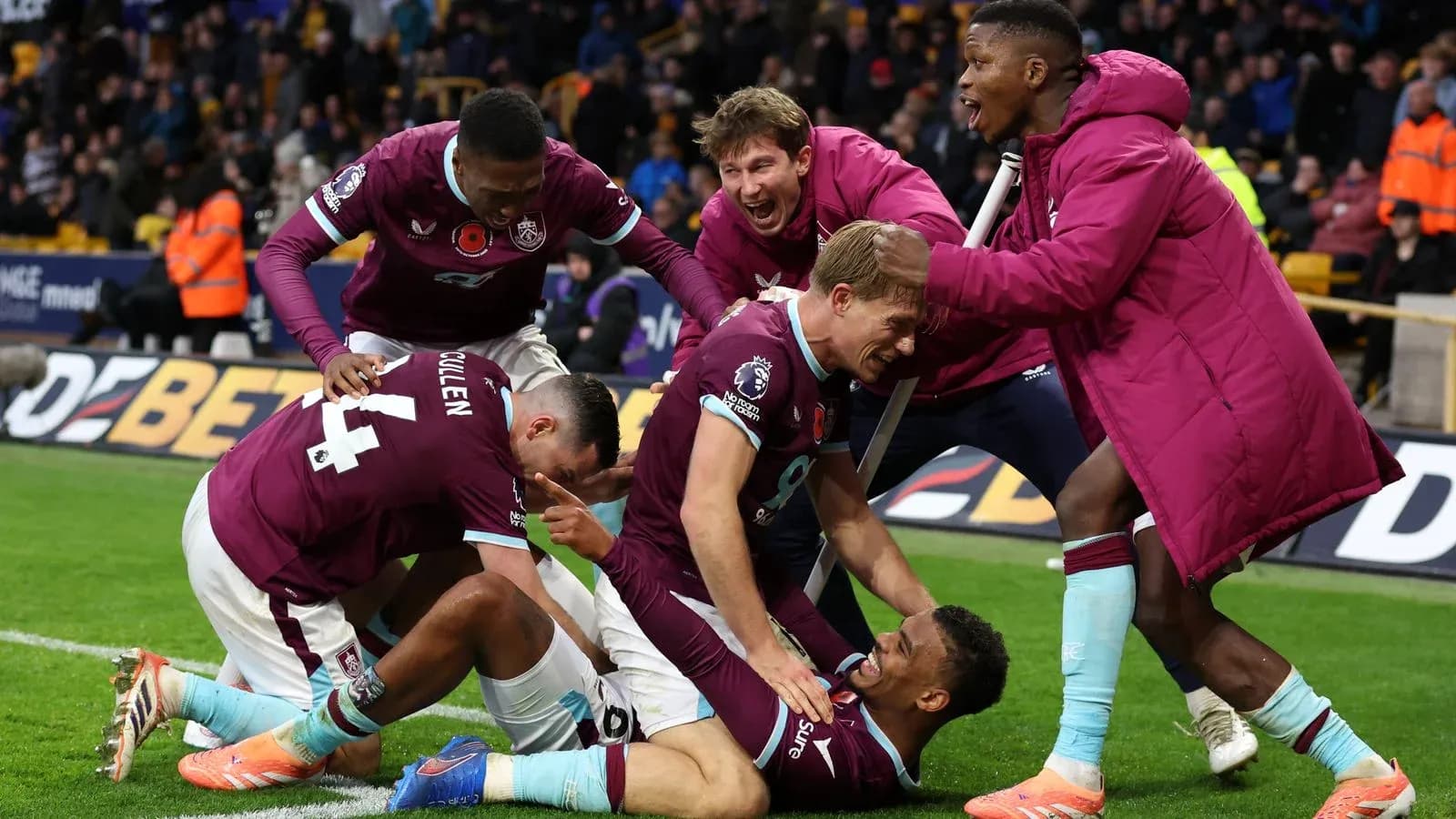
The key attacking adjustment came right after the interval. At 47', Z. Flemming’s equaliser, assisted by L. Tchaouna, was the payoff for Burnley’s persistent occupation of Wolves’ defensive third. Tchaouna, operating from the right-sided attacking midfield slot, had been Burnley’s most incisive vertical runner, and his assist encapsulated the pattern: overloads in wide channels, then a late-arriving forward exploiting gaps between Wolves’ centre-backs. Flemming’s role as a roaming nine, dropping between lines rather than playing on the last shoulder, helped unbalance Wolves’ back three and created the pocket from which he could finish.
Wolves, however, remained extremely dangerous on fewer touches. With only 30% possession and 223 passes (164 accurate, 74%), they still matched Burnley’s shot volume at 16 attempts, putting 4 on target. Crucially, their xG of 2.05 dwarfed Burnley’s 1.06, indicating that when they did reach the final third, the chances were clearer. The front trio of M. Mane, Hwang Hee-Chan and A. Armstrong focused on running off the shoulders of Burnley’s centre-backs, especially in transitions when Burnley’s full-backs had advanced.
The wing-backs and wide midfielders were central to Wolves’ counter-attacking structure. R. Gomes and D. M. Wolfe provided width from the midfield line, while Andre and A. Gomes worked as connectors inside. Their role was to win second balls and immediately release forwards into space. This directness is reflected in Wolves’ shot map balance: 10 shots inside the box versus 6 from outside, a profile more consistent with fast attacks into exposed defensive lines than with long, patient build-up.
In goal, M. Weiss (Burnley) made 3 saves and, with 0.29 goals prevented, broadly matched Wolves’ shot quality, keeping Burnley in the game despite the visitors’ high xG. His interventions were particularly important when Burnley’s high defensive line was pierced and he had to deal with clear sights of goal. At the other end, J. Sa (Wolves) produced 7 saves and also posted 0.29 goals prevented, an indication that while Burnley’s volume was high, many of their efforts were from manageable angles or distances that an in-form goalkeeper could handle. Still, Sa’s workload illustrates how deep Wolves were forced to defend for long stretches.
The substitution pattern reinforced both managers’ initial ideas. At 66', Burnley replaced Hannibal Mejbri with Z. Amdouni – Z. Amdouni (IN) came on for H. Mejbri (OUT) – seeking more final-third incision and shooting threat from the central attacking midfield role. Wolves, at the same minute, freshened their midfield and back line: T. Arokodare (IN) came on for A. Gomes (OUT), adding a more direct, vertical outlet, while Toti (IN) came on for L. Krejci (OUT) to maintain defensive intensity on the left side of the back three.
As the game entered its final quarter, Burnley doubled down on attacking changes. At 75', J. Ward-Prowse (IN) came on for L. Ugochukwu (OUT), adding distribution quality and set-piece threat to the pivot, while M. Edwards (IN) came on for L. Tchaouna (OUT), a like-for-like swap to keep energy and 1v1 threat on the flank. Later, at 84', A. Barnes (IN) came on for Z. Flemming (OUT) and J. Bruun Larsen (IN) came on for J. Anthony (OUT), signalling a shift towards a more traditional penalty-box presence with Barnes and fresh wide service from Bruun Larsen. This move aimed to turn sustained pressure and 7 corner kicks into a decisive second goal through crosses and knockdowns.
Wolves’ bench management mirrored their need to maintain transition potency while protecting the draw. At 74', H. Bueno (IN) came on for D. M. Wolfe (OUT) to stabilise the left side defensively, and J. Abbey (IN) came on for A. Armstrong (OUT), injecting fresh legs into the forward line to continue pressing Burnley’s build-up and threaten in behind. Later, at 82', Pedro Lima (IN) came on for R. Gomes (OUT), another defensive-minded change to help withstand Burnley’s late surge down the flanks.
Discipline added an undercurrent of tension to the tactical battle. Wolves finished with 2 yellow cards, Burnley also with 2, but the timing and reasons mattered. At 41', Hwang Hee-chan (Wolves) was booked — “Off the ball foul” — a by-product of Wolves’ combative approach in transition phases. Burnley’s Hannibal Mejbri received a yellow at 45+9' — “Argument” — reflecting the emotional edge as Burnley pushed hard before the break. Deep into stoppage time at 90+4', with the game stretched and both sides contesting every decision, Ashley Barnes (Burnley) was cautioned — “Argument” — shortly followed by Yerson Mosquera (Wolves) also booked at 90+4' — “Argument”. These late cards underlined the psychological intensity of a match where both teams felt they could have taken more than a point.
Set-piece dynamics were finely balanced: 7 corner kicks each. For Burnley, corners were an extension of their territorial control, often aimed at exploiting the aerial presence of Tuanzebe, Humphreys and later Barnes. Wolves used their corners more sparingly but as rare opportunities to commit their tall centre-backs forward, knowing open-play chances would mostly come from counters.
Defensively, Burnley’s 6 blocked shots versus Wolves’ 7 highlight how both teams were willing to protect the box with numbers. For Burnley, blocks often came from their centre-backs recovering after Wolves’ counters, while for Wolves, the back three and screening midfielders repeatedly stepped out to smother Burnley’s attempts around the D.
The statistical verdict frames the draw as a clash between control and punch. Burnley’s 70% possession, superior pass count and 8 shots on goal suggest they dictated the rhythm and territory. Yet Wolves’ higher xG (2.05 to 1.06), greater share of shots inside the box, and ability to create clear chances from limited possession point to a more efficient attacking structure tailored to transitions. Both goalkeepers, M. Weiss (Burnley) with 3 saves and J. Sa (Wolves) with 7, plus identical 0.29 goals prevented, ensured the tactical stalemate on the scoreboard.
In the end, Burnley’s 4-2-3-1 delivered control but not quite enough penetration to turn dominance into victory, while Wolves’ 3-4-2-1 and counter-attacking emphasis produced the better chances without the clinical edge to steal all three points. The 1-1 at Turf Moor was a fair reflection of two coherent but contrasting game plans cancelling each other out.