Brighton vs Manchester United: Tactical Analysis of 0-3 Defeat
Brighton’s 0-3 home defeat to Manchester United at Amex Stadium was decided less by possession and volume of shots than by the clarity and ruthlessness of United’s attacking structure. Both sides lined up in a 4-2-3-1, but the way they used that shape diverged sharply, especially in transition and penalty-box occupation.
Brighton, under Fabian Hurzeler, tried to impose their usual positional play. Their 51% of the ball, 463 passes and 86% accuracy (463 passes, 397 accurate, 86%) show they succeeded in circulating possession. The back four of M. Wieffer, J. P. van Hecke, L. Dunk and F. Kadioglu stepped high, with P. Gross and J. Milner as the double pivot tasked with connecting into a narrow band of three – D. Gomez, J. Hinshelwood and M. De Cuyper – behind D. Welbeck. The structure produced 13 total shots and 9 inside the box, but the quality of those looks was modest, reflected in an xG of just 0.81.
United’s pressing trap was built around the double pivot of M. Mount and Kobbie Mainoo screening central lanes while B. Fernandes, A. Diallo and P. Dorgu pressed out of a 4-4-2/4-2-3-1 hybrid against Brighton’s first line. B. Mbeumo led the press from the front, angling his runs to force Brighton’s buildup to one side, where full-backs N. Mazraoui and L. Shaw could step aggressively. When Brighton played through the first wave, United dropped into a compact mid-block, with Mainoo and Mount holding narrow distances to deny central progression and funneling Brighton wide, trusting the centre-back pairing of H. Maguire and L. Martinez to dominate crosses and direct balls into Welbeck.
The game’s key tactical hinge was United’s superiority in transition. Despite having slightly less of the ball (49% possession, 447 passes, 369 accurate, 83%), they generated 1.82 xG from just 11 shots by attacking quickly and vertically once they recovered. The first goal at 33' – P. Dorgu finishing from a B. Fernandes assist – epitomised this: a turnover allowed Fernandes to receive between Brighton’s lines, with Dorgu attacking the space outside Dunk. Brighton’s high full-backs left the channels exposed, and the centre-backs were repeatedly forced into lateral, recovery defending rather than holding a stable line.
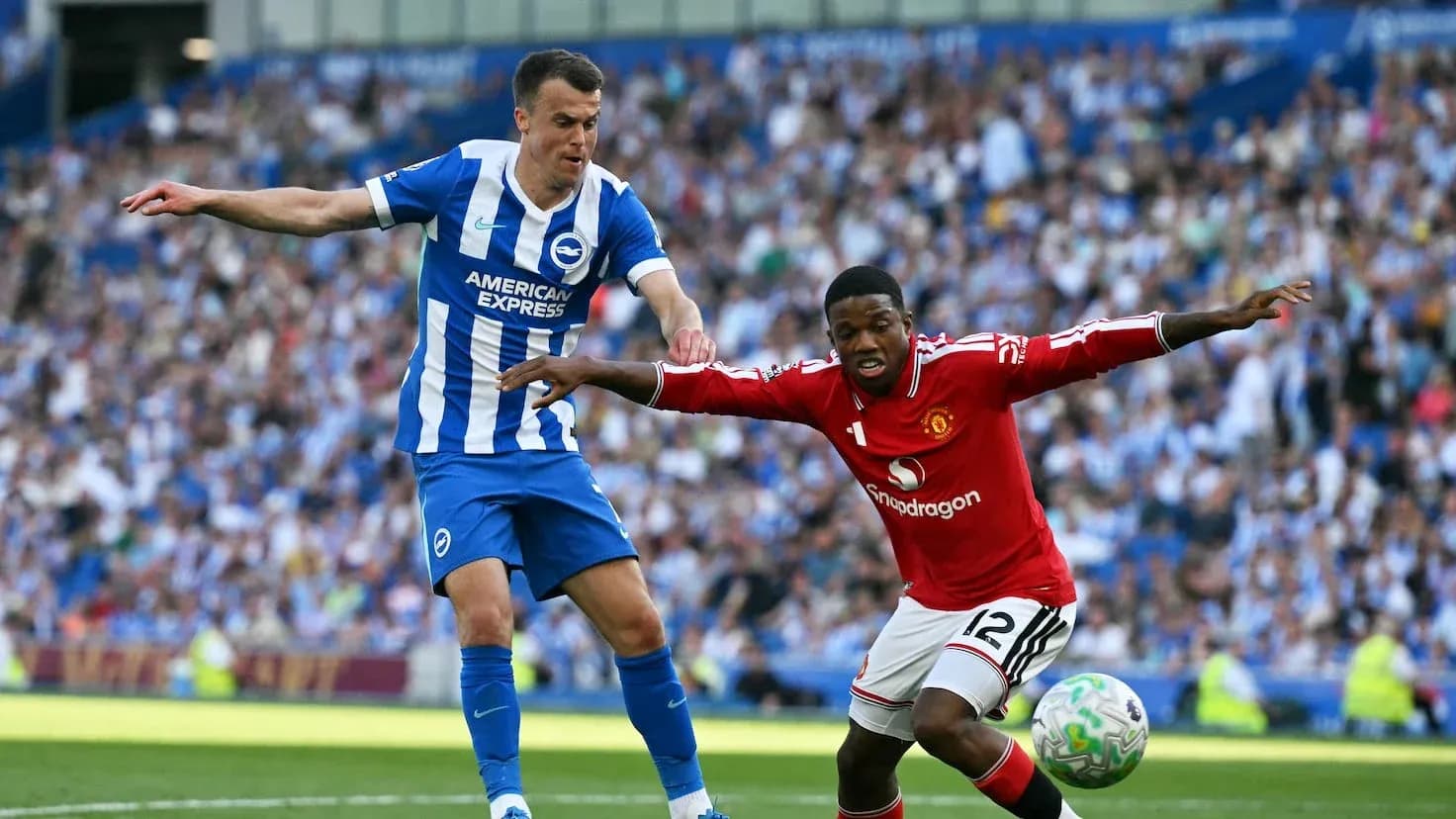
The second goal at 44' came from a similar pattern. A. Diallo’s assist for B. Mbeumo again punished Brighton’s rest defence. With both full-backs advanced and the double pivot stretched, United broke into the vacated half-spaces. Diallo’s positioning on the right side of the three behind Mbeumo consistently targeted the space behind De Cuyper, who was asked to push high as an extra midfielder. Once United got into those zones, their shot selection was notably cleaner: 7 shots on goal from 11 total, compared to Brighton’s 2 from 13.
Second Half Changes
After half-time, Hurzeler moved early to change the attacking dynamic. At 46', Y. Minteh (IN) came on for M. De Cuyper (OUT), adding a more direct, dribbling threat on the flank. Later, at 59', S. March (IN) replaced D. Gomez (OUT), C. Baleba (IN) replaced J. Milner (OUT), and C. Kostoulas (IN) replaced D. Welbeck (OUT), collectively tilting Brighton towards greater verticality and fresh legs in midfield. The intention was clear: inject pace and ball-carrying to destabilise United’s mid-block and increase penalty-box entries.
However, United immediately reasserted control with the third goal at 48', B. Fernandes scoring from a P. Dorgu assist. Again, the pattern was a quick, direct exploitation of Brighton’s advanced structure. At 50', VAR confirmed the goal after a check, but tactically the damage was already done: at 0-3, United could compress the field, lower the block, and protect central zones even more conservatively.
Defensively, Brighton’s back four struggled to balance aggression with cover. The 5 blocked shots show they got bodies in front of attempts, but the defensive line often lacked depth when dealing with United’s counters. The double pivot was overloaded by United’s fluid rotations: Fernandes drifting into pockets, Diallo coming inside, and Dorgu underlapping. This forced Gross and Milner – and later Baleba – into constant horizontal shifting, opening seams for line-breaking passes.
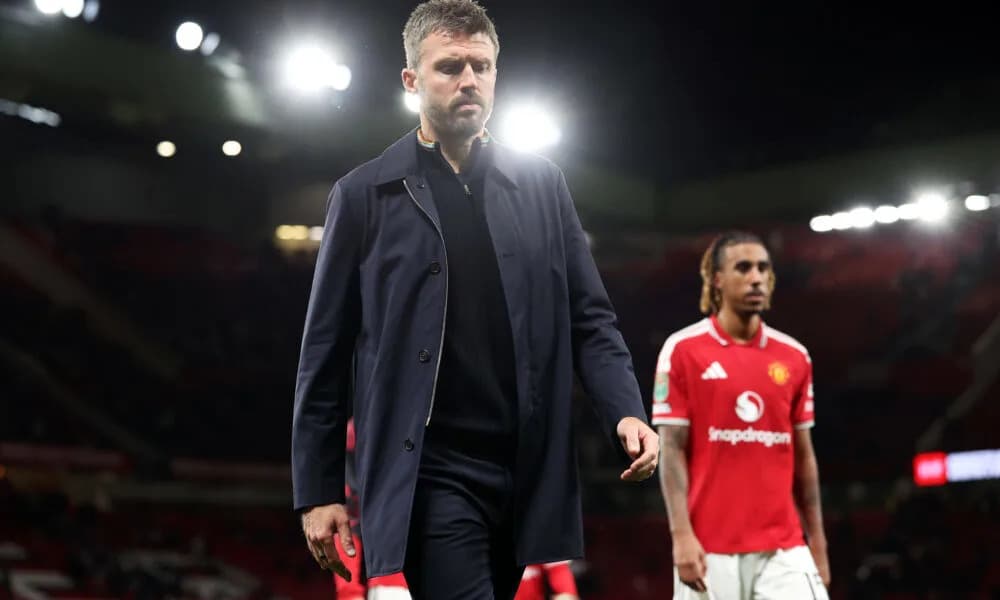
In contrast, United’s defensive management of the game was mature once ahead. The only card of the match – 45+3' Kobbie Mainoo (Manchester United) — Foul – came from a midfield duel just before half-time, underlining the combative but controlled nature of their central unit. With a three-goal cushion, Michael Carrick’s substitutions at 62' and 74' were about energy and stability: S. Lacey (IN) for P. Dorgu (OUT) at 62', then J. Zirkzee (IN) for B. Mbeumo (OUT), L. Yoro (IN) for N. Mazraoui (OUT), and T. Fletcher (IN) for M. Mount (OUT) at 74', followed by T. Malacia (IN) for L. Shaw (OUT) at 82'. These changes maintained intensity in the first line of pressure and added defensive security in the full-back and centre-back positions, closing off the flanks that Brighton tried to exploit through Minteh and March.
In goal, B. Verbruggen (Brighton) made 5 saves and posted 0.32 goals prevented, a reflection that, despite conceding three, he was repeatedly exposed to high-quality chances that came from structural issues in front of him rather than individual errors. At the other end, S. Lammens (Manchester United) was rarely threatened, needing just 2 saves. United’s defensive shape forced Brighton into lower-quality attempts, many of which were either blocked (1 blocked shot by United) or taken from less favourable positions despite the 9 shots inside the box.
Statistically, the match underlines a classic pattern: Brighton’s territorial control and passing accuracy did not translate into high-value chances, while United’s more modest volume of possession produced far more incisive attacking returns. Brighton’s 0.81 xG against United’s 1.82 xG maps almost exactly onto the 0-3 scoreline. United’s ability to turn midfield recoveries into immediate, well-supported attacks – with clear roles for Fernandes as the primary playmaker and Dorgu, Diallo and Mbeumo as vertical runners – defined the tactical story. Brighton’s late attacking substitutions increased tempo but could not alter the underlying dynamic: United’s compactness without the ball and their ruthless exploitation of space in transition made the 4-2-3-1 a far more effective tool for the away side.