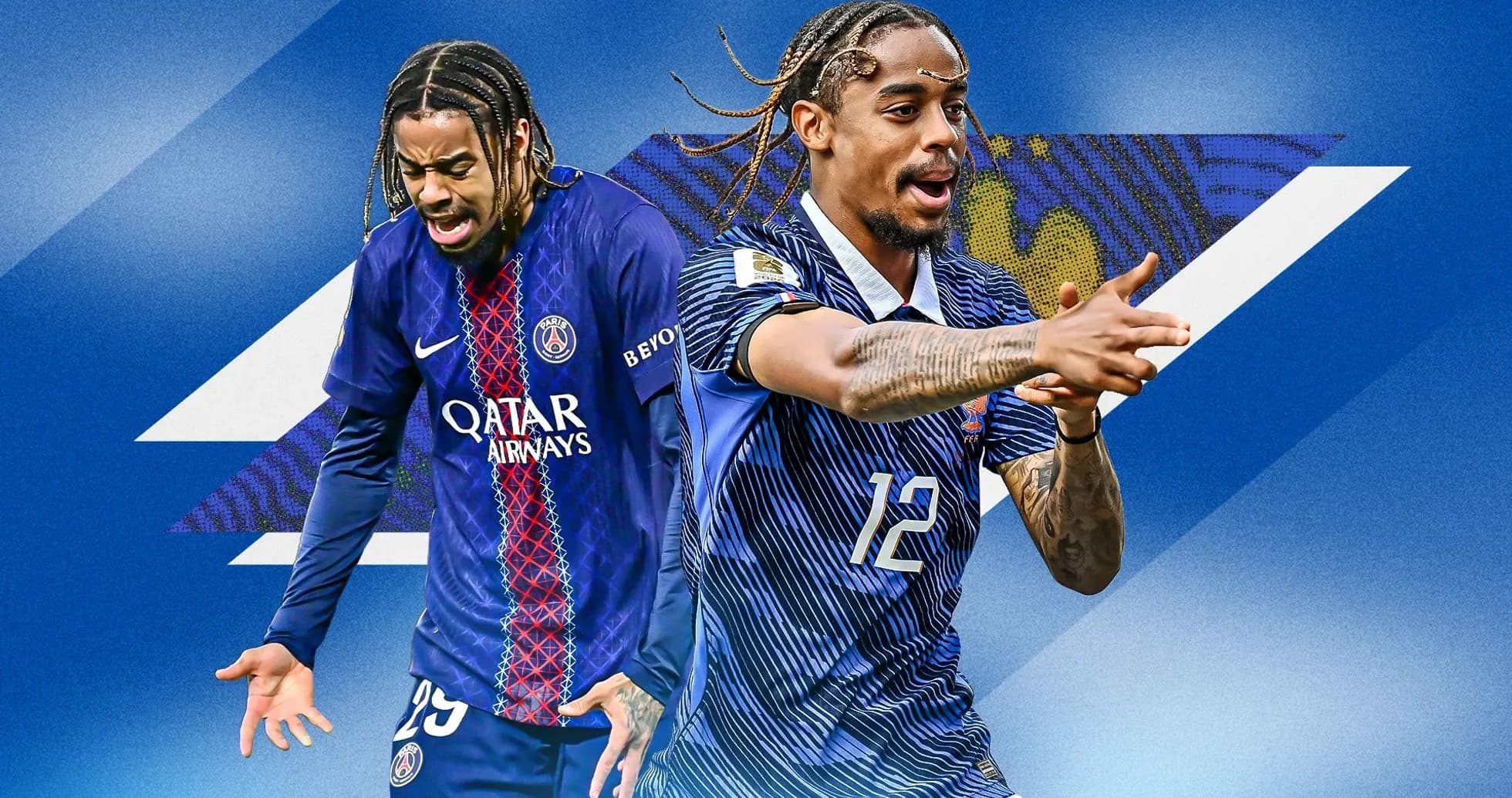
Bradley Barcola's PSG Struggles: From Rising Star to Rotation Piece
Bradley Barcola was supposed to be past this stage by now.
Three years on from swapping Lyon for the Parisian glare, the expectation was simple: locked-in starter, pillar of the project, the man to inherit the left flank after Kylian Mbappé’s departure. Instead, he finds himself living a strange half-life at PSG and a stop-start existence with France, his future increasingly defined by what might be rather than what is.
From rising star to rotation piece
The numbers say one thing, the team sheet another.
Barcola’s debut season in Paris was respectable enough, 14 goal contributions and flashes of the direct, fearless winger PSG thought they were getting. Then came the summer of 2024 and the post-Mbappé rebuild. Desire Doue arrived to compete on the left. By January 2025, Khvicha Kvaratskhelia swept into town, a blockbuster signing who instantly altered the hierarchy.
Barcola responded the way top players are supposed to. His 2024-25 campaign was outrageous on paper: 21 goals, 21 assists. Those are “build-the-team-around-him” numbers. Yet when the games grew heavier and the stakes climbed, he was pushed to the margins. He didn’t start the Champions League final against Inter. When he did make the XI in big matches, he rarely saw the final whistle. The trust never quite matched the output.
The pattern hardened last season. In 2025-26, his production collapsed to 13 goals and seven assists, and with it, his status. Luis Enrique rotated aggressively in Ligue 1, preserving his core for Europe, but Barcola was conspicuously absent from the inner circle. He did not start a single Champions League quarter-final, semi-final or final in another triumphant continental run. He stayed on the bench for marquee league fixtures against Lyon and Monaco in the first half of the season, watching the club’s domestic battles from the wrong side of the white line.
For a player of his age and ambition, that kind of role is more warning sign than inconvenience.
France’s nearly man
The same story now shadows him at international level.
Barcola could reasonably have imagined himself as France’s long-term answer on the left. Instead, his World Cup has distilled his entire career to date into a few weeks: decisive, talented, yet never fully trusted.
He did not start the opener against Senegal, a heavyweight tie against African opposition. When he did appear, he changed it. Two minutes after coming on, he scored what proved to be the winner, a sharp, clinical intervention that underlined his value as a game-breaker.
That cameo earned him a start against Iraq on matchday two. This was his chance to grab the shirt and keep it. He didn’t. The performance lacked the same edge, and Deschamps promptly sent him back to the bench for the final group game against Norway.
Again, he responded in the only way he knows: by influencing the match. Introduced with 25 minutes to play, Barcola delivered a pinpoint cross for Desire Doue’s late header, adding shine to the scoreline and reminding everyone of his quality in the final third.
Deschamps rewarded him with another start in the last-32 clash with Sweden. This time, Barcola cashed in. Benefiting from a virtuoso display by Michael Olise, he lashed home a fine second-half finish, a goal that felt like another argument in his favour.
He finally kept his place for the round-of-16 meeting with Paraguay. It should have been the moment he settled into the tournament. Instead, in a fractious 1-0 win, he faded. Anonymous in an ill-tempered contest, he did little to strengthen his case and now walks into a quarter-final against Morocco with his spot under threat yet again.
For a 23-year-old with this much ability, the stop-start rhythm is becoming a theme, not a phase.
Contract standstill and a shifting PSG stance
All of this unfolds against a complicated backdrop in Paris.
Barcola’s contract runs until 2028, but talks over an extension have stalled. The issue is not money; it is status. He wants clarity on his place in the pecking order at Parc des Princes, and right now, the answers are not reassuring.
Earlier in the summer, PSG’s line was unambiguous: Barcola was not for sale. Their valuation, according to reports, sat “much higher” than the £116 million Manchester City paid Nottingham Forest for Elliot Anderson, a fee that underlined how highly the European champions rated their winger.
That stance has softened. On his YouTube channel, transfer specialist Fabrizio Romano summed up the shift starkly: “Until last week, Barcola was untouchable; now I see him linked to several clubs. The reality is that Barcola is not untouchable. Barcola has serious possibilities to leave Paris in the summer transfer window.”
Something has clearly changed at PSG. The reason is not hard to find.
Diomande, the market opportunity and the financial reality
PSG see an opening in the market and intend to take it.
Diomande, the RB Leipzig and Ivory Coast sensation, has emerged as one of the standout talents of the 2025-26 season. Liverpool were widely reported to be leading the race for the 19-year-old, lining up a deal in the region of €100m. Then came the twist: Diomande, it emerged, prefers Paris.
The teenager believes that Luis Enrique’s project offers the best path to trophies and, potentially, the Ballon d’Or. PSG, never shy when it comes to chasing star power, have moved towards the front of the queue.
Leipzig, though, are in no mood to discount. Their valuation stands at an eye-watering €130m. Even for PSG, that figure demands some accounting. Gonçalo Ramos has already been sold to AC Milan. Lee Kang-in is on his way to Atletico Madrid. To go any further, the club may need another significant departure.
At the same time, Barcola is looking at the likely arrival of another high-profile attacking talent and seeing his minutes squeezed even more. If he already feels peripheral, what happens when Diomande walks through the door?
The alignment is obvious: PSG need to balance the books; Barcola needs a platform. The door that was once bolted now looks ajar.
Anfield calling?
Liverpool, ironically, could end up the winners from losing Diomande.
The club are reshaping their attack in the wake of Mohamed Salah’s departure. Victor Munoz has already arrived, and new manager Andoni Iraola must handle the development of wonderkid Rio Ngumoha carefully, with the teenager not turning 18 until late August. The need for a ready-made, high-level wide forward is glaring.
Barcola fits that profile.
At Anfield, he would walk into a situation that offers what PSG no longer can: near-guaranteed starter status on one of the biggest stages in world football. His Champions League experience means he would not be learning on the job. He has already lived the pressure of knockout nights, even if too often from the bench.
Stylistically, he looks a strong match for Iraola’s high-intensity, vertical football. Barcola’s direct running, ability to attack space and final-ball quality would give Liverpool an immediate weapon on the flank. Crucially, he has the star wattage the club craves to soften the blow of losing Salah. Among the realistic options on the market, there are not many who tick as many boxes.
For PSG, cashing in on a player they have never fully embraced as a cornerstone could fund a marquee move for Diomande. For Liverpool, it would be a statement signing with less risk than a raw 19-year-old making his first jump to the elite. For Barcola, it would be a reset.
The transfer starts to look less like a gamble and more like an inevitability waiting for a fee.
“Honestly, I don’t know”
If there was any lingering doubt about how Barcola views his situation, he addressed it — as much as any player can during a major tournament — at a France press conference before the Paraguay tie.
“Right now, I’m really focused on the World Cup,” he said. “But regarding what happens afterward, honestly, I don’t know at the moment.”
That is as close as it gets to an admission of uncertainty. No declarations of loyalty. No insistence that he will fight for his place in Paris at all costs. Just an open question hanging over the summer.
What is clear is that Diomande’s likely arrival in Paris threatens to push Barcola even further to the fringes. For a winger who has already shown he can produce elite numbers when trusted, another year of half-starts and late cameos would be a waste.
He needs a stage. PSG are moving on. Liverpool are searching. The next decision he makes will define whether he remains a luxury rotation piece in Paris — or finally becomes the leading man his talent demands somewhere else.