Boavista: The Rise and Fall of a Portuguese Football Icon
Boavista are gone. Not relegated, not restructured, not rebranded. Extinct.
A court order delivered on 16 July 2026 told the Porto club to cease all activities by 31 July and hand over their premises, the final act in a slow, painful collapse brought on by years of unpaid debts and failed restructuring. A century-old institution, champions of Portugal in 2001, wiped from the professional map.
For Celtic supporters, the name Boavista carries a very different weight: floodlit European nights, tight margins, and the sound of Henrik Larsson dragging his team towards Seville.
Now those memories outlive the club that helped create them.
The first meeting: Dalglish, Deans and history in hoops
Celtic’s relationship with Boavista began long before that snarling, suffocating UEFA Cup semi-final in 2003.
The first encounter came in the Cup Winners’ Cup in 1975. Over two legs, Celtic edged the Portuguese side 3-1 on aggregate, a tie remembered as much for its historical footnote as for the scoreline.
In Porto, the sides cancelled each other out in a 0-0 draw. It set up a decisive night at Celtic Park a fortnight later, when Jock Stein’s men found their stride. Kenny Dalglish, Shuggie Edvaldsson and Dixie Deans all scored in a 3-1 win that pushed Celtic through and underlined the gulf in class at that time.
That game also marked a quiet revolution in the club’s visual identity. For the first time, Celtic wore squad numbers on the back of those iconic hooped jerseys. A small detail, perhaps, but one that stitched Boavista into the fabric of Celtic history before the rivalry ever felt like a rivalry.
Larsson, the semi-final and a road to Seville
For most Celtic fans, though, Boavista will forever be tied to one spring in 2003.
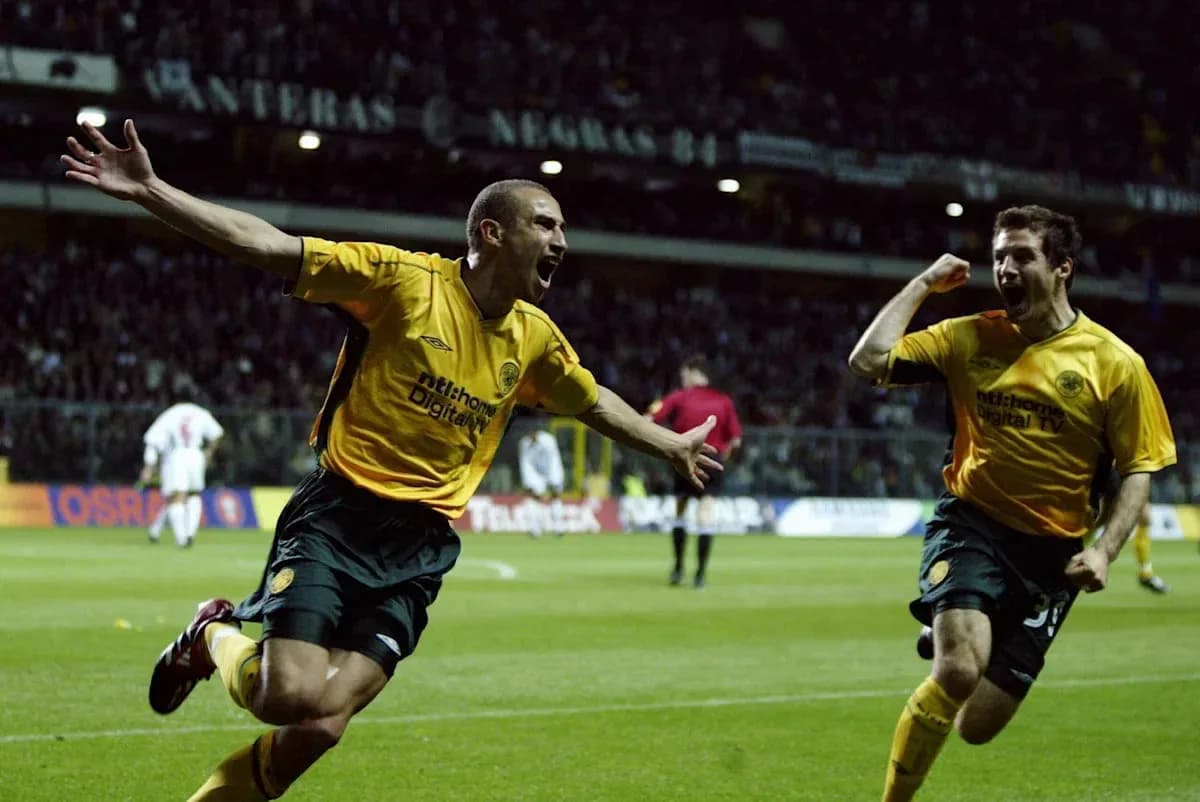
The UEFA Cup semi-final felt like a throwback: two-legged, tight, tactical, with every mistake magnified. At Celtic Park on 10 April, the first leg ended 1-1, a frustrating result on paper but one rescued by a familiar figure. Henrik Larsson, once again, refused to let the occasion drift away, scoring the equaliser to keep Celtic alive in the tie.
The second leg in Porto on 24 April turned into a test of nerve. Boavista, disciplined and awkward, tried to smother the game and the dream. Celtic pushed, probed, ran into dead ends. The tension grew.
Then Larsson struck.
His goal in the Bessa Stadium delivered a 1-0 win on the night and a 2-1 aggregate victory. It booked Celtic’s place in a European final for the first time since 1970, against Boavista’s city neighbours Porto. The final in Seville still stings; many would rather gloss over what happened there. But the route to that night ran straight through Boavista, and through Larsson’s cold-blooded finishing.
Martin O’Neill’s embrace with his talisman at full-time in Porto captured it perfectly: relief, release, and the sense that Celtic had just stepped back onto the European stage with intent.
The outsiders who broke the Big Three
Boavista were never meant to sit at the same table as Benfica, Porto and Sporting Lisbon. Yet, for a fleeting moment at the turn of the century, they did more than that.
Founded in 1903, the club built a reputation as a stubborn, streetwise outfit, awkward to play against and fiercely backed in their corner of Porto. Their peak came in 2001, when they won the Primeira Liga and shattered the domestic monopoly. To this day, they remain the only club outside Portugal’s “big three” to have lifted the league title.
Nine major honours in total. A black-and-white chequered shirt recognised across Europe. A team that, at their best, embodied defiance.
That same defiance couldn’t save them from what came next.
Transfer bans, chaos and a slow fall
Boavista’s troubles didn’t arrive overnight. Financial problems had been simmering for years, but the last stretch was brutal.
Hit with a ban on signing players across five transfer windows, the club lurched from one crisis to another. When that restriction finally lifted, the response was desperate: nine signings in a single day in February 2025, a flurry that spoke of panic rather than planning.
On the pitch, the slide continued. In the 2024/25 season, Boavista finished bottom and were relegated after a 4-1 defeat away to Arouca on the final day. Around 2,000 travelling fans watched the team crumble, then some of them spilled onto the pitch in a raw, angry invasion that felt like a breaking point.
It got worse. The Portuguese league authority barred Boavista from playing in Liga Portugal 2. Oliveirense, who had been relegated, were handed a reprieve. Boavista were refused registration for both the third tier and the fourth-tier Campeonato de Portugal in 2025.
The solution was messy. A new company structure emerged, and with it a fresh start of sorts in the Liga Pro, the new elite league of the Porto Football Association. The original club, trying to cling to its identity, entered a team in the fourth division of the district leagues, a move intertwined with a supporters’ group of the same name.
Even that didn’t last. Failing to turn up for fixtures led to losses by default, and by the end of October the club-run team had withdrawn from competition altogether.
The writing was on the wall long before the court order arrived.
A court order and a club erased
On 16 July 2026, the legal hammer finally fell. Boavista were ordered to cease all activities by 31 July and surrender their premises. The insolvency process, tied to unpaid obligations to creditors and failed attempts to restructure, reached its inevitable conclusion.
In simple terms: Boavista didn’t pay their debts. The punishment wasn’t a points deduction or another relegation. It was oblivion.
For Celtic supporters, the news lands with a strange mix of nostalgia and unease. Those nights in 1975 and 2003 are now chapters in a story that no longer has a living author. The club that once blocked Celtic’s path, then opened the door to Seville, now exists only in memory, archives and old photographs.
Football, of course, has seen this before. Names disappear, then re-emerge with a tweak: a “newco”, a suffix, a fresh badge. Maybe “The Boavista FC” will rise from the ashes, backed by fans who refuse to let the chequered shirts vanish.
But the original Boavista, league champions and European semi-finalists, have been consigned to history. And for anyone who watched Larsson wheel away in Porto that night in 2003, it’s hard not to wonder how a club that once stood so tall ended up with nothing but a court order and a locked gate.