Barcelona Dominates Athletic Club in La Liga 2026
Under the late-summer lights of Camp Nou, Barcelona’s 2–0 win over Athletic Club felt less like a narrow contest and more like a controlled statement of intent. In Regular Season - 1 of La Liga 2026, Hansi Flick’s side leaned on structure, youth and a razor-sharp front line to extend a perfect start that already has them sitting 2nd in the table with 6 points and a goal difference of 7 from 7 goals scored and 0 conceded overall. Athletic, by contrast, leave Barcelona rooted in 19th with 0 points and a goal difference of -4 after scoring just 1 and conceding 5 in total.
I. The Big Picture – Flick’s Blueprint vs Terzic’s Resistance
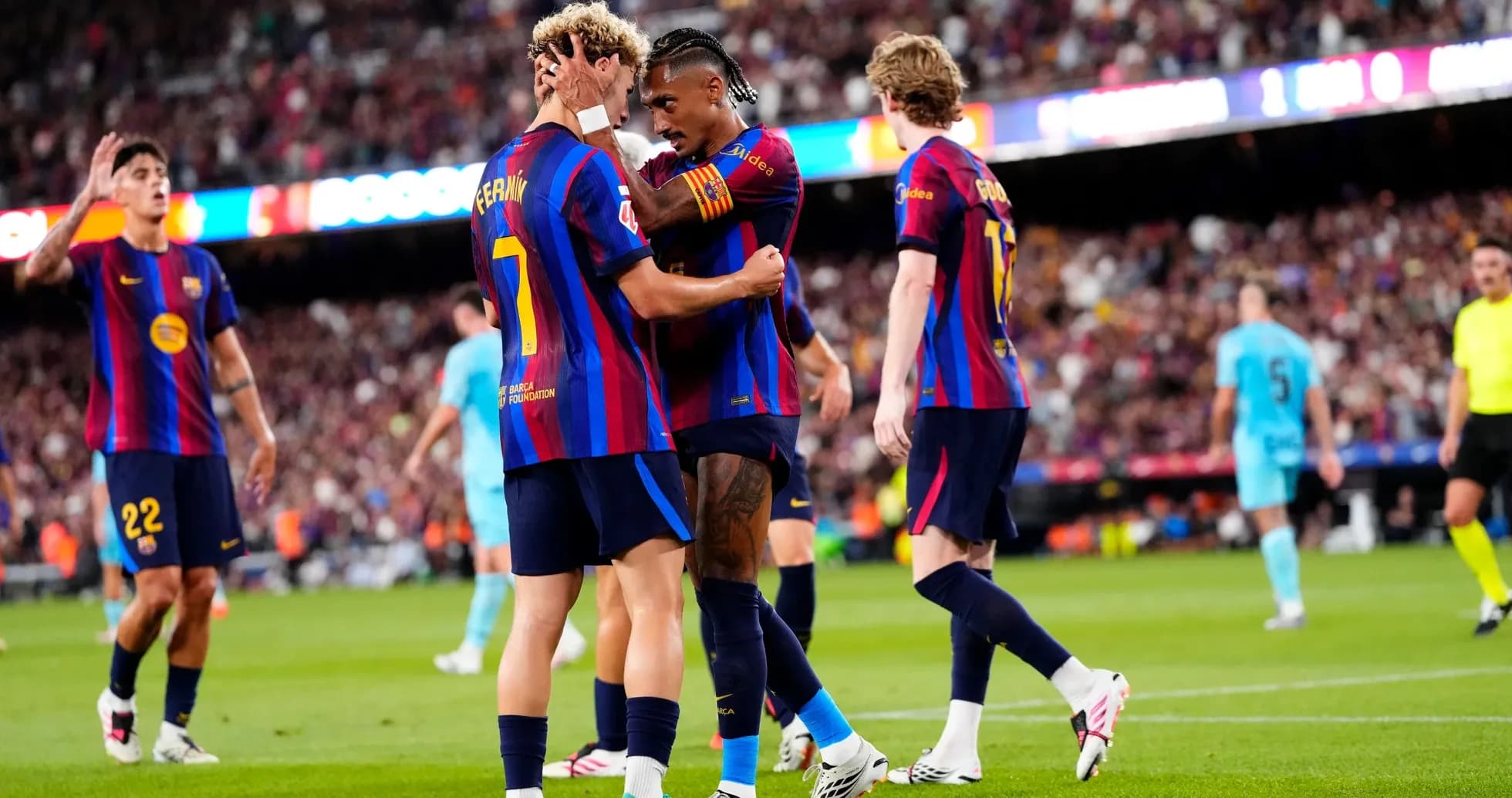
Flick doubled down on his preferred 4‑3‑3, a shape that Barcelona had already used once this season and which now looks like the template for a new era. J. Garcia in goal sat behind a back four of X. Espart, G. Martin, P. Cubarsi and E. Garcia. Ahead of them, a midfield trio of Pedri, M. Bernal and Fermín offered the technical heartbeat, while the front three of A. Gordon, Raphinha and Lamine Yamal stretched the pitch horizontally and vertically.
The numbers coming into this game already framed the narrative. Barcelona had won both of their opening fixtures, with 2 goals scored and 0 conceded at home, and 5 scored and 0 conceded on their travels. An average of 2.0 goals at home and 5.0 away, with 3.5 in total, underlined an attack that doesn’t simply edge games – it overwhelms them. Defensively, 0.0 goals conceded on every front spoke of a unit that, even without key names, was functioning with ruthless clarity.
Edin Terzic’s Athletic arrived in a very different mood. Two defeats from two, 1 goal scored and 5 conceded in total, with 1–3 at home and 0–2 away, painted the picture of a side trying to reconcile a proactive 4‑2‑3‑1 with a back line still finding its bearings. At Camp Nou, Terzic stuck to that 4‑2‑3‑1: U. Simon in goal; a back four of J. Louis-Jean, A. Laporte, Y. Alvarez and H. Rincon; a double pivot of P. Canales and M. Jauregizar; and an attacking band of N. Williams, O. Sancet and I. Williams behind lone striker G. Guruzeta.
II. Tactical Voids – Absences and Discipline
The teamsheets revealed the structural bravery behind Barcelona’s performance. Flick had to navigate a midfield and leadership vacuum: F. de Jong and Gavi both missed out with knee injuries, stripping the side of two of its most established controllers. Depth options R. Bardghji, M. Casado and H. Fort were also unavailable, while D. Livakovic remained inactive. That placed an even greater onus on Pedri’s orchestration and Fermín’s two-way energy.
Athletic’s problems were more defensive and structural. U. Egiluz (knee injury), D. Vivian (hamstring injury) and A. Gorosabel (muscle injury) all missed the trip, removing three potential pieces from Terzic’s defensive puzzle. B. Prados Diaz (thigh injury) and N. Serrano (coach’s decision) further thinned the options in midfield and attack.
Disciplinary trends added another layer. Heading into this game, Barcelona’s card profile was almost spotless: just a single yellow card in the 16–30 minute window and no reds at all. Athletic, however, carried a more volatile record. Their yellow cards were spread evenly – 25.00% in each of the 16–30, 46–60, 61–75 and 76–90 minute ranges – suggesting a side that tends to foul consistently as matches wear on. More ominously, they had already seen one red card in the 0–15 minute window, through Yuri, whose dismissal after just 11 minutes in a previous match had left a tactical scar. That volatility forced Terzic to be more conservative at Camp Nou, even as his team chased the game.
III. Key Matchups – Hunters and Shields
The contest was always going to be shaped by Barcelona’s attacking trident and their emergent midfield star.
Fermín, already one of La Liga’s standout performers, arrived with 3 goals from midfield, 5 shots all on target and an 8.15 average rating. His 76 passes at 82% accuracy and 18 duels (10 won) mark him out not just as a late-arriving scorer but as a high-intensity connector. Against Athletic’s double pivot of Canales and Jauregizar, Fermín’s freedom to drift between lines and attack the box was the central “Engine Room” battle. With Athletic conceding 3.0 goals at home and 2.0 away on average, their overall 2.5 goals conceded per match was a red flag against a midfielder who times his surges with such precision.
On the flanks, Raphinha and A. Gordon embodied the “Hunter vs Shield” narrative. Raphinha entered this fixture with 3 goals and 1 assist in just 143 minutes, 5 shots (4 on target) and 6 key passes, all while converting the only penalty Barcelona had been awarded this season. That perfect penalty record – 1 scored from 1, 0 missed – underlined his composure in decisive moments. Gordon, meanwhile, led the league’s creative charts for Barcelona with 2 assists, 3 key passes, 3 successful dribbles from 3 attempts and 91% passing accuracy. Together with Lamine Yamal’s directness, they pinned back J. Louis-Jean and H. Rincon, forcing Athletic’s full-backs to defend deeper than Terzic would have liked.
For Athletic, G. Guruzeta embodied both effort and edge. With 2 yellow cards already, he was among La Liga’s leading card collectors, but also a tireless reference point: 19 duels contested, 8 won, and 23 passes attempted. Up against P. Cubarsi and E. Garcia, his task was to occupy both centre-backs and create space for the Williams brothers to attack from wide. Yet with Barcelona having kept clean sheets in both their home and away games so far, and with 2 clean sheets in total this season, the Catalan back line once again proved an efficient shield, limiting Guruzeta’s influence and protecting J. Garcia.
IV. Statistical Prognosis – A Controlled Superiority
Following this result, the numbers only harden the narrative. Barcelona remain flawless in La Liga 2026: 2 wins from 2 overall, 2.0 goals scored at home and 5.0 away on average, 0.0 conceded everywhere. Their biggest wins – 2–0 at home and 5–0 away – now have a companion in this 2–0, reinforcing a pattern of clean, controlled victories rather than chaotic shootouts. They have yet to fail to score in any competition game this season and have not conceded a single goal, an almost ideal statistical platform for a title challenge.
Athletic, conversely, stay winless, with 0 points from 2 matches, 0.5 goals scored and 2.5 conceded on average in total. They have not kept a clean sheet and have already failed to score once, away from home. The even spread of yellow cards across the 16–90 minute range and the early-season red underline a side that spends long stretches under pressure and often responds with fouls rather than control.
Tactically and statistically, this felt less like a narrow 2–0 and more like a confirmation of trajectories. Barcelona’s 4‑3‑3, powered by Fermín’s surges, Pedri’s rhythm and the Raphinha–Gordon–Lamine axis, looks sustainably dangerous. Their defensive record, anchored by Cubarsi and E. Garcia and protected by a disciplined midfield, remains pristine.
For Athletic, the 4‑2‑3‑1 offers promise in theory, with the Williams brothers and Sancet capable of hurting anyone in transition. But until Terzic can stabilise a back line shorn of key defenders and temper the disciplinary lapses that have already produced one red and multiple bookings, nights like this at Camp Nou will continue to feel like uphill climbs against a side that is, statistically and structurally, already operating at Champions League level.