
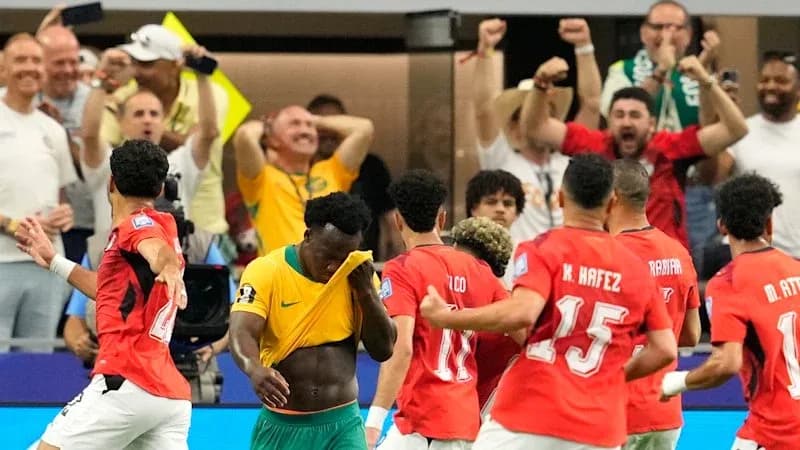
Australia Faces Egypt: A Goal Down at Half-Time
Australia walked into the break a goal down, bruised, aggrieved and yet somehow still very much alive.
Egypt led 1-0 at half-time, a cheap goal from a set piece prising open a game the Socceroos had largely controlled in open play. It was the kind of concession that cuts deeper because it goes against a team’s identity. Australia pride themselves on set-piece discipline. Here, they were slow to push out, possibly keeping the scorer onside, and paid full price.
The response from the Australian camp at the interval said plenty. There was frustration with the officiating – a sense that the referee played advantage on a foul but never came back to book the offender – but also a clear-eyed acceptance that the real fix lay with them. The message was simple: keep the ball, stitch together five, six, seven passes, and the pockets of space will open. Do that, and the chances will follow.
They already had, to a point. The most threatening side in open play looked like Australia, before and after the Egyptian goal. The problem was not getting into good areas. It was what happened when they arrived.
Egypt sit deep, Australia chase
The goal gave the Pharaohs exactly what they wanted: something to protect. From that moment they dropped in, tightened the lines and invited Australia to solve the puzzle. They were combative in the challenge and cynical in the dark arts, squeezing every second out of stoppages and embellishing contact when it suited. It worked. It also infuriated.
Five minutes of added time at the end of the half felt insultingly light given a three-minute hydration break, a goal and repeated bouts of Egyptian time management. The Socceroos could read it two ways: a refereeing slight, or a backhanded compliment to the threat they posed.
Mo Salah, the headline name on the pitch, stayed largely on the fringes of the contest. The hamstring tightness that had shadowed his build-up appeared to temper his usual explosiveness, but his mind remained sharp. On one foray he peeled off Harry Souttar’s shoulder, darting in behind with the kind of timing that has tormented defenders across Europe, only for Bailey Herrington to recover and snuff out the danger. Egypt’s goal had not come from Salah magic. It had come from Australia switching off.
Openings, collisions and a costly blow
For all Egypt’s compactness, Australia still carved out moments. Aziz Behich sparked one of the best, driving at Ahmed Hany down the left inside Egypt’s defensive third. The move ended with a long throw from Alessandro Circati hurled into a crowded box. Jackson Irvine and Souttar both climbed but couldn’t get a clean touch. Herrington flicked on, Nestor Irankunda recycled it, and Behich, now on the edge, drilled a low strike that forced the goalkeeper into a sharp save at his right post.
Irankunda nearly turned another half-chance into something more moments later, a reminder of the raw, unpredictable threat he brings when given a yard.
At the other end, Egypt continued to live off moments and dead balls. Ashour went to ground under an errant arm from Jordan Bos, winning a free kick that drew more Australian ire. Salah stood over it, but rather than whip it towards goal he nudged a short pass square to Attia, whose long-range drive was clean and powerful. Australia’s back post cover held firm.
Then came the flashpoint in the box. Australia worked the ball into a crowded area, where a weak header on goal squeezed between two defenders. Ali Rabia appeared to make contact with the ball on his arm – more ball-to-arm than deliberate handball – and play rolled on. Nestor, feeling he had a case, gestured to his own arm, imploring the officials to take another look. At the back post, Cristian Volpato was dragged down by Havez. Again, nothing. Two penalty shouts in one sequence, both waved away.
The half took an even darker turn for Australia when Bos, one of their most dynamic outlets, went down and stayed there. As trainers rushed on, the concern was immediate. He eventually rose but could not put weight on his left foot and had to be helped from the field by two staff members. On the balance of the first 45 minutes, losing him felt like more than just a substitution. It was a tactical and emotional blow.
A game still there to be taken
Egypt’s 1-0 lead at 45+3 minutes felt fragile rather than definitive. They had forced Australia to run, to chase, to work for every metre, but they had not killed the contest. Their advantage came from capitalising on a single lapse. The Socceroos, for all their annoyance at the whistle and the theatrics, knew they had enough of the ball and enough of the territory to do the same.
The equation heading into the second half was stark. Keep possession longer. Turn those promising passages into ruthless final actions. Stay switched on at set pieces. And, above all, make sure the next big moment belongs to them, not to a Pharaoh in red.





