Aston Villa's Tactical Masterclass Against Manchester City
Manchester City’s 1-2 defeat to Aston Villa at Etihad Stadium was defined less by volume of possession and shots, and more by Villa’s superior structure in both boxes. In a match where City held 52% of the ball and out-shot Villa 16-12, Unai Emery’s side were more efficient, generated higher xG (1.58 to City’s 1.25), and managed key moments with greater clarity.
Pep Guardiola set City up in a 4-2-2-2 that in practice resembled a fluid, high-possession shape. J. Trafford (Manchester City) was the starting goalkeeper, behind a back four of R. Lewis, J. Stones, R. Dias and N. Ake. Nico and B. Silva formed the double pivot, with A. Semenyo and Savinho as advanced midfielders underneath a front pairing of P. Foden and T. Reijnders. The idea was clear: overload central zones with technical profiles, use Semenyo and Savinho between lines, and allow Foden and Reijnders to roam into pockets rather than stay as fixed strikers.
The plan initially worked. City’s 10 shots inside the box and 9 corners reflect a side able to pin Villa back and attack the area repeatedly. The opening goal on 23 minutes from A. Semenyo, for Manchester City, crystallised that dominance: City were able to occupy Villa’s double pivot and back line, creating the conditions for a midfielder arriving from deeper zones to finish. Even without an official assist, the pattern fit the structure — midfield runners exploiting Villa’s defensive shifting.
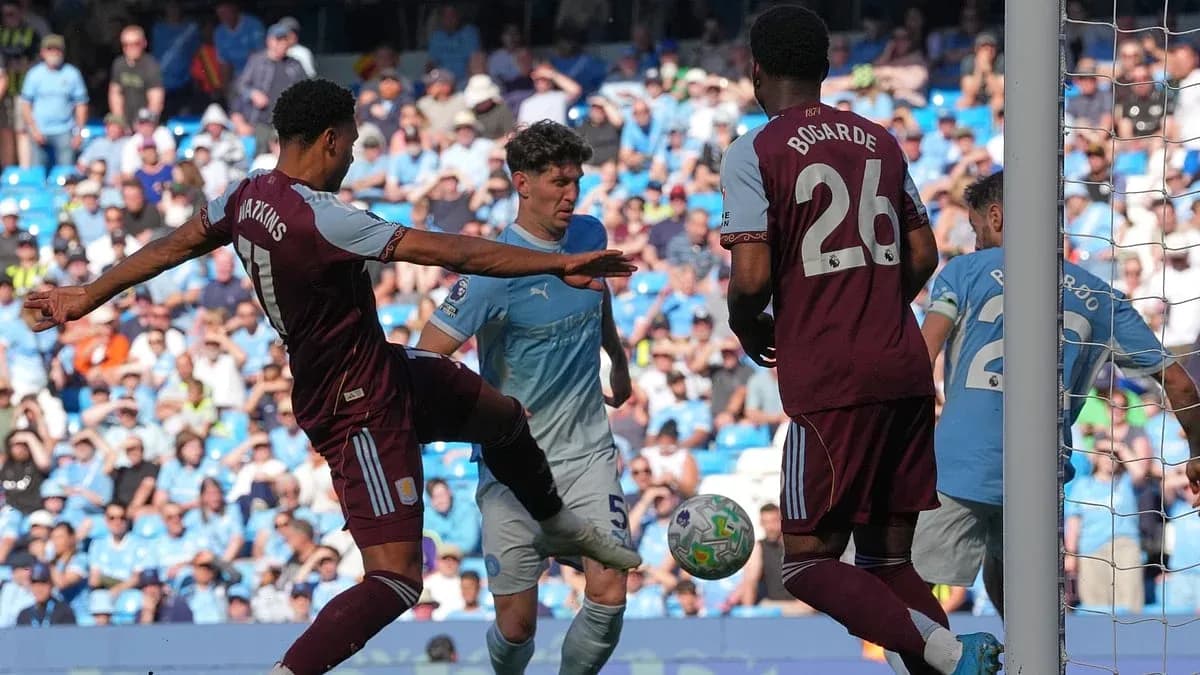
Defensively, City’s high line and aggressive positioning of full-backs were a double-edged sword. With only 8 fouls committed, City tried to defend largely through counter-pressing and compactness rather than breaking play cynically. But once Aston Villa found their timing in transition, that approach began to unravel. O. Watkins’ equaliser at 47 minutes came just after half-time, a classic Emery punch immediately after the restart. Villa’s 4-2-3-1, with L. Bogarde and Douglas Luiz as the deeper midfielders and R. Barkley, L. Bailey and E. Buendia behind Watkins, was built to spring forward quickly once the first line of pressure was broken.
Villa’s structure grew stronger as the game progressed. They took only 12 shots to City’s 16, but 9 of those were inside the box, almost matching City’s 10. This tells the tactical story: while City’s possession and territory were sustained, Villa’s attacks were more selective and higher quality. Their xG edge (1.58 vs 1.25) confirms that their shot profile was superior despite fewer attempts.
The second Watkins goal at 61 minutes, assisted by R. Barkley, encapsulated Villa’s tactical maturity. Barkley, operating as the central attacking midfielder, exploited the spaces that opened between City’s lines as Guardiola pushed for a second goal. With City’s double pivot stretched and full-backs high, Villa could play through or around the first press, then feed Watkins attacking a destabilised back line. VAR confirmed this goal at 63 minutes, underlining that it came from a clear, repeatable pattern rather than a chaotic moment.
From the bench, Guardiola’s changes were aimed at re-energising the attack and adding ball progression. R. Cherki (IN) came on for A. Semenyo (OUT) at 58', followed by M. Kovacic (IN) for B. Silva (OUT) at 59'. Later, J. Doku (IN) replaced T. Reijnders (OUT) at 77', R. Ait-Nouri (IN) came on for N. Ake (OUT), and J. Gvardiol (IN) for J. Stones (OUT). Collectively, these moves tilted City even more towards an aggressive, possession-heavy setup, but they also increased the risk in rest defence. The late VAR intervention at 90+2', when a potential goal by Phil Foden was disallowed, showed City could still carve out big moments, yet the structural exposure behind the ball remained a constant threat.
Emery’s substitutions were more conservative and control-oriented. For Aston Villa, M. Cash (IN) came on for A. Garcia (OUT) at 46', giving Villa fresh legs and defensive solidity on the flank just as City were preparing their second-half push. At 73', Y. Tielemans (IN) replaced Douglas Luiz (OUT), P. Torres (IN) came on for V. Lindelof (OUT), and A. Onana (IN) entered for L. Bogarde (OUT), a triple adjustment that refreshed central zones and back line simultaneously. J. McGinn (IN) for R. Barkley (OUT) at 86' added late-game work rate and ball retention. These moves collectively shifted Villa into a more compact, game-management mode, protecting the 2-1 lead by reinforcing the spine and wide defensive coverage.
In goal, J. Trafford (Manchester City) made 3 saves, while M. Bizot (Aston Villa) registered 2. The raw save counts, combined with the xG figures, underline how Villa’s finishing and chance quality tilted the match: Trafford faced fewer total shots on target (5) than City generated (3 against Bizot), but Villa’s attempts were more dangerous on average. Both goalkeepers had identical goals prevented values (0.28 for each team’s block), suggesting neither dramatically overperformed or underperformed their shot-stopping expectation; the difference lay in how often their defences allowed clean looks.
Discipline also reflected the tactical identities. City collected 1 yellow card, shown to Rico Lewis at 82' for “Foul”, while Villa finished without a booking. That single caution, in a match where City were chasing and Villa were protecting a lead, hints at City’s increasing desperation to break Villa’s rhythm, contrasted with Villa’s controlled, low-foul approach (4 fouls total).
Passing data reinforces the narrative of finely balanced control rather than overwhelming dominance. City attempted 458 passes, completing 405 for an 88% success rate. Villa were almost as involved in possession with 436 passes, and even more precise at 90% accuracy (394 accurate). Rather than a one-sided siege, this was a high-level contest of two possession-capable sides, with Villa comfortable enough on the ball to evade pressure and construct attacks rather than simply clear long.
Ultimately, the statistical verdict matches the tactical impression: Manchester City generated volume and territory but not enough clear superiority in chance quality. Aston Villa, with a slightly lower share of the ball but sharper xG, better exploitation of transition spaces, and a more conservative, game-state-aware substitution pattern, deservedly converted their structural advantages into a 2-1 away win on the final day.