AS Roma Dominates Fiorentina 4-0: A Tactical Breakdown
Under the lights of the Stadio Olimpico, this Serie A night became a statement. In a season where AS Roma have built a solid identity, this 4-0 home dismantling of Fiorentina felt like the distilled version of their 2025 campaign: a ruthless, vertical side thriving in a three-at-the-back structure, imposing themselves on a vulnerable visitor whose season-long fragility finally cracked.
I. The Big Picture – Roma’s structure, Fiorentina’s fault lines
Following this result, Roma sit 5th with 64 points and a goal difference of 23, built on 52 goals scored and 29 conceded overall. At home, their profile is that of a genuine Europa League contender: 18 matches, 12 wins, only 3 defeats, with 31 goals for and just 10 against. An average of 1.7 goals scored at home, combined with only 0.6 conceded, has made the Olimpico a controlled fortress rather than a chaotic cauldron.
Fiorentina arrive at this stage of the season in a very different place. They are 16th on 37 points, with a goal difference of -11 (38 scored, 49 conceded overall). On their travels they have played 18 times, winning only 4, losing 8, with 18 goals scored and 29 conceded. That away average of 1.0 goal for against 1.6 against paints the picture: they can compete in moments, but structurally they are porous, particularly once the game stretches.
Roma’s 3-4-2-1 under Piero Gasperini Gian was once again the tactical spine: M. Svilar behind a back three of G. Mancini, E. Ndicka and M. Hermoso; Z. Celik and Wesley Franca as wing-backs; N. Pisilli and M. Kone as the central hinge; M. Soule and B. Cristante floating behind lone striker D. Malen. Fiorentina’s Paolo Vanoli chose a 4-3-3: D. de Gea in goal, a back four of Dodo, M. Pongracic, L. Ranieri and R. Gosens, with M. Brescianini, N. Fagioli and C. Ndour in midfield, and a front three of J. Harrison, A. Gudmundsson and M. Solomon.
II. Tactical Voids – Absences and discipline
Both squads came into this fixture scarred by absences. Roma were without A. Dovbyk (groin injury), N. El Aynaoui (yellow card suspension), E. Ferguson (ankle injury), L. Pellegrini (thigh injury) and B. Zaragoza (knee injury). That stripped Gasperini of a natural penalty-box reference, a key midfield conductor and an influential captain, forcing him deeper into the flexibility of his 3-4-2-1. It also elevated the importance of Malen’s movement and Soule’s creativity between the lines.
Fiorentina’s issues were just as severe. L. Balbo, N. Fortini, M. Kean, T. Lamptey and R. Piccoli all missed out, removing depth in attack and energy in the wide areas. Kean’s absence in particular robbed Vanoli of his primary penalty-box threat and a forward who had contributed 8 league goals and 2 penalties scored. Without him, the burden fell more heavily on Gudmundsson and Solomon to both stretch the pitch and finish moves.
Disciplinary trends shaped the emotional undercurrent. Roma’s season-long yellow card distribution is heavily clustered between 46-90 minutes, with 23.08% of their cautions in each of the 46-60, 61-75 and 76-90 ranges. Fiorentina, by contrast, tilt even later: 25.00% of their yellows arrive between 76-90, and both of their red cards this season have also come in that 76-90 window. With Gudmundsson already carrying a red this campaign and Z. Celik sent off once for Roma, the second half was always likely to be a psychological test as much as a tactical one.
III. Key Matchups – Hunter vs Shield, Engine Room battles
Hunter vs Shield
D. Malen came into the night as one of Serie A’s sharpest forwards: 11 league goals in 15 appearances, with 2 penalties scored from 2, 40 shots in total and 24 on target. His 7.32 average rating underlines his influence; he is not just a finisher, but a constant reference for vertical attacks.
His “shield” was Fiorentina’s central pairing of M. Pongracic and L. Ranieri. Pongracic is a statistical wall: 29 tackles, 23 successful blocks, 34 interceptions and 1806 passes completed at 91% accuracy, but also 11 yellow cards and 66 fouls committed. Ranieri adds 34 tackles, 10 blocks and 21 interceptions, but has 8 yellows of his own. Together, they form a proactive, front-foot duo that steps out to engage – and that aggression is exactly what Malen thrives on.
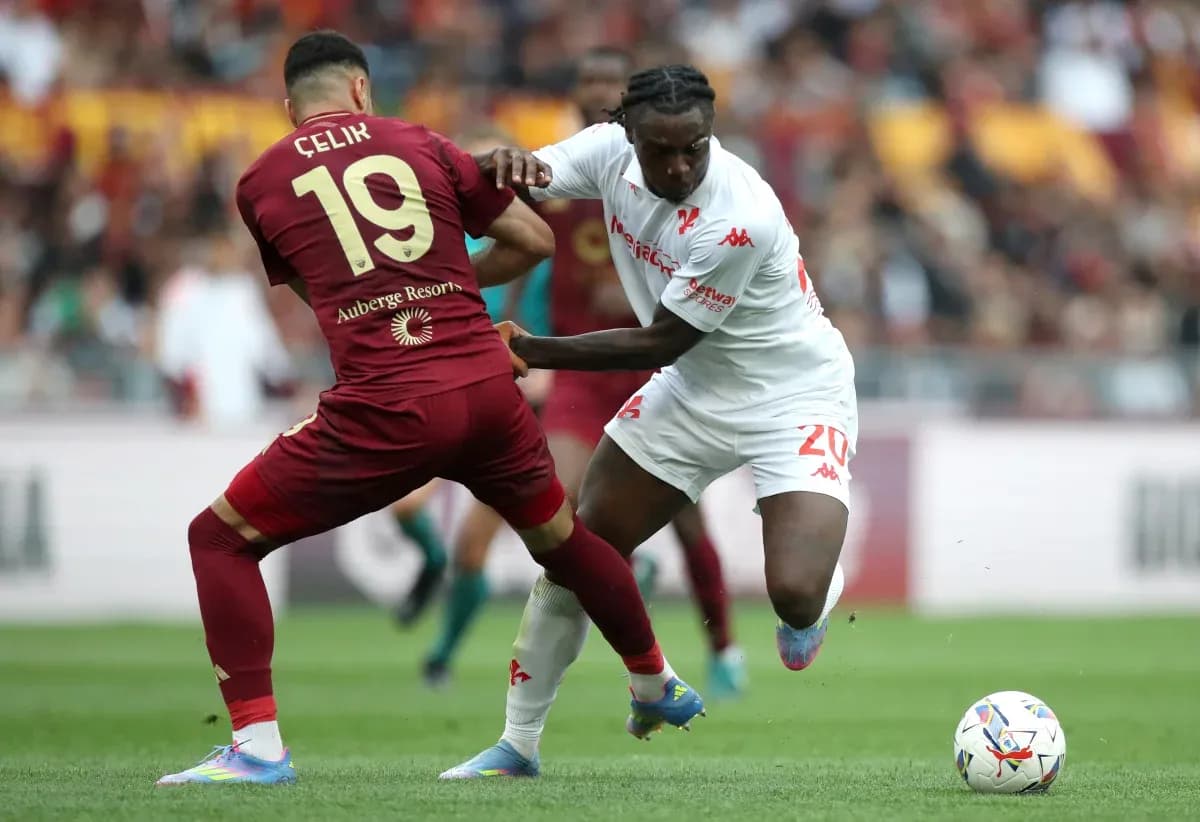
Roma’s 3-4-2-1 is built to isolate that duel. Soule and Cristante occupy the half-spaces, dragging Pongracic and Ranieri into uncomfortable lateral movements, while Celik and Wesley Franca pin Dodo and Gosens deep. Once the Fiorentina full-backs are locked back, Malen can attack the space between centre-back and full-back, forcing decisions from defenders already walking a disciplinary tightrope.
Engine Room – Soule vs Brescianini & Fagioli
In the middle third, the game’s rhythm hinged on whether Fiorentina’s trio could suffocate Soule’s creativity. Soule has 6 goals and 5 assists this season, with 43 key passes and 918 total passes at 83% accuracy. He is Roma’s primary conduit between midfield and attack, combining with Pisilli and Kone to progress play and then turning to face the back line.
Opposite him, M. Brescianini and N. Fagioli were tasked with both building and breaking. Yet Fiorentina’s season-long defensive numbers – 49 goals conceded overall, 29 on their travels – suggest that once their first line of pressure is bypassed, the back four is exposed. Roma’s ability to play through Soule and Cristante, then release wing-backs, forced Brescianini and Fagioli into constant lateral shuttling rather than controlled pressing.
IV. Statistical Prognosis – Why this scoreline made sense
Following this result, the numbers still frame Roma as a side that wins by control rather than chaos. Overall, they average 1.5 goals scored and 0.8 conceded per match, with 16 clean sheets and only 7 games where they failed to score. Their home dominance – 12 wins from 18, 31 goals for and 10 against – is not an accident but the product of a system that compresses space, limits transitions and capitalises on moments of quality from Malen and Soule.
Fiorentina’s profile remains that of a team permanently flirting with danger. Overall, they score 1.1 goals per game and concede 1.4, with just 8 clean sheets and 10 matches where they failed to score. On their travels, 18 goals for and 29 against underline a side that struggles to control territory and tempo. Their late-game card surge (25.00% of yellows in 76-90, plus both reds in that window) speaks to fatigue and frustration when chasing matches.
Overlay those trends and the 4-0 feels less like an outlier and more like the logical intersection of two trajectories. Roma’s offensive structure, powered by Malen’s movement and Soule’s craft, met Fiorentina’s away frailty and disciplinary volatility. The Olimpico simply amplified what the season’s numbers had already whispered: when these two versions of Roma and Fiorentina share a pitch, the gap is not just in the table – it is in every phase of play.