Arsenal's Young Star Myles Lewis-Skelly Shines in Title Race
At full time in east London, it felt less like a refereeing decision and more like a minor miracle.
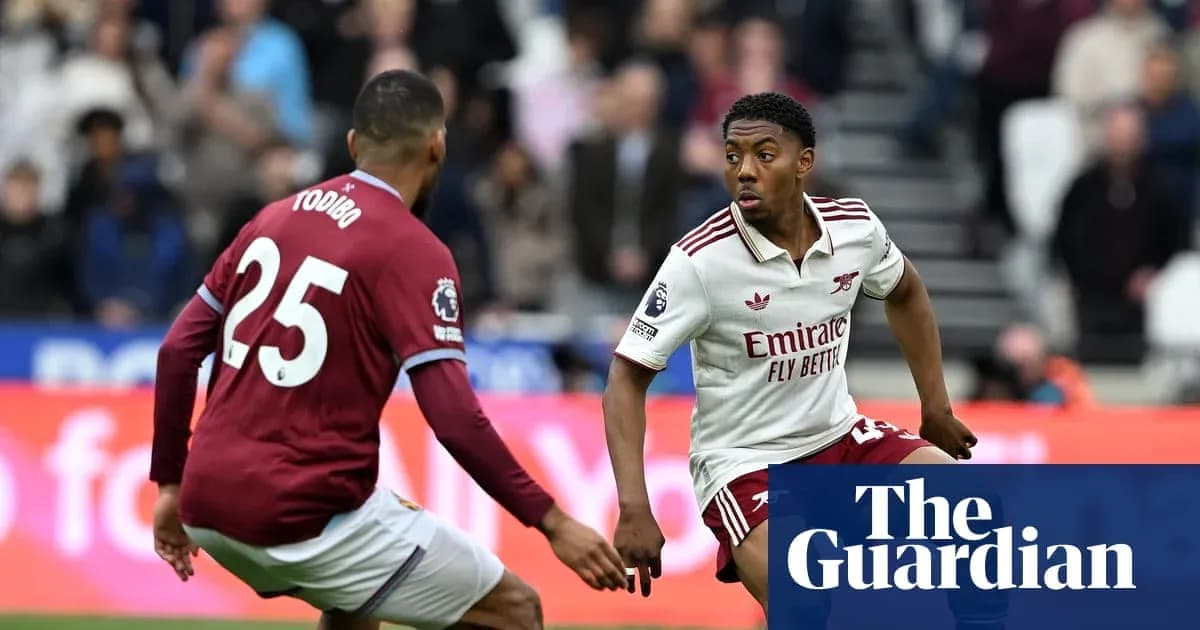
Chris Kavanagh’s voice cut through the chaos at the London Stadium, the words every Arsenal player and supporter had been silently begging to hear after a breathless, desperate finale. Pablo had fouled David Raya. Callum Wilson’s 95th‑minute equaliser would not stand. “Final decision, direct free-kick.”
For Ian Wright, watching on duty for television, it was poetry. Asked on Sky Sports if they were the sweetest words he had ever heard, the Arsenal legend reached for the grandest of comparisons. “The sweetest words since Martin Luther King’s ‘I have a dream’,” he said, half-joking, wholly euphoric.
Inside the away dressing room, the mood bordered on delirium. A 1-0 win, three more points, and the title dream still crackling with life. Arsenal sit five points clear of Manchester City with two games left – Burnley at home, Crystal Palace away. City still have that game in hand and a run-in of Palace at home, Bournemouth away, Aston Villa at home. The margin for error remains paper thin.
For Myles Lewis-Skelly, the night felt like vindication and salvation rolled into one.
‘Just God on our side’
The 19-year-old tried to put the moment into words and almost gave up.
“I don’t even know … it was just God on our side,” he said, still riding the adrenaline. “We are so grateful.”
He had started by talking about “a huge sense of relief,” but that barely scratched the surface. The young midfielder rattled through the emotions: joy, excitement, fulfilment. Arsenal’s players were “buzzing”, he said, but already speaking as if the season had turned into a series of cup finals. “We know that the job is not done. We have got two more finals left.”
It was an apt phrase. For Lewis-Skelly, this has been a season of tests. Of waiting. Of wondering.
Only a year ago he looked like he was scripting his own rise. Fifteen Premier League starts. His first Arsenal goal in a 5-1 demolition of Manchester City, followed by that cheeky imitation of Erling Haaland’s “Zen” celebration. A teenager who seemed to belong under the brightest lights.
He carried that swagger into the international and European arenas. A goal 20 minutes into his England debut against Albania. A fearless display at the Bernabéu in the Champions League quarter-final against Real Madrid, where club greats in the executive seats turned to each other with a simple question: “Who is this kid?”
Then the brakes went on.
From frustration to Fulham
This season, the minutes dried up. His place in the England squad disappeared. The promise of last year drifted into the background as Mikel Arteta leaned on others and pushed him harder.
When Arteta finally handed him a rare league start against Bournemouth on 11 April – only his second of the campaign – it ended in a damaging defeat. The performance and the result sharpened the scrutiny. This, suddenly, was the “acid test” of his mentality.
Arteta has since admitted he has been tough on him. Demanding. Uncompromising. For a while, the answer to how Lewis-Skelly would respond remained unclear.
Then came Fulham, nine days ago, and a decision from the manager that changed everything.
Arteta went with a “gut feeling” and restored Lewis-Skelly to the XI, but this time in his natural role. Not at left-back, where he had first broken into the side, but in midfield – the position he grew up playing in the academy. The result was electric. He drove Arsenal to a 3-0 win, snapping into duels, carrying the ball, knitting the play. It looked like a reconnection with the player who had burst through last season.
“It feels so natural for me to be there,” he said. “I have been training there a lot so [against Fulham] I felt comfortable. The boss told me: ‘You are going to play midfield, so go for it.’ That is what I did. I had to be bold and play with courage because that is what this league demands.”
Arteta kept faith. Lewis-Skelly started again in the 1-0 win over Atlético Madrid in the Champions League semi-final second leg, helping Arsenal into a mouthwatering final against Paris Saint-Germain. He kept his place at West Ham too, this time in a match where the stakes at both ends of the table were suffocating.
Mental strength and a shifting hierarchy
The story of his season, he insists, is not one of injustice but of resilience.
“It was tough for me initially,” he admitted. “But I pride myself on having mental strength. Sport is not one pathway because there are ups and downs. It’s how you bounce back from that, how you are in those moments when you face adversity. That is what defines you.”
He shut out the outside noise. Or tried to.
“I spoke with my family and friends. I just told them: ‘I don’t want to hear all the noise that is coming from social media. Let me stay in this moment, let me continue to face this adversity and let me come out the other side of it.’
“It is always being prepared, always feeling like I prepare as a starter because you never know when your time will come. Luckily enough, it came against Fulham. I took my opportunity and helped the team out as much as I can.”
The impact has been immediate and brutal in its clarity. Almost overnight, Lewis-Skelly has moved ahead of Martín Zubimendi in the midfield hierarchy. The competition has not gone away – far from it. Martin Ødegaard, the captain and creative heartbeat, came on after 67 minutes at West Ham and changed the temperature of the game, injecting urgency and control. Lewis-Skelly shuffled to left-back to accommodate him, a reminder that nothing is guaranteed.
Yet the message is clear. When the season reached its sharpest edge, Arteta turned to a 19-year-old whose campaign had been defined by waiting and told him to seize it.
Future talk can wait
The chatter around Lewis-Skelly’s future has followed the familiar modern script. When a homegrown player struggles for minutes, the dreaded phrase “pure profit” is never far away, the idea of a sale too tempting a line for some to ignore.
Right now, that talk feels distant. Almost irrelevant.
Lewis-Skelly has a title race to influence and a Champions League final on the horizon. He has his place back in the team, his confidence restored, and a manager who has tested him and still trusted him when it mattered.
“I am focused on the games we have got coming up,” he said. “And bringing this club back to glory.”
Two league games left. City lurking. A European final to come. For a teenager who thought this season might pass him by, the question now is very different: how big a part will he play in writing Arsenal’s ending?