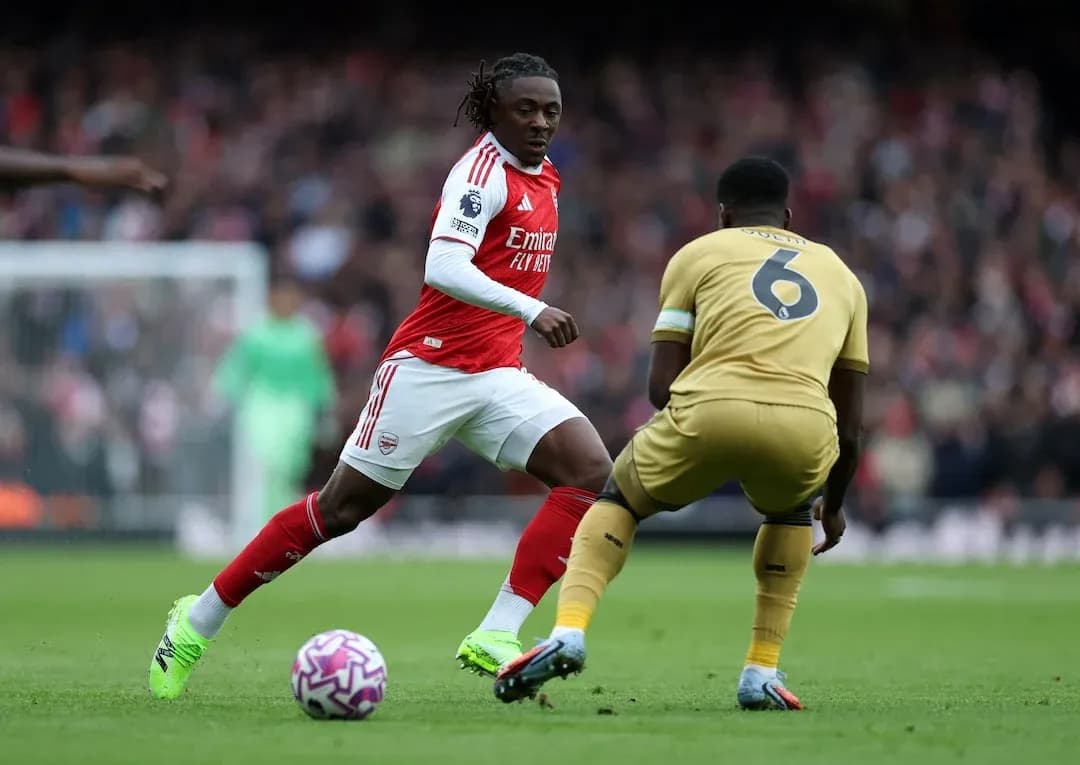
Arsenal Edges Crystal Palace 2–1 in Premier League Clash
Selhurst Park’s final act of the 2025–26 Premier League season closed with a narrow 2–1 Arsenal win, a scoreline that neatly reflected the structural gap between a champion-elect and a side still learning its new identity. Following this result, Arsenal finished top with 85 points and a formidable overall goal difference of +44 (71 scored, 27 conceded), while Crystal Palace settled in 15th on 45 points, their overall goal difference a more fragile -10 (41 for, 51 against). It was a meeting between a heavyweight that knows exactly what it is, and a Palace side still in tactical transition.
I. The Big Picture – Structures and Seasonal DNA
Oliver Glasner stayed loyal to his blueprint, rolling out Palace in a 3-4-2-1 that has underpinned the campaign: three centre-backs, wing-backs high, and a front line built on mobility rather than pure penalty-box presence. D. Henderson anchored the back line behind a trio of N. Clyne, J. Lerma and C. Riad, with D. Munoz and the young R. Cardines stretching the width as nominal wing-backs. W. Hughes and D. Kamada formed the central hinge, with J. Devenny and I. Sarr operating off J. S. Larsen.
Heading into this game, that structure had produced mixed returns. Overall, Palace averaged 1.1 goals for and 1.3 against per match, with Selhurst Park seeing 1.0 goals for and 1.2 against at home. They were awkward rather than incisive: 12 clean sheets overall, but also 12 matches in which they failed to score. The league table corroborated the picture of a side that could frustrate but not consistently hurt opponents.
Arsenal, by contrast, arrived as a fully formed machine. Mikel Arteta chose a 4-2-3-1 variation of his season-long 4-3-3/4-2-3-1 blend, trusting K. Arrizabalaga in goal behind a back four of M. Zubimendi, C. Mosquera, P. Hincapie and R. Calafiori. C. Norgaard and M. Lewis-Skelly formed the double pivot, with N. Madueke, academy product M. Dowman and G. Martinelli buzzing behind Gabriel Jesus.
Heading into this game, Arsenal’s numbers were title-worthy: overall 1.9 goals scored per match and just 0.7 conceded. On their travels, they still carried a sharp edge, averaging 1.6 goals for and 0.8 against away. Nineteen clean sheets in total and only three away matches without scoring underlined a side that married control with ruthlessness.
II. Tactical Voids – Absences and Discipline
Both managers had to navigate notable absences that subtly shaped the contest. For Palace, C. Doucoure’s knee injury removed a natural ball-winner and screen in front of the back three; his absence forced Lerma into the back line and left Hughes and Kamada to manage central traffic without a true destroyer. C. Richards and B. Sosa were also missing, limiting Glasner’s options for left-sided balance and defensive rotation, while the listing of E. Nketiah as a Palace absentee was more administrative than tactical.
Arsenal’s back line was shorn of two trusted pieces: J. Timber (ankle) and B. White (knee). Without them, Arteta leaned into the versatility of Zubimendi at right-back and Calafiori on the left, sacrificing some of White’s overlapping thrust and Timber’s build-up precision, but maintaining a high technical floor.
From a disciplinary perspective, the underlying season data hinted at where the emotional edges might fray. Palace’s yellow cards were spread, but with noticeable spikes at 31–45' and 46–60' (both 18.42%), and another late swell at 76–90' (18.42%), reflecting a team that often found itself scrambling as halves wore on. Arsenal’s bookings skewed even later: 21.57% between 61–75' and 25.49% between 76–90', a sign of a side that defends aggressively to protect leads in the closing stages. No red cards were recorded for Arsenal across the campaign, while Palace’s red profile showed two dismissals concentrated between 46–75', underlining the risk when they are forced to chase.
III. Key Matchups – Hunter vs Shield, Engine Room Battles
The headline duel in the abstract was always going to be Arsenal’s attacking depth against Palace’s brittle defensive averages. On their travels, Arsenal’s 1.6 goals per match met a Palace home defence conceding 1.2 per game; over 90 minutes, the visitors were statistically favoured to find at least one decisive opening, and the final 2–1 scoreline followed that logic.
The “Hunter vs Shield” narrative extended beyond Gabriel Jesus. Off the bench, V. Gyökeres – Arsenal’s top league scorer with 14 goals overall and 3 penalties scored from 3 attempts – loomed as the pure finisher. His profile is that of a relentless runner who thrives on service into the channels and box. Against a Palace defence that had conceded 51 overall (1.3 per match) and whose biggest away defeat of the season was 4–1, Arsenal’s primary striker options were always likely to find space, especially as Palace pushed forward late.
Palace’s own “hunter”, J. Mateta, started on the bench but remained a central figure in the season narrative: 12 goals overall, 4 penalties scored from 4, and a physically dominant presence who had blocked 6 shots and engaged in 292 duels, winning 110. His introduction would always threaten to tilt the game towards a more direct, penalty-box contest, particularly against a visiting defence that, while elite, is less comfortable when repeatedly asked to defend high balls and second phases.
In midfield, the “Engine Room” battle pitted Kamada and Hughes against Norgaard and Lewis-Skelly. Kamada’s role as Palace’s connector was to break Arsenal’s rhythm and stitch transitions into Sarr and Devenny, while Hughes offered metronomic recycling. Norgaard, for Arsenal, was the enforcer and distributor, tasked with screening the spaces between the lines where Sarr and Devenny tried to operate. Lewis-Skelly, meanwhile, brought legs and verticality, ensuring that any Palace press could be broken with one or two sharp carries.
Out wide, Munoz and Cardines had to live on the edge: high enough to pin Martinelli and Madueke back, but wary of leaving Clyne and Riad exposed in wide 2v2s. Arsenal’s season-long attacking averages suggested that if Martinelli could isolate his man, the visitors would eventually manufacture the sort of cut-backs and low crosses that their forwards feast on.
IV. Statistical Prognosis – xG Logic and Defensive Solidity
Even without explicit xG numbers, the season data offers a clear probabilistic story. Arsenal’s overall balance – 71 scored, 27 conceded – and especially their away profile of 30 for and 16 against over 19 matches, pointed towards a side that routinely wins the territory and shot-quality battle. Palace, with 41 scored and 51 conceded overall, profile as a team that lives on fine margins, relying on defensive organisation and set-piece moments rather than sustained chance creation.
Palace’s 12 clean sheets show they can lock games down when the structure holds, but the identical figure of 12 matches failing to score underlines how often their own xG is likely to be suppressed against elite defences. Arsenal’s 19 clean sheets, combined with only 3 matches all season in which they failed to score, make them a low-variance proposition: they almost always generate enough to justify a positive xG differential.
Following this result, the numbers and the narrative align. Arsenal’s structural superiority, depth – with weapons like Gyökeres and M. Ødegaard in reserve – and defensive solidity made them clear favourites to edge the underlying metrics at Selhurst Park. Palace’s 3-4-2-1 posed questions, and their late-season resilience ensured the game remained competitive, but in the cold light of the season’s data, a narrow Arsenal win felt like the most statistically coherent outcome – a champion’s performance in miniature, carved out against a Palace side still searching for the next step in its evolution.