
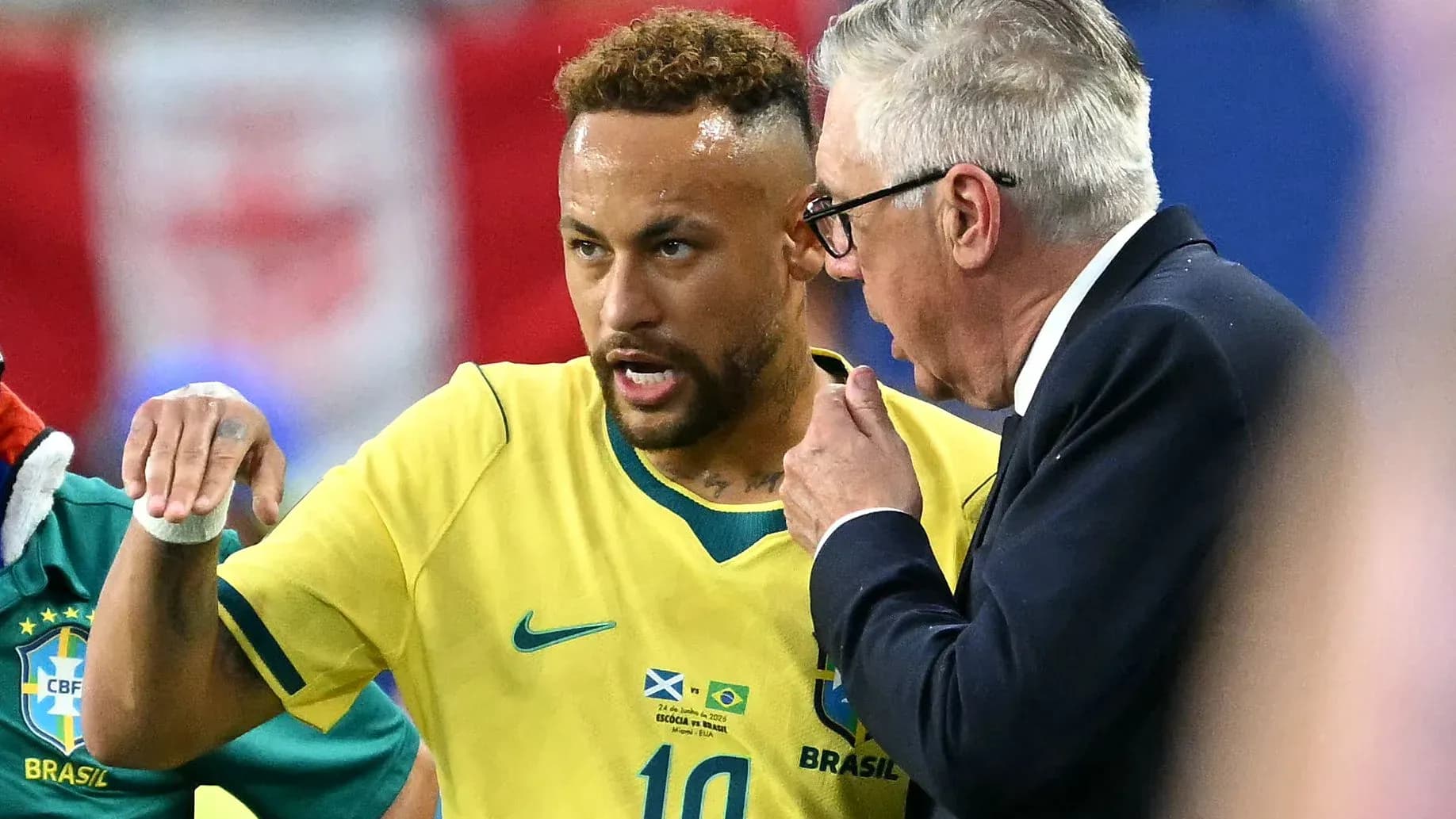
Carlo Ancelotti on Neymar's Future and Brazil's Rebuild
Carlo Ancelotti has never been afraid of hard truths. This time, one of them is about Neymar.
The Italian coach, now tasked with reshaping Brazil’s future, laid bare the tension between admiration and frustration as he reflected on the forward’s troubled tournament — a campaign undermined by a grade 2 calf strain and a race against time that he ultimately lost.
Neymar missed Brazil’s opening group games against Morocco and Haiti, and when he did finally appear, he was a shadow of the player expected to drag a nation forward.
“I think he didn’t contribute on a technical level as it was hoped he could, because he couldn’t,” Ancelotti told ESPN. The sentence hung there: not a criticism of talent, but of circumstance. “But, in terms of attitude, it was a very positive attitude. I have a lot of affection for him, I thanked him for his attitude, for his behavior, and I think it was the right decision to include him on the 26-man roster.”
So the coach defended the call to take him. He praised the leadership in the dressing room, the professionalism away from the cameras. Yet he did not gloss over the central issue: Neymar’s body was not ready when Brazil needed him most.
“The only thing that bothered me is that Neymar could have prepared himself better during that lead-up period,” Ancelotti added. “He could have been ready for game one instead of game four. That was the only disappointing part.”
It was a rare public rebuke, wrapped in respect. Ancelotti’s words pointed to a deeper shift: Brazil can no longer wait for yesterday’s heroes to get fit, to find rhythm, to turn back time.
With his iconic No. 10 now stepping away from the international stage, Ancelotti is preparing something far more radical than a simple refresh. He is talking about a total rebuild, a new program aimed squarely at the 2030 World Cup. The message is clear: the era of the 2010s idols is closing, and the next generation will not just be asked to replace them, but to surpass them.
“I think that players like Neymar, who already commented yesterday, and with all due respect to his decision. I believe that in history, one generation ends and another has to come, and it has to be better than the last one,” the former Real Madrid boss said.
This is not just about one superstar. The old guard that defined Brazil for a decade is being gently, but decisively, moved toward the exit.
Asked about the futures of Casemiro, Danilo and Alex Sandro, Ancelotti did not dodge. He acknowledged what many in Brazil have sensed for some time: this group is nearing the end of its international road.
“I think so. It is a period that is coming to an end. Obviously, we have to thank all of them, and I have a lot of affection for all of them. But I think the idea that a player over 30 is done means that we have to think about the future.... Some of these players will be there, obviously. Marquinhos, for example. Alisson, we’ll see.”
There it was — gratitude, affection, and a firm line. Marquinhos is pencilled in as a pillar. Alisson’s place will be judged in time. Others, legends of a recent past, are drifting out of the frame.
For Brazil, this is more than a tactical reset. It is a cultural break from a decade spent leaning on the same names, waiting for the same shoulders to carry the weight. Ancelotti has chosen his moment to say it out loud: the next Brazil will belong to players who are not defined by what they once were, but by what they can still become by 2030.





