
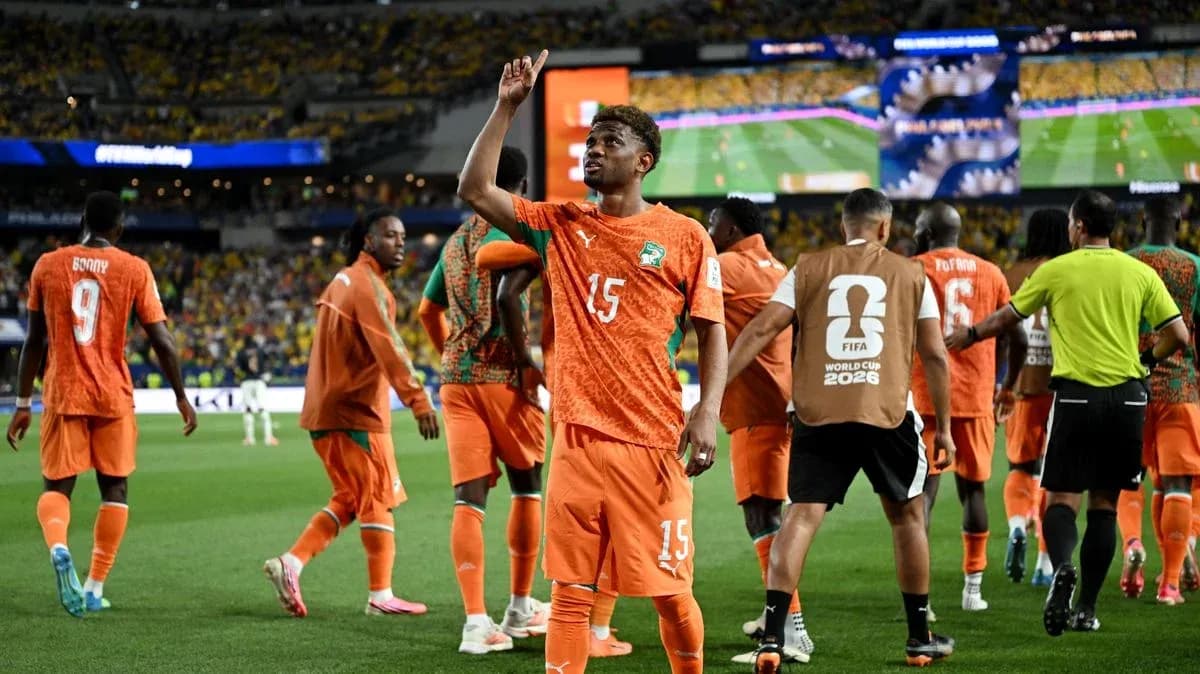
Amad Diallo: From Bench to Star in Ivory Coast's World Cup Journey
Amad Diallo walked off the pitch in Philadelphia with the look of a player who had just reminded everyone of the obvious: leave him out at your peril.
Days after scoring a late winner against France in a World Cup warm-up, the Ivory Coast forward might reasonably have expected his name to be inked, not pencilled, into Emerse Fae’s first competitive XI. Instead, when the real tournament began against Ecuador, he watched the kick-off from the bench.
Frozen out, then unleashed
Fae had gone with youth and variety. Yan Diomande, the 19-year-old wide talent wanted by Manchester United earlier this season and now seemingly Liverpool-bound from RB Leipzig, started on the right. On the opposite flank, 20-year-old Bazoumana Toure. Between them, the seasoned Nicolas Pepe in the No. 10 role.
Amad was nowhere.
The selection underlined the depth Fae now enjoys in attacking areas. It also left one of his sharpest weapons unused for nearly an hour. When Amad finally entered, replacing Toure, he didn’t hug the touchline. He drifted inside, operated through the middle, and immediately changed the temperature of the game.
In just 34 minutes he looked like the most dangerous player on the pitch. His movement was cleaner, his touch sharper, his intent clearer. The performance peaked with a wonderfully taken goal, swept home with the kind of first-time finish that makes a manager rethink his pecking order on the spot and sealed a vital win over Ecuador.
With minnows Curacao still to come, that strike may well have pushed Ivory Coast to the brink of a first-ever World Cup knockout appearance. It should also push Amad back into the starting team.
A different story for club and country
The contrast with his club season is stark. At Old Trafford, Amad has just come through a difficult campaign: two goals and four assists in 32 Premier League games is a modest return for a forward of his talent.
The shirt of Ivory Coast, though, seems to unlock something. The goal in Philadelphia was his fifth in nine appearances for his country since the start of the Africa Cup of Nations in December, a run that also includes two assists. When the orange jersey goes on, the numbers jump and the confidence flows.
Crucially, his recent goals have not come from the flank. Both have arrived from central positions, each one a first-time finish from low crosses delivered from the right. Same pattern, same ruthless end product. They are a reminder that Amad is not just a neat winger who links play. He is a finisher, and a dangerous one, when allowed to operate closer to goal.
More than a right winger
For United, that matters.
Last season he spent almost all his time on the right, stretching play and working the channels. Yet his loan spell at Sunderland told a different story. There, used frequently as a false nine, he became a regular goalscorer in the Championship, arriving in pockets of space, turning quickly, and striking early. The instincts were there then; Ivory Coast are benefitting from them now.
Diomande’s emergence on the right for his country changes the picture again. If the teenager continues to impress, Amad may find his long-term international future drifting away from the wing and towards the middle. Pepe, now 31, currently occupies the No. 10 role, but he will not hold it forever. Amad, at 23, looks perfectly placed to grow into that space, or even to attack from the left in Toure’s position.
Every touch against Ecuador hinted at that evolution. He didn’t just hug the half-space; he owned it. He linked with runners, arrived late, and struck cleanly when the chance came. This is a player who can operate across the front line, but whose ceiling might be highest where the traffic is heaviest: through the centre.
A question for Carrick
Back in Manchester, that versatility hands Michael Carrick a genuine tactical card to play.
United’s front line is already flexible. Bryan Mbeumo and Matheus Cunha can both operate across all three attacking roles. Recruitment plans include adding either an experienced forward or a left-sided attacker to deepen the rotation.
Yet the real gap is not on the wing. It is behind the striker.
Bruno Fernandes has just delivered the season of his life, dragging United through games and seasons with the relentlessness that has defined his time at the club since January 2020. He turns 32 in September and has logged an enormous volume of minutes. At some point, United must find a way to give their captain a breather without stripping the side of invention.
Cunha and Mason Mount can both step in as a No. 10 for certain matches. They bring energy, pressing, and technical quality. Amad, though, is quietly joining that conversation. His recent international displays show a player comfortable receiving between the lines, turning quickly, and finishing like a centre-forward.
Carrick has already publicly defended Amad, urging critics to look beyond the raw numbers and focus on his contribution to the overall structure of a winning team. Now, with Ivory Coast showcasing a more central, decisive version of the same player, the question sharpens.
Is Amad still just another option on the right for United? Or is he becoming something far more valuable: the man who can step into Fernandes’ orbit, keep opponents guessing, and still carry the weight of a match on his own shoulders?
For Ivory Coast, the answer feels closer with every game he plays. United may not be far behind.





