Žilina's Tactical Comeback Against Hajduk Split in UEFA Europa League
Žilina’s 2-1 comeback at Štadión pod Dubňom in the UEFA Europa League 1st Qualifying Round was built almost entirely on structural and momentum shifts rather than any clear statistical dominance, because the numerical data beyond card counts is absent. The tactical story is therefore written on shapes, substitutions and how each coach adjusted around a narrow scoreline that flipped late.
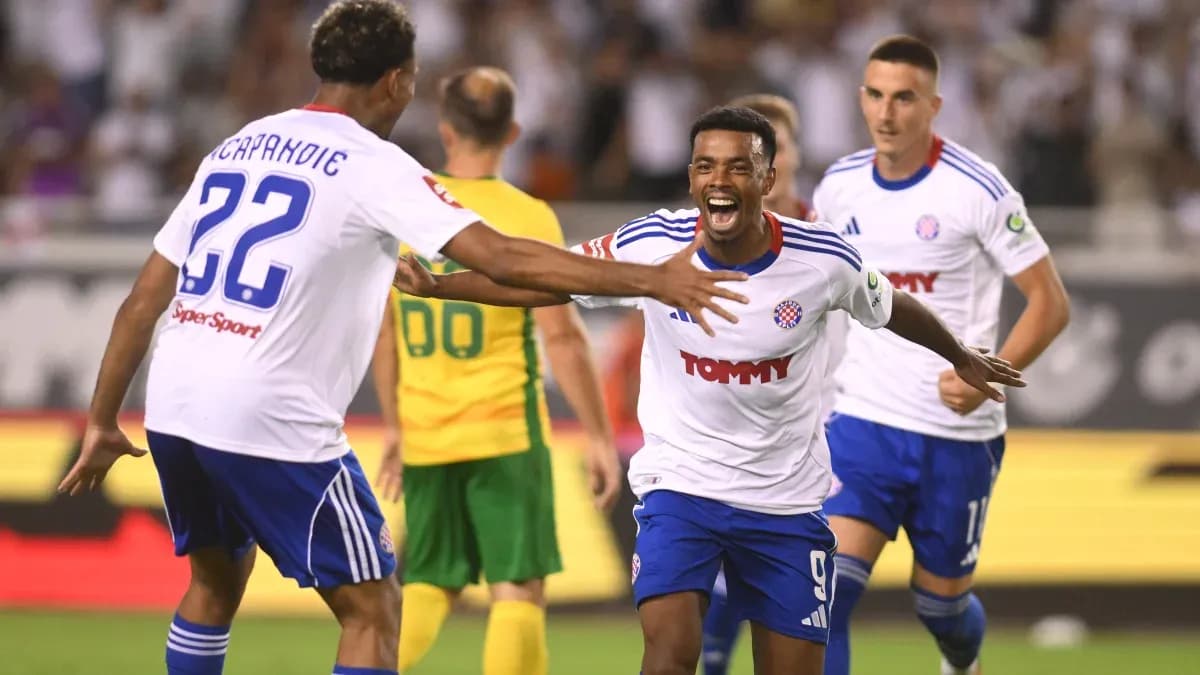
HNK Hajduk Split began from a clear 4-2-3-1 under Gonzalo Garcia, with T. Silic in goal, a back four of M. Acapandie, M. Skelin, Alec Van Hoorenbeeck and Šimun Hrgović, a double pivot of R. Pukstas and A. Pajaziti, and an attacking band of R. Brajkovic, N. Skoko and D. Melnjak behind lone forward M. Sego. The structure aimed at control through the middle: Pukstas and Pajaziti screening transitions, Skoko between the lines, and the full-backs—especially Hrgović on the left—pushing to create overloads.
Žilina, coached by Pavol Stano, lined up in a 3-4-3 with J. Badzgon in goal, a back three of T. Hranica, J. Minarik and A. Narimanidze, wing‑backs T. Paliscak and K. Bari, and a central pairing of Xavier Adang and M. Kacer. Up front, F. Kosa and P. Ilko flanked M. Roginic. On paper this gave Žilina a spare man in the first line versus Hajduk’s single striker, inviting them to build patiently and then attack wide where the wing‑backs could pin Hajduk’s full‑backs.
First Half
The first half, however, tilted in Hajduk’s favour through better exploitation of set phases and wide spaces. The 30th‑minute yellow card to Alec Van Hoorenbeeck for “Foul” did not blunt his influence; instead, he became a decisive attacking weapon. At 45’, he scored the opener, assisted by Šimun Hrgović, who had already been booked at 21’ for “Foul”. The pattern suggests Hajduk using Hrgović’s left‑side aggression to push Žilina’s wing‑back back, then attacking the far post where Van Hoorenbeeck could arrive untracked from deep. The VAR “Goal confirmed” check at 45+3’ underlined how tight the margins were around this pattern: Hajduk’s structure was functioning, but only just staying onside and on the right side of duels.
Going into half-time 0-1, Žilina’s 3-4-3 needed more thrust and defensive stability on the flank. Stano’s first move was immediate: at 46’, M. Okal (IN) came on for T. Paliscak (OUT). This likely shifted the right side’s defensive profile, either to solidify against Melnjak and Hrgović or to give more direct running in transition. The impact of these adjustments became visible as Žilina began to punch through Hajduk’s mid-block.
On 52’, M. Roginic, assisted by F. Kosa, levelled the match. This action, later “Goal confirmed” by VAR at 54’, encapsulated Žilina’s intended 3-4-3 logic: a central forward finishing a move constructed by a wide forward receiving service from the midfield/wing corridor. With the back three secure behind them, Žilina could commit more numbers into the final third, and Hajduk’s 4-2-3-1 began to look stretched between its lines.
Middle Phase
The middle phase (60’–80’) became a contest of benches and rebalancing. Garcia’s first response came at 64’: D. de Almeida (IN) for N. Skoko (OUT), freshening the No.10 zone and trying to regain control between Žilina’s midfield and defence. Stano countered with a double change at 66’: F. Bzdyl (IN) for M. Kacer (OUT) and M. Fasko (IN) for F. Kosa (OUT). Žilina effectively re‑armed both central and attacking lanes, keeping intensity high where Hajduk’s double pivot and centre-backs had to defend more space.
The 67’ yellow card to Xavier Adang for “Persistent fouling” was tactically revealing: Žilina’s central midfielder was repeatedly breaking up Hajduk’s attempts to transition or play through the middle. Even while on a booking, he remained central to the physical control of that zone until he was withdrawn at 82’, when A. Florea (IN) replaced X. Adang (OUT). That substitution was a key late-game tactical pivot: with the score at 1-1, Stano chose to protect his booked ball-winner and inject fresh legs and, potentially, more progressive passing into midfield.
Hajduk, meanwhile, tried to restore width and penetration. At 75’, A. Sanyang (IN) replaced Šimun Hrgović (OUT), and A. Guram (IN) replaced R. Brajkovic (OUT). Swapping both a full-back and a wide midfielder at once indicated a desire to re‑energise the flanks, perhaps to press Žilina’s back three more aggressively or to deliver better service to Sego. Yet by 84’, Garcia went a step further: M. Livaja (IN) came on for M. Sego (OUT). Bringing on a forward of Livaja’s profile late suggested Hajduk were still hunting a winner, but it also changed how they defended from the front—more emphasis on hold‑up and link play, less pure running in behind.
Final Moments
Žilina’s response was to double down on midfield bite and discipline. At 90+2’, A. Florea received a yellow card for “Foul”, underlining how the hosts were willing to trade cautions for disruption in central areas. With total yellow cards locked at two per side (Hajduk: Hrgović and Van Hoorenbeeck; Žilina: Adang and Florea), the disciplinary profile matched a match of persistent, structured fouling rather than chaos—each team targeting key zones rather than losing control collectively.
The decisive moment came from structure-induced pressure rather than a crafted attacking move. At 90’, D. Melnjak’s own goal turned 1-1 into 2-1 for Žilina. Although the data does not specify the exact pattern, the context of Žilina’s late substitutions and territorial tilt suggests sustained pressure on Hajduk’s defensive line, forcing a mistake from a full-back who had spent much of the night balancing advanced duties with defensive recovery.
Without figures for possession, shots, passes, xG or saves, the statistical verdict rests on the tactical patterns implied by the events. Hajduk’s early control and 0-1 lead reflected a coherent 4-2-3-1 exploiting wide overloads and set‑piece or crossing situations. Žilina’s comeback was driven by the inherent advantages of their 3-4-3—spare man at the back, strong wing presence, and the ability to refresh both midfield and attack in waves. The card distribution confirms that both teams were prepared to foul to protect key zones rather than allow transitions.
In the end, the match hinged on who could better sustain their structure under fatigue and pressure. Žilina’s layered substitutions, especially the timing of removing a booked pivot and adding fresh forwards, allowed them to maintain intensity into stoppage time. Hajduk’s reshaped flanks and late switch up front did not restore the early control, and their defensive line finally cracked under pressure, turning a balanced tie into a narrow but tactically earned 2-1 home win.