West Ham's Dramatic Victory and New Era Unfolds
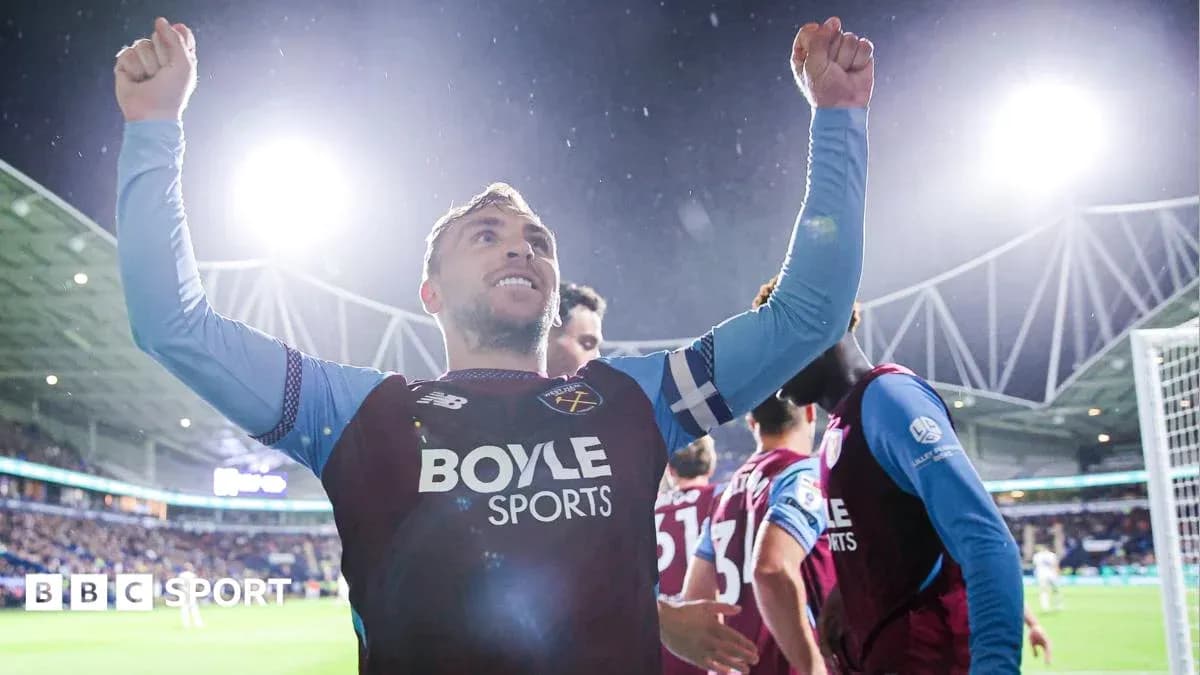
The away end at Bolton did not want to leave. Why would they? West Ham had just won a five-goal scrap, gone top of the Championship and watched their captain drag them there almost on his own.
Jarrod Bowen struck early, then settled it late, the kind of talismanic performance that keeps a club moving forward and a fanbase singing long after the final whistle. For a support that has lived off scraps of joy in recent seasons, this felt like a night to savour, even if many of them would not see home until the small hours.
From Moyes’ high point to the drop
This is West Ham’s third league win on the spin, something they had not managed since December 2023. That previous surge had looked like the start of something. Instead, it became a reference point for a decline.
Back then, that run nudged the board into putting a new contract on the table for David Moyes. He never signed it. The offer was eventually pulled, and six months later he was gone. The slide did not stop, and by May, West Ham were out of the Premier League.
Relegation has a way of stripping a club bare. At Bolton, you could feel how much the travelling 4,500 needed this. They stayed behind, applauding, chanting, leaning into the moment. Bubbles, “West Ham are massive” – and, pointedly, song after song about former chairman David Sullivan. None of them flattering.
Sullivan was nowhere to be seen at Bolton. He has been a regular presence at the London Stadium this season and even turned up at Watford for last month’s 1-1 draw. For some, that continued visibility jars with what they thought would happen next.
Sullivan steps aside – but not away
When the 77-year-old resigned as chairman in June, saying he wanted to concentrate on fighting allegations made in a joint BBC Panorama and Times investigation, many around the club assumed it marked the start of his exit.
His departure from the chair, coupled with Karren Brady standing down as managing director in April, helped shift the mood. Those changes were cited by some as a key factor behind West Ham shifting a remarkable 50,000 season tickets for their first season outside the top flight since 2011.
The crowds have followed. Average league gates at the London Stadium are already above 60,000. A crowd of 53,369 for the EFL Cup first-round win over Portsmouth set a record for that stage of the competition.
Yet Sullivan is still in the picture. If the complex agreement announced on 3 September is completed as expected in the coming weeks, he will retain a 40% stake. He is no longer the dominant force he once was, but he has not disappeared.
Inside the club, they talk about a different West Ham.
Kretinsky’s era and a new structure
Czech billionaire Daniel Kretinsky, who also owns Royal Mail, is now chairman and is expected to become the largest shareholder with 46%. Around him, a new structure has taken shape.
Chief executive Karim Virani has quickly made a mark. Those who deal with him praise his willingness to front up, to listen, to tackle long-running supporter concerns – including the club badge, altered in 2016 when West Ham left the Boleyn Ground.
Director of football Nils Koppen now has a genuine say in recruitment. The days of deals being pushed through in the shadows have, for now at least, been replaced by a more open process, with the right people involved and lines of responsibility clearer.
The scale of the summer overhaul underlines that shift. Twelve players were sold, among them Crysencio Summerville and Mateus Fernandes. Nine arrived.
The headline figure was the EFL record £22m fee paid to Celtic for Belgium international Arne Engels. Yet inside the club they point to another signing as the real symbol of change.
Edvin Austbo, 21, arrived for an initial £10m after being tracked for a significant period. Named Norway’s young player of the year for his role in Viking’s shock Eliteserien title win, he was not a late scramble, but a long-planned move. West Ham see that as the new model.
Of course, this is West Ham. Nothing is ever entirely clean.
The Staveley question
Uncertainty still hangs over Amanda Staveley’s intentions. Her agreement with former co-chair Vanessa Gold in July triggered the pre-emption rights process that reshaped the club’s ownership – the same process that will leave Kretinsky and Sullivan with larger stakes, and also increases the holdings of fellow shareholders Tripp Smith and Terry Brown.
On paper, if Staveley were to strike a deal with Sullivan and Smith, who is set to hold 11%, she could end up controlling more than half the club. That scenario would also be subject to pre-emption rights, though, and is far from straightforward.
Privately, Sullivan speaks positively about Kretinsky and is said to be frustrated that the recent ownership wrangling dragged focus away from the transfer window. Those close to him do not hear the language of a man preparing to plunge the London Stadium back into chaos.
Plenty of supporters remain sceptical.
“It seemed Sullivan was going when he stepped down, but that hasn’t happened,” said Simon Lane, a season-ticket holder from north Wales, pausing outside the away end 90 minutes before kick-off.
“No-one really knows what to make of it all. Does he want more shares? Does he want to get out? Why would he do a deal with Kretinsky and then sell the whole thing?
“It’s difficult to know what is for the best really. Some fans do like what Amanda Staveley did at Newcastle but Kretinsky puts the right people in place and Karim is talking with fans, which is what we have wanted.
“I am optimistic for the season though.”
Nuno’s West Ham starts to take shape
On the pitch, there is enough quality to justify that optimism. In Bowen, in Engels, and in others, West Ham possess a level of class that most Championship rivals cannot match.
Nuno Espírito Santo knows that talent alone is not enough. The club he has walked into has been defined by tension and division for years. He is trying to build something more solid.
“I hope it’s better,” he said. “I think it’s the belief of everybody, starting from the ownership to the staff, to the players, and fans, that we are trying to improve and have better days.
“What I see, and feel is unity in all the departments of the club. Five thousand fans on a Tuesday night. (What happened in the past) is behind us. It’s very important to be unified. There is no other way.”
On a raucous night in Bolton, with Bowen leading from the front and the away end roaring his name, that unity did not feel like a slogan. It looked like a plan.