U.S. Men's National Team Journey at the 2022 World Cup
On the eve of Wales, Gregg Berhalter pulled his squad into a circle and reached for history.
No tactics board. No video. Just a number.
Each player, he told them, carried a specific place in the lineage of U.S. World Cup football. Walker Zimmerman was 152. The 152nd man ever to represent the United States at a World Cup.
You could see the realization in the way players later spoke about it. One hundred and fifty-two. That was it. Strip away the jerseys and endorsements and social media, and you’re left with a tiny, elite fraternity. Narrow it by position, by minutes, by starts, and the circle shrinks again. The point landed. This wasn’t just a trip to Qatar. It was an entry into a book that only gets a few new names every four years.
For this generation, that book had a shared first chapter.
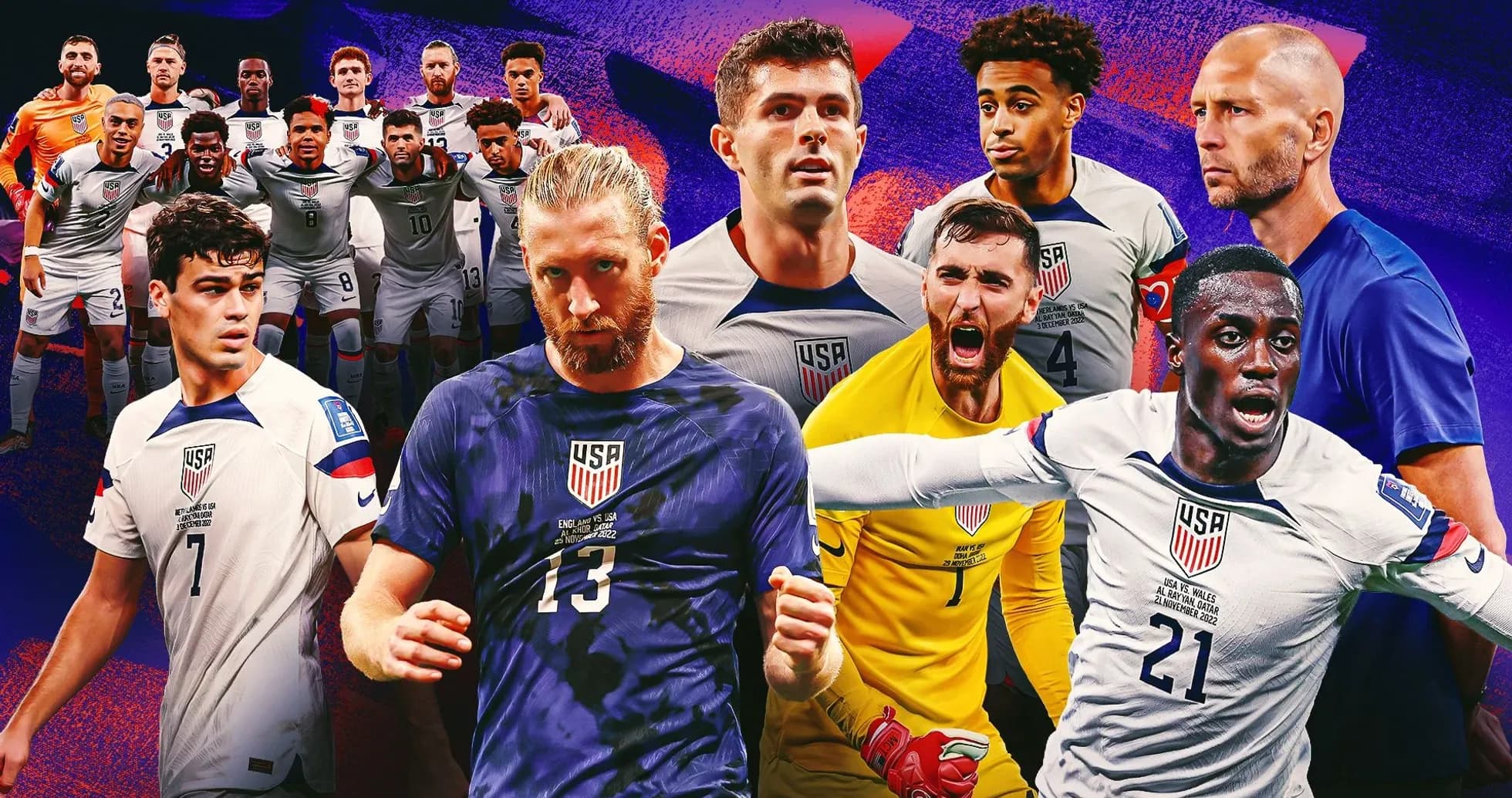
Tyler Adams had grown up with Christian Pulisic and Weston McKennie in U.S. youth camps. Tim Weah, Josh Sargent, Sergiño Dest – they had their own memories from buses and backfields and half-empty stadiums. By the time they walked into Qatar, they weren’t simply teammates. They were co-authors.
Those childhood days still mean more to Adams than anything he’s done as a professional. The climb, not the summit. The grind, not the glow.
A World Cup at fast‑forward
Then the whistle blew on the tournament, and everything sped up.
No long pre-camp, no gentle ramp. Players flew in from clubs, dropped straight into the furnace. Tim Ream remembers the schedule bending time out of shape. Late kickoffs. Body clocks flipped. Breakfast at noon, lunch at four, training under lights. Nights that ran to 3 a.m. even when they weren’t playing.
Some tried to slow it down. Sargent leaned on a mental coach, on breathing exercises, on reminders to be grateful and present. It still felt like trying to hold water in your hands.
Three group games in eight days. Wales, England, Iran. Training, ice baths, media hits, video sessions. The World Cup bubble distorts everything: days blur, details vanish. Haji Wright now calls it a “fever dream.” He’s not alone.
For others, the dream never reached the field. Joe Scally never got a minute, but he felt the tournament’s pull just as strongly from the bench. The anthem. The noise. The knowledge that the whole world was watching. It lit a fire. He’d been there, but not really. Not in the way he wanted.
Three goals, three very different scars
Before Qatar, only 22 American men had scored at a World Cup. Three more joined them in 2022, each with a story that still sits a little differently in the mind.
Weah struck first. The opener against Wales, the goal that announced the U.S. was back on this stage. Slipped through by Pulisic, he finished with the calm of someone who had rehearsed that moment a thousand times in his head. Because he had. Years of daydreams, imagined celebrations, phantom goals on imaginary nights. When it finally arrived, the reality outstripped the fantasy.
Pulisic’s turn came with far less joy and far more pain.
The stakes against Iran were brutally simple: win or go home. He threw himself into a first-half cross, steered the ball over the line, and crashed into goalkeeper Alireza Beiranvand. The goal sent the U.S. through. It also sent its scorer to the hospital with a pelvic injury.
No iconic sprint to the corner flag. No choreographed celebration. Just a player lying in the net, then lying in a hospital bed, FaceTiming his teammates as they saw out the result. Later, Pulisic would call it a huge moment he never really got to feel. He insists he wouldn’t change it. The point, for him, was winning the game and the tournament beyond it, not curating a poster for the bedroom wall.
Wright’s goal, in the round of 16 against the Netherlands, lives in an even stranger place.
His flicked finish, looping improbably into the far corner, dragged the U.S. briefly back into a match they had been chasing all night. For a heartbeat, he felt the momentum turn. Maybe another chance was coming. It didn’t. The Netherlands closed the door. The U.S. went out 3-1.
So what remains? Not a clean highlight. A knot of emotion. Pride at scoring on that stage. Pain at going home on the same night. When Wright thinks back, he remembers the flood after the final whistle more than the ball hitting the net.
With time, perspective has crept in. Social media keeps resurfacing those goals, the replays and the fan reactions back home. Weah admits they were searching Twitter in the hotel, watching clips of living rooms and watch parties explode when he or Pulisic scored. Only later did they begin to understand what those moments meant for people thousands of miles away.
The quiet moments that mattered more
Ask enough players about Qatar, though, and the goals fade into the background.
DeAndre Yedlin, the lone holdover from 2014, became the team’s unofficial guide to perspective. After every match, he led a group back out onto the empty pitch. No cameras, no noise. Just grass, floodlights and teammates. A chance to breathe and to understand where they were.
He’d learned how heavy the scrutiny can feel, how every mistake is magnified, every gesture dissected. To him, the key was remembering what football really is at that level: entertainment that can also inspire and offer hope, but entertainment all the same. That balance – knowing you’re tiny in the grand scheme and yet somehow hugely important to millions – is hard to hold. Those quiet walks helped.
Players tried different tricks to fix the experience in their memory. Sargent avoided his phone and soaked up every second. Ream went the other way, into tunnel vision, so focused that he now only sees flashes when he looks back.
Certain images, though, refuse to blur.
The call to prayer rolling across Doha. The old markets pressed up against brand-new stadiums. The sense that the entire city moved to World Cup time, every conversation bending back toward the next match.
Matt Turner loved it. The unfamiliar culture, the soundscape, the feeling that at certain times of day the whole place paused for faith. For him, it turned Qatar into a “rock solid bubble” that wrapped around a team that had already been hardened by qualifying.
Dest would escape to the rooftop, sit with a bottle of water and watch the city breathe. Flags, crowds, street screens, the soundtrack of a tournament from a balcony. He called it “the sound of life” and misses it still.
Inside the team hotel on The Pearl, the soundtrack changed. Televised games. Movie nights. Ping-pong. Pool. Video games. Long hours in the Players’ Lounge at the Marsa Malaz Kempinski – the true heart of the U.S. experience.
Yunus Musah went back a year later just to walk those corridors again. The smell, the view, the layout – everything snapped him back to 2022. For him, the World Cup wasn’t just a tournament. It was the best time of his life.
Tyler Adams remembers that lounge as a sanctuary. No outside noise, just teammates and football on TV. Gregg Berhalter had made camaraderie a pillar of the project. In Qatar, the idea crystallized. Adams felt he grew even closer to players he thought he already knew inside out. Weston McKennie, Brenden Aaronson, Pulisic – friendships built over years somehow deepened in a matter of weeks.
Competition drove a lot of that bonding. When there wasn’t a World Cup match on, there was always something to beat someone at. Sean Johnson and Yedlin turned pool into a kind of slow-motion snooker trap, barely nudging balls and trying to lure opponents into scratching. Zimmerman still laughs about it.
Cristian Roldan barely saw his room. If he wasn’t on the training pitch, he was in the lounge. He refused to let a single moment slip by unshared.
The people in the stands
On the field, the anthem can feel like a blur. For Zimmerman, the first one in Qatar didn’t.
As the music started before the Wales match, his eyes went hunting for the family section. That was the real story for him: the parents who’d driven to early-morning practices, the siblings, the partners, the kids, the friends. The people whose sacrifices had quietly underwritten every step of the journey.
He watched their faces and saw the pride, the payoff, the release. The 26 players on the roster carried all of that with them. In that moment, he says, gratitude hit as hard as adrenaline.
Those family windows became essential. Ream talks about the rare hours when loved ones were allowed into the hotel as the only times he could truly exhale, sit back and take a mental picture. His wife, his kids, the World Cup, all in the same room. That’s what stuck.
The families bonded with each other, too. Years of seeing names on rosters turned into real relationships. Weah still talks about how that time drew everyone closer, players and families alike. He’s convinced those emotions will still be vivid when they’re old and gray.
Life has moved on since. Some players are fathers now. Some kids are old enough to understand what their dads do. Circles have widened through marriages and births. The motivations have shifted, but they’ve also sharpened.
Roldan’s daughter is almost two. The thought of her watching him play at a World Cup – not just sitting on a bench, but actually on the pitch – is the fuel for this next phase of his career. He comes home from games to a child who doesn’t care about the scoreline, only that her dad is there. That unconditional gaze pushes him on.
Sebastian Berhalter saw Qatar from another angle entirely: as a son. Still trying to establish himself in MLS, he went to the World Cup to watch his father coach the national team. He describes it as the one time he got to feel like an ultra, living every kick from the stands as Gregg Berhalter went up against the best in the world.
Not every family story was clean. Not every memory from 2022 is framed in soft light.
The tournament that exposed as much as it rewarded
For Gio Reyna, Qatar became a knot he’ll spend years untangling.
He arrived nursing injuries and discovered that his role would be smaller than he’d imagined. Frustration spilled over. Questions about his response in training followed. After the tournament, the fallout turned poisonous: the Reyna family informing U.S. Soccer of a decades-old domestic violence incident involving Berhalter. An internal investigation. A coach suspended, then brought back, then eventually replaced by Mauricio Pochettino.
It was messy, deeply personal, and far bigger than anything on the pitch.
Reyna has tried to pull lessons from it. He talks now about youth and inexperience, about running into a Dutch side that was simply more seasoned and more ruthless. He talks about learning that a World Cup is about doing whatever you can for the collective, even when your individual dreams take a hit. With 2026 on home soil, he frames it as a chance to be part of something bigger, properly this time.
He isn’t alone in feeling unfinished business.
Some players never got off the bench. Others never got on the plane.
Miles Robinson was supposed to be there. He’d been a rock in qualifying, penciled into most projected lineups. Then his Achilles went. The diagnosis ended his World Cup before it started.
When the tournament kicked off, he had a choice: turn away or lean in. He chose the latter. He watched games outside, in the chaos, partying and cheering, trying to absorb the energy he’d missed on the pitch.
Chris Richards didn’t get that kind of runway. A hamstring injury at Crystal Palace flared up just weeks before the squad announcement. The timing was brutal. He stayed in London, rehabbing while teammates chased their dream.
He made it to a pub for one of the games, but the dominant feeling wasn’t joy. It was loneliness. He was thrilled for his friends. For himself, it felt like the dream had been ripped away at the last second. He didn’t want to be near football for a while.
Mark McKenzie’s pain was different again. He was fit. He’d been involved. Then the call came: he wasn’t going. No injury to blame, no medical report to point at. Just a coach’s decision.
He describes it as a punch to the stomach, a moment that forced him to reassess where he was and who he was. Maybe, he says now, he’d loaded too much of his identity onto making that squad. Missing out forced him to zoom back in on the smaller details of his game and his life.
From prelude to main event
So much has shifted since that winter.
Berhalter’s second spell ended with a Copa América exit in 2024. Pochettino now holds the whistle and the power to name the 26 who will carry the country into a home World Cup.
For the players who went to Qatar, the scale of what they’d done only really hit when they came back.
Adams felt it on the streets of New York. Before 2022, he could walk around largely unnoticed. After captaining his country at a World Cup, anonymity vanished. Recognition arrived at the same time as fatherhood. He suddenly had to juggle a new public profile with a new private responsibility.
The whole squad now faces a different kind of pressure. In 2022, they were guests. In 2026, they are hosts, in a country where the sport is still growing into itself. The margin for error shrinks when the world comes to your house.
McKennie feels the weight and the opportunity. He grew up idolizing players he mostly saw on television or in the occasional magazine spread. Today’s kids have Instagram, TikTok, a direct line to their heroes. With that comes responsibility. He wants this World Cup to show young Americans that there is a path, even if it won’t look exactly like his or Pulisic’s or Richards’.
Soon, 26 more players will join Zimmerman in that numbered lineage. Some will be back for a second ride, Qatar stamped into their memory. Others will be walking into the World Cup for the first time, not yet aware of how fast it will go or how deeply it will mark them.
Some will start. Some won’t play a minute. All of them will leave changed.
That, in the end, is what binds the class of 2022. Not just the goals or the games, but the way that month in Qatar rewired something inside them. For some, it was the best time of their lives. For others, it was a bruise that still hasn’t fully faded. Either way, it was singular. Irreplicable.
Wright talks about chasing that feeling now, knowing how hard it is to find it anywhere but a World Cup. Turner feels it too. He calls those weeks “amazing experiences” and says he needs to get back, not for status or statistics, but to feel that rush again.
The next chance is almost here.