
Turki Al-Sheikh's Bid and the Future of Derby County
English football’s new independent regulator has barely taken its first steps. It already faces a moment that will define what it is – and what it is for.
At the centre of it all stands Turki Al‑Sheikh.
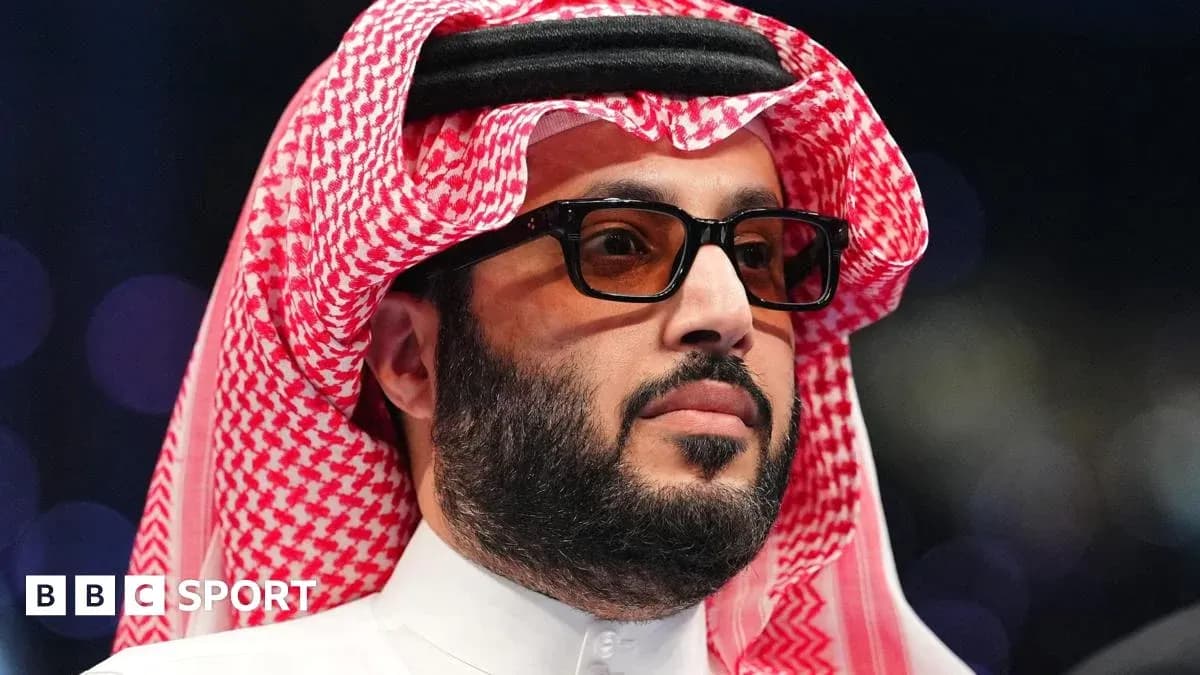
The 44-year-old chairman of Saudi Arabia’s General Entertainment Authority, a key figure in the inner circle of de facto ruler Mohammed bin Salman and now one of the most influential powerbrokers in world boxing, wants to buy into Derby County. Not a full takeover, but a stake in one of English football’s grand old clubs, a name woven deep into the game’s history.
On paper, it is just another investment story in a sport awash with overseas money. In reality, it cuts straight to the heart of the debate about who should be allowed to own English clubs.
A new regulator, an early reckoning
Al‑Sheikh’s bid will be one of the first major cases to land in front of the Independent Football Regulator (IFR), the body created last year to protect the “future and integrity” of the English game.
The IFR has taken control of the owners’, directors’ and senior executives’ test for Championship clubs, a responsibility that previously sat with the English Football League. Any deal for Derby cannot progress without its approval.
Amnesty International has wasted no time in framing the stakes.
“This is a defining test for English football’s new independent regulator,” said Felix Jakens, head of campaigns at Amnesty International UK.
“Will it allow a senior representative of a government directly implicated in mass human rights violations to take control of one of the country’s oldest football clubs? The regulator must ask these questions and answer them transparently.”
Saudi Arabia’s human rights record sits at the core of Amnesty’s concern. The kingdom has long been accused of using sport and culture to launder its global image – “sportswashing” – while critics highlight its treatment of women, its anti-LGBT stance and extensive use of the death penalty.
Amnesty says 356 people were executed in Saudi Arabia last year, a record figure that has drawn fierce condemnation from rights groups.
“The serious questions surrounding Saudi involvement in sport anywhere in the world are just as relevant here,” Jakens added. “Al‑Sheikh is not a private businessman. He is the chairman of Saudi Arabia’s General Entertainment Authority.”
With Newcastle United already majority-owned by Saudi Arabia’s Public Investment Fund, Amnesty argues that any Derby stake “would mark a significant expansion of Saudi Arabia’s footprint in English football”.
The regulator’s decision will signal whether that footprint keeps growing – and on what terms.
Silence in public, pressure in the background
For now, those closest to the process are saying nothing.
The IFR has declined to comment. So too have the EFL and Derby County. Al‑Sheikh’s representatives have also stayed silent.
Behind the scenes, though, the implications are clear. This is not just about Derby. It is about the direction of English football’s ownership landscape at a time when money from the Gulf is reshaping the sport.
Al‑Sheikh has already circled English clubs before. He has held takeover talks with Bristol City and explored possible investments in Southampton and Millwall. None of those came off. Derby could be different.
His growing ties to the Saudi-backed Newcastle project add another layer. Multi-club ownership is a live issue in the game, and the Premier League’s own owners’ and directors’ test explicitly forbids any individual or entity from directly or indirectly determining the management of more than one English league club.
Any move into Derby will be scrutinised through that lens as well.
Derby at a crossroads
Inside Pride Park, the picture is more pragmatic. Owner David Clowes, the Derbyshire property developer who dragged the club out of administration in the summer of 2022, has been open about the need for fresh capital.
Since 2024, Clowes has been looking for new investors and has said he could be willing to sell upwards of 80% of his shareholding. The club’s ambitions – to re-establish itself in the Championship and, eventually, to return to the Premier League after almost 20 years away – demand serious funding.
Al‑Sheikh offers that in abundance. He is a billionaire with a taste for big, theatrical sporting projects.
The divide among Derby fans tells its own story.
Some supporters see only the upside: deeper pockets, stronger squads, a fast-track back to the elite. Others cannot look past the ethical questions that have followed Saudi money into football and boxing.
Rams fan Nick Webster, speaking on BBC Radio Derby’s Sportscene at Six, did not pretend there was an easy consensus.
“There is no skirting around how the fanbase will be divided,” he said. “Many are excited by the billions that potentially could be invested, and then there are the human rights and all the other issues that are going on. Then there will be people in the middle, and it will make a lot of people uncomfortable.”
That tension – hope versus discomfort – now hangs over the club.
The showman and the sell
If anyone embodies the scale and spectacle of Saudi Arabia’s sporting push, it is Al‑Sheikh.
In boxing, he has become the driving force behind some of the sport’s most lavish events. Derby supporter Sam Jones, a boxing manager who has worked closely with him, admits he was “excited straight away” when he heard of Al‑Sheikh’s interest in his club.
Jones points to the May fight night at the Pyramids of Giza as a window into what Derby might be buying into. The card, headlined by Oleksandr Usyk’s world title bout with Rico Verhoeven and featuring Jones’s own fighter Jack Catterall, was staged in one of the most dramatic backdrops sport has ever seen.
“In my 10 years in boxing I’ve been to some very mad places, and my fighter Jack has just won a world title [WBA ‘regular’ welterweight belt] on the foot of the pyramids,” Jones told BBC Radio Derby.
“Before Jack’s ring walk, about half an hour before, there was a bit of a sandstorm. It was completely crazy. But to have that type of vision for boxing, to put on a show there, you’ve got to have serious ambition.
“And if Turki Al‑Sheikh does take over the club or invest heavily in the club, whatever he’s doing, and he puts in a quarter of the effort that he has done with boxing, making all the biggest fights come true, then Derby County fans need to be very excited.”
That is the sales pitch: ambition, vision, scale. For a club that has endured administration, points deductions and years of drift, the idea of a bold new era is seductive.
Yet the bigger the vision, the sharper the questions.
A decision that reaches beyond Derby
English football has wrestled with the ethics of ownership for years, but rarely with a regulator specifically designed to hold the line. That is what makes this case different.
The IFR was created in the wake of the European Super League fiasco and a series of financial collapses that left supporters wondering who, if anyone, was looking after the game’s long-term health. It was meant to be a safeguard.
Now it must decide whether one of the most powerful cultural figures in Saudi Arabia – a state accused of using sport as a political tool and condemned for its human rights record – should help shape the future of Derby County.
Whatever the ruling, it will echo far beyond the East Midlands.
If Al‑Sheikh is waved through, Saudi influence in English football will deepen again, and other clubs may quickly follow Derby’s path. If he is blocked, the regulator will have drawn a firm red line that every would-be owner, from every state and every fortune, will have to reckon with.
For Derby fans, the calculation is more personal: silverware and stability on one side, serious ethical concerns on the other.
For the new regulator, it is simpler and harsher.
This is the job. This is the test. How it answers will tell English football exactly what kind of future it has chosen.





