Trent Alexander-Arnold's Midfield Debate: Mourinho's Verdict
The Trent Alexander-Arnold midfield debate refuses to die. It has followed him from Liverpool to England and now to Madrid, surviving tournaments, managers and tactical revolutions. Every time it feels settled, another coach is tempted to try again.
This time, it was Jose Mourinho.
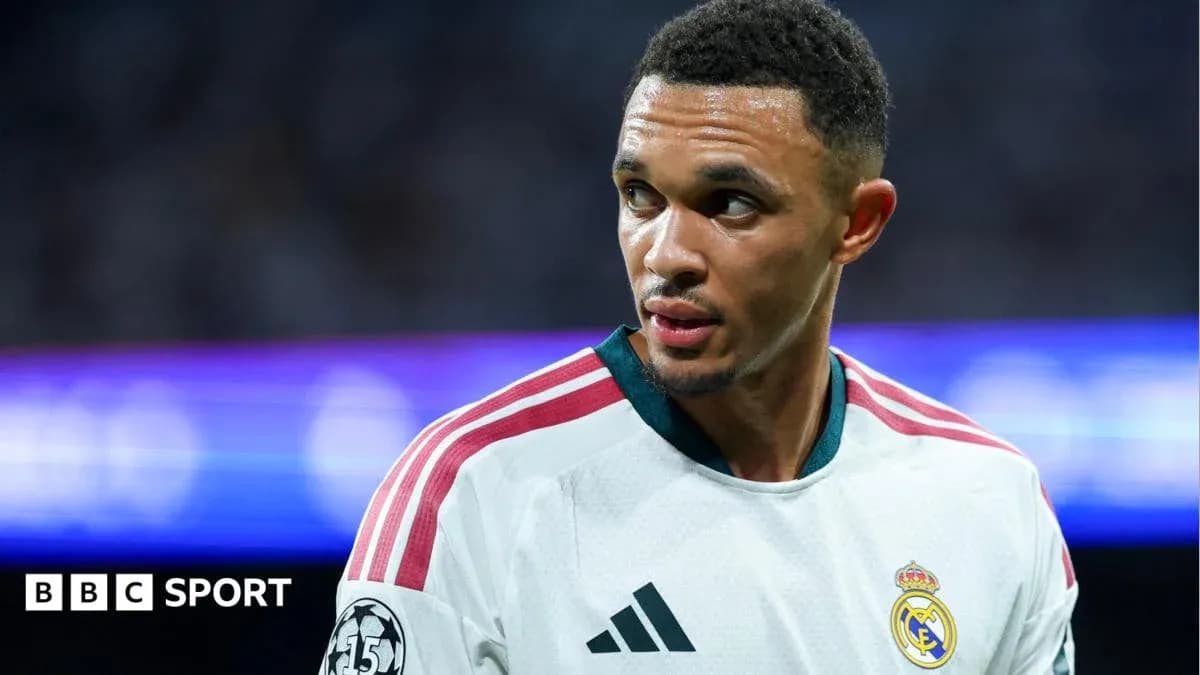
On Tuesday night, under Champions League lights against Inter Milan, the 27-year-old started in central midfield for Real Madrid. Not drifting inside from right-back as he did under Jurgen Klopp, but named there, stationed there, judged there.
It felt like a potential turning point. A player who has struggled to lock down the right-back spot since arriving at the Bernabeu last summer, suddenly trusted in the heart of the pitch on a big European night.
Then came Mourinho’s verdict.
“He has played midfield with England and Liverpool... but he is not a midfielder,” the Real Madrid boss said after an anxious 2-1 win.
That line cut through all the noise. Experiment, yes. Reinvention, no.
A role born of necessity
Alexander-Arnold’s selection in midfield was less grand plan, more emergency measure. Suspensions for Eduardo Camavinga, Arda Guler and Bernardo Silva stripped Mourinho of options and pushed him towards the one player in his squad who has always blurred positional lines.
He lined up alongside Federico Valverde and delivered a mixed performance. On the ball, the qualities were familiar: he created two chances and attempted more crosses than any other Real player. The right foot still sings.
Out of possession, the old questions resurfaced. He failed to win a tackle. His passing accuracy dropped to 83.3%, a noticeable dip at this level. The rhythm he enjoys stepping in from full-back simply wasn’t there in the traffic of central midfield.
When Inter pulled one back on 77 minutes, Mourinho reacted. Alexander-Arnold’s number went up. As he walked off, whistles rippled around the Bernabeu. They sounded more like a verdict on Madrid’s jittery performance than on one man, but the timing did him no favours.
Still fighting for a position
This was the first competitive game in which Alexander-Arnold and fellow right-back Denzel Dumfries both started. Mourinho had already tested the pairing in pre-season against Fiorentina, with Alexander-Arnold at right-back and Dumfries pushed higher on the same flank.
That tells its own story. Mourinho is still searching for a definitive solution at right-back. Just as Alexander-Arnold had to wrestle minutes from Dani Carvajal last season, he now finds himself in another duel, this time with Dumfries.
Yet inside the club, there is respect. BBC Sport understands Mourinho has been impressed by the England international’s performances, his professionalism and, crucially, his versatility. He sees a full-back unlike most others: one who can step into central pockets, dictate from unusual angles and unlock defences with passes most defenders never even attempt.
The weapons remain the same. Passing. Crossing. Through balls. Set-piece delivery. At his best, those attributes tilt games.
The question is where to deploy them.
England’s great ‘what if’
Gareth Southgate tried to answer that. At Euro 2024, he pushed Alexander-Arnold into central midfield for England, only to scrap the idea after two group games and a flat 1-1 draw with Denmark, in which the Liverpool academy graduate was substituted before the hour.
It was not Southgate’s first flirtation with the idea. In June 2023, he handed Alexander-Arnold the number 10 shirt for a qualifier in Malta. England won 4-0, Alexander-Arnold scored from midfield and spoke afterwards about how natural the role felt.
“I haven't played it too much, but it feels comfortable,” he told Channel 4. “It feels natural, I will say that. It's somewhere I can see myself playing.”
That conviction from the player has never quite been matched by the managers who pick him. Southgate edged away from the experiment. Now Mourinho, after one high-stakes trial, has drawn his own line.
Mourinho’s challenge
After the Inter win, the Portuguese coach did not hide the difficulties of the role change.
“He has lost some balls because it is not the same to play in this position compared to at right-back,” Mourinho said. “The intensity of physical work is quite difficult. He has a different engine. He has given 100%. He left the pitch with nothing left to give.”
That last sentence matters. Mourinho clearly values the effort, the willingness to stretch himself for the team, even if he doesn’t see a long-term midfielder in front of him.
For now, Alexander-Arnold remains in a familiar limbo: too gifted to ignore, too unique to fit neatly into a traditional box. Madrid still need a nailed-on right-back. England still haven’t fully solved their midfield puzzle. And a player who can do a bit of both keeps getting pulled between the two.
The debate will not stop here. It will flare again the next time Real are short in midfield, or England chase a game, or a coach looks at that right foot and wonders: what if?