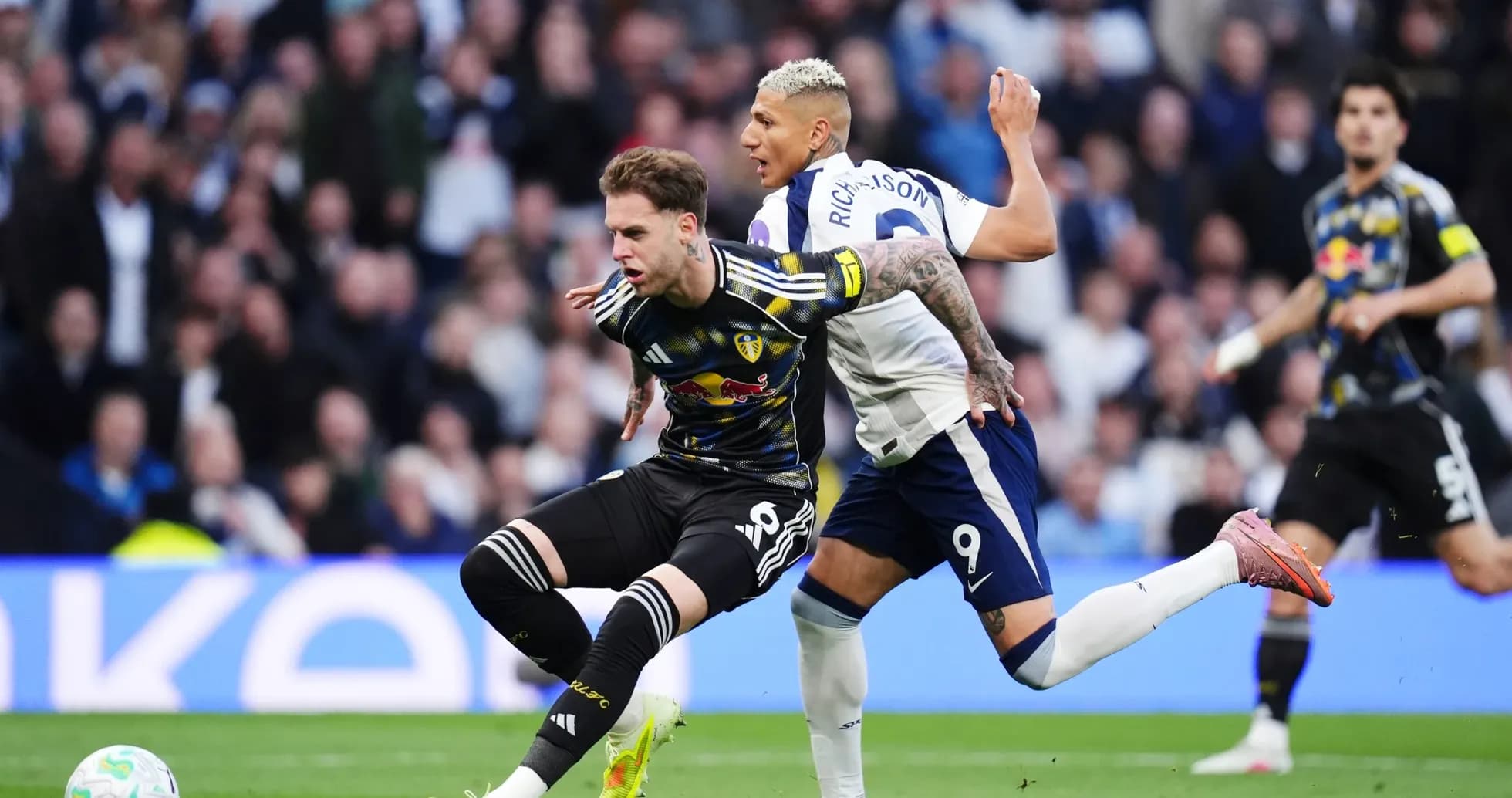
Tottenham 1–1 Leeds: A Stalemate at Tottenham Hotspur Stadium
Under the lights at Tottenham Hotspur Stadium, a tense Premier League narrative unfolded and then froze in stalemate. Tottenham 1–1 Leeds, a result that felt like a missed escape route for the hosts and a hard-earned point for visitors who arrived with more stability, more confidence, and a clearer tactical identity. Following this result in Round 36, the table still tells a harsh truth for Tottenham: 17th place, 38 points, and a negative goal difference of -9 (46 scored, 55 conceded overall). Leeds, in 14th with 44 points and a goal difference of -5 (48 for, 53 against overall), look the more coherent project, even if they had to bend under late pressure in London.
I. The Big Picture – Clashing Identities, Colliding Contexts
This was a meeting of two sides whose seasonal DNA could hardly be more different. Tottenham’s campaign has been defined by volatility: just 9 wins in total from 36 matches, with a stark split between an anaemic home record and a far more functional away side. At home they have won only 2 of 18, drawing 6 and losing 10, scoring 21 and conceding 31. On their travels, they look like another team entirely: 7 wins, 5 draws, 6 defeats, 25 goals for and 24 against.
Leeds, by contrast, are built on home strength and away resilience. At Elland Road they have 8 wins from 18, with 28 goals scored and only 21 conceded. Away, they have been stubborn if unspectacular: just 2 wins but 9 draws from 18, with 20 goals scored and 32 conceded. Daniel Farke’s side arrived with a form line of “DWDWW”, while Tottenham’s “DWWDL” hinted at recent improvement but not transformation.
On the night, Roberto De Zerbi leaned into his preferred 4-2-3-1, trusting the structure that has underpinned 17 league lineups this season. Leeds countered with a 3-5-2, one of their most-used shapes (10 league outings), designed to compress the central corridor and spring quickly into transition.
II. Tactical Voids – Who Was Missing, and What That Cost
The team sheets told their own story of absences and adaptation. Tottenham were stripped of an entire spine of potential starters. Cristian Romero, one of the league’s most aggressive defenders and a card magnet (10 yellows, 1 yellow-red, 1 straight red in 23 appearances), was out with a knee injury. His absence forced Micky van de Ven and Kevin Danso to shoulder the central defensive leadership without their usual enforcer.
Further forward, the creative and attacking deficit was stark. Xavi Simons (2 goals, 5 assists in 28 appearances) and Dejan Kulusevski were both missing through knee injuries, while Mohammed Kudus and Dominic Solanke were sidelined with muscle issues. Guglielmo Vicario’s groin injury handed the gloves to A. Kinsky, altering the build-up dynamic from the back. Ben Davies and Wilson Odobert were also out, further thinning De Zerbi’s options on the left.
Leeds had their own wounds: J. Bogle (hamstring), F. Buonanotte (hamstring), I. Gruev (knee), G. Gudmundsson (muscle) and N. Okafor (calf) all unavailable. Yet crucially, their core spine remained intact: Ethan Ampadu at the base of midfield, A. Stach alongside him, Brenden Aaronson between the lines, and Dominic Calvert-Lewin up top.
Disciplinary profiles framed the edge of the contest. Without Romero on the pitch, Tottenham lost a defender who has already blocked 14 shots and made 31 interceptions this season, but also removed a walking red-card risk. Pedro Porro, another high-card defender with 9 yellows, still carried that edge on the right. For Leeds, Ampadu’s 9 yellow cards and 46 fouls committed underlined his role as the side’s enforcer – and a potential flashpoint in midfield duels.
III. Key Matchups – Hunter vs Shield, Engine Room Wars
The “Hunter vs Shield” narrative revolved around two forwards with very different contexts. Richarlison, Tottenham’s leading scorer with 10 league goals and 4 assists in total, led the line in front of a patchwork creative unit. Behind him, Randal Kolo Muani, Conor Gallagher and Mathys Tel had to collectively replace the absent guile of Simons and Kulusevski. Richarlison’s 42 total shots (24 on target) and 30 fouls drawn this season speak to a striker who thrives on chaos and contact; Leeds’ back three had to manage both his movement and his temperament.
Opposite him, Dominic Calvert-Lewin arrived as one of the league’s most productive central strikers: 13 goals and 1 assist in 33 appearances, with 64 shots and 32 on target. His aerial and physical presence is underlined by 444 total duels, 174 won, and his penalty profile is revealing: 4 scored but 1 missed, meaning Leeds’ spot-kick record is not flawless despite the team’s perfect 6-from-6 penalty conversion overall this season. Against a Tottenham defence missing Romero, Calvert-Lewin’s ability to pin centre-backs and attack crosses was a constant looming threat.
In the “Engine Room”, the duel between Ethan Ampadu and Tottenham’s double pivot of João Palhinha and Rodrigo Bentancur shaped the rhythm. Ampadu’s season numbers – 1628 passes with 85% accuracy, 78 tackles, 16 blocked shots and 50 interceptions – paint the picture of a metronome with bite. Palhinha, stationed alongside Bentancur in the 4-2-3-1, was tasked with disrupting Leeds’ transitions and screening a back line that has conceded 55 goals overall, including 31 at home. The absence of Simons pushed more creative responsibility onto Gallagher, whose role between the lines was to find pockets behind Ampadu and A. Stach, forcing Leeds’ wing-backs, D. James and J. Justin, to collapse infield and open the flanks for Porro and Destiny Udogie.
Out wide, Porro’s dual identity as creator and risk factor was central. With 1377 passes, 49 key passes and 40 dribbles attempted this season, his overlaps and underlaps were Tottenham’s best route to destabilising Leeds’ compact 3-5-2 block. But his 9 yellow cards and 29 fouls committed meant any transition turnover in his zone could leave Danso and van de Ven exposed to Calvert-Lewin and Aaronson running into space.
IV. Statistical Prognosis – xG, Pressure, and a Draw that Fits
Even without explicit xG values in the data, the statistical profiles offer a clear prognosis of how this match was likely to tilt – and why 1–1 feels about right. Heading into this game, both sides averaged 1.3 goals scored per match overall. Tottenham’s defensive fragility at home (1.7 goals conceded on average at Tottenham Hotspur Stadium) met a Leeds attack that is more modest away from Elland Road (1.1 goals scored on their travels) but still capable of capitalising on structural cracks.
Conversely, Leeds’ away defence, conceding 1.8 goals per game on their travels, faced a Tottenham side that, at home, only averaged 1.2 goals scored. The numbers almost beg for a one-goal-each scenario: neither attack consistently ruthless enough to blow the other away, neither defence solid enough to shut the door.
Card distributions reinforced the sense of late tension. Tottenham’s yellow cards peak between 61–75 minutes at 25.26%, signalling a tendency to grow ragged as legs tire and game states tighten. Leeds show a late-game surge of their own, with 23.33% of yellows from 61–75 and 16.67% from 76–90. This is a fixture structurally designed for a scrappy, nervy final quarter, where tactical plans fray and individual duels decide territory more than patterns do.
Following this result, Tottenham’s long, chaotic season remains unresolved, their home frailties still glaring despite flashes of De Zerbi’s positional play. Leeds walk away with a point that fits their away identity: organised, hard to beat, reliant on the work of Ampadu and the threat of Calvert-Lewin and Aaronson. The numbers, the shapes, and the absences all pointed towards balance rather than breakthrough – and 1–1 at the Tottenham Hotspur Stadium felt like the table, and the season, speaking through the scoreline.