Spain’s New Era: From Entitlement to Tactical Powerhouse
There was a time when Spain walked into every tournament as if the trophy already belonged to them. From 2008 to 2012, La Roja didn’t just win; they rewrote football’s rulebook. A World Cup wedged between back-to-back European Championships. An era of such suffocating dominance that everyone else looked like they were playing a different sport.
Then it collapsed. Brutally.
The decade that followed was a long, public comedown. Failed experiments, early exits, identity crises. A nation gorged on success had to swallow humility. The entitlement went. The scars stayed.
Now, as Spain head to the 2026 World Cup, the mood is different. Not meek. Not hysterical. Something far more dangerous: calm, grounded belief.
Fresh from tearing through Euro 2024 – beating Croatia, Italy, Germany, France and England on their way to the title – Luis de la Fuente’s side arrive in North America looking less like a team chasing redemption and more like a fully formed superpower that knows exactly what it is.
Spanish-American journalist and ITV World Cup presenter Semra Hunter sees a national team that has finally grown up.
From suffocating pressure to a healthier pact
The old Spain lived under a constant ultimatum: win or be condemned. That toxic weight has lifted.
Hunter points to a fanbase that has learned the hard way. Supporters who once assumed endless glory now understand the cost of arrogance.
“The fans learned their lesson from how spoiled they were getting with all the success from 2008 to 2012,” she explains. That sense of being “untouchable” vanished when results turned and reality hit. The crash after 2012 was not just sporting; it was emotional.
The turning point came before Euro 2024. De la Fuente walked into the tournament under a cloud. Skepticism, not expectation, followed Spain to Germany. “Going into the Euros, fans were super critical of Luis de la Fuente. There was almost no hope,” Hunter recalls.
That doubt lit a fire. A squad that felt underestimated played with a chip on its shoulder and systematically dismantled everyone in its path. “They were consistently the best team,” she says. The relationship between stands and pitch shifted. Trust returned, but without the old ultimatum.
Now, the message is simple: we believe in you, but we won’t crucify you. A healthier pact for a more mature generation.
The wingers Spain dare not lose
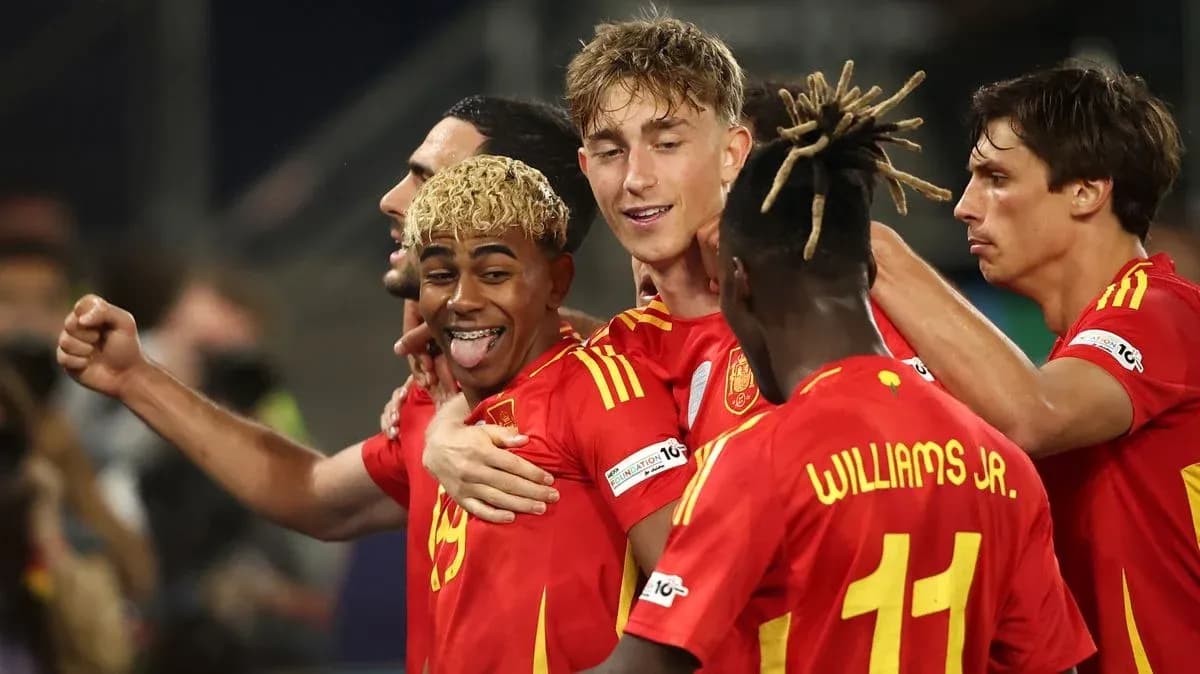
If Spain are to climb the mountain again this summer, the flanks will be decisive. The squad’s most explosive weapons, Lamine Yamal and Nico Williams, carry not just the ball but a nation’s attacking edge in their boots.
Both also carry hamstring worries.
Yamal, the 18-year-old phenomenon, suffered a hamstring injury in April. He is expected to feature at the World Cup, but no one can guarantee what version of him will turn up when the tournament starts.
“They are two of the most special, unique wingers in world football at the moment and they give Spain an edge they wouldn’t have without them,” Hunter says. Yamal, in particular, is a chaos agent. “Lamine Yamal provides so much unpredictability; he’s a destabilising force. We’ve even seen him starting to evolve into the Messi role a little bit, coming more inside. He’s capable of conjuring up a moment of brilliance when the going gets tough.”
On the opposite side, Williams, arguably Spain’s standout star at Euro 2024, has his own hamstring concern after a setback in May. Hunter offers cautious reassurance. “Thankfully, that one doesn’t seem to be as bad, and he should be back to fitness to start training.”
Spain’s structure means they can function without them. But that’s not the point. To win a World Cup, structure alone rarely suffices. “Spain can win without them because of the team’s structure,” Hunter admits, “but they really need both at full tilt to go all the way.”
The system is elite. The wingers make it terrifying.
A midfield that embarrasses the rest of the world
If there is one area where Spain still live in excess, it is midfield. The options are absurd.
Rodri, Manchester City’s metronome and arguably the best holding midfielder on the planet. Barcelona’s trio of Pedri, Gavi and Dani Olmo, each offering a different shade of control and incision. Arsenal’s Martin Zubimendi and Mikel Merino. PSG’s Fabian Ruiz. It reads like a Ballon d’Or longlist.
Hunter is clear: two of them are untouchable. “As long as Rodri and Pedri are fit and firing, they are non-negotiable starters,” she says. Everything else bends around them.
Gavi adds the edge. The snarl, the aggression, the willingness to turn a chess match into a street fight. Dani Olmo brings verticality and goals, drifting into pockets where he can play almost as a forward, breaking lines with his movement and finishing.
Yet even in this wealth, there has been pain. Barcelona’s Fermin Lopez, who racked up 30 goal contributions this season, misses the tournament with a broken foot after undergoing surgery. “Fermin Lopez is a big loss. He’s somebody who probably could have been a breakout player for Spain,” Hunter notes.
Still, the depth is almost indecent. “Luckily, Spanish players are so versatile,” she adds. With Zubimendi a like-for-like deputy for Rodri and others able to adapt across roles, De la Fuente can reshuffle without tearing up his blueprint.
Spain don’t just have a midfield. They have a midfield factory.
The same old flaw: no killer in the box
For all the artistry between the lines, one problem refuses to go away. Spain still lack the one thing that used to terrify defences: a ruthless, penalty-box predator.
“Our biggest weakness is so obvious for me,” Hunter says. “We haven’t had a proper, lethal ‘fox in the box’ striker who can put balls away first touch since the days of David Villa and Fernando Torres.”
The issue is cultural as much as tactical. “No disrespect to Alvaro Morata but Spain just doesn’t produce that kind of player. It’s all about midfielders.”
Real Sociedad’s Mikel Oyarzabal, who scored the winner against England in the Euro 2024 final, is expected to lead the line. Intelligent, technically gifted, reliable in big moments – but not the sort of centre forward who haunts defenders in their sleep.
Spain will once again rely on collective threat, late runs, and shared responsibility for goals. It worked at the Euros. The World Cup, with its razor-thin margins, may ask for something more brutal.
A nation of whiteboard romantics
If Spain export anything as well as midfielders, it is managers. Pep Guardiola, Mikel Arteta, Unai Emery, Xabi Alonso, Andoni Iraola – different personalities, same roots.
“In Spain, football is a language,” Hunter says. From childhood, players are schooled in tactics, positioning, and game theory. The whiteboard is not a tool; it’s a culture.
“Everybody fancies themselves a football philosopher in Spain, really. There’s so much romance about it,” she explains. Guardiola and Xabi Alonso were, in effect, coaches long before they stepped into technical areas. They were managers on the pitch.
Their philosophy is consistent: the collective above the individual. “They focus on the collective, on being collaborative, on the whole being more important than the individual. They’re very humble, they’re hardworking people,” Hunter says. That mentality bleeds into their teams, shaping both management style and playing identity.
This Spain side is an extension of that obsession. Tactically drilled, emotionally balanced, and built on the idea that the system will outlast any single star.
Navigating the group – and beyond
On paper, Spain’s group does not look like a minefield. Cape Verde, Saudi Arabia and Uruguay stand between La Roja and the knockouts.
Hunter expects authority from the start. “They should get through relatively comfortably. Cape Verde are debutants and Saudi Arabia are organised, but Spain should get past them,” she says.
The real examination should come from Uruguay. A side that relishes chaos. “Uruguay will be the biggest test. They are intense, aggressive, streetwise, and technically more talented than people give them credit for. If they want to rough up Spain, they certainly can.”
Spain will need to show they can handle more than just tactical puzzles – they must withstand a fight.
Hunter’s forecast is bold but measured. “I see them getting seven to nine points, topping the group and advancing. Quite honestly, I think they will make it all the way to the final.”
Then comes the line that strips away any last trace of caution.
“I think it’s going to be Spain to win it.”
Not the entitlement of 2010. Not the blind faith of a golden generation. A prediction rooted in structure, depth, tactical culture and a squad that has already proved it can carry a nation without being crushed by it.
Spain arrive in North America not as nostalgic champions clinging to old myths, but as a new kind of giant – humbler, sharper, and, perhaps, even more dangerous.