Shamrock Rovers Secure 3-1 Victory Over Egnatia Rrogozhinë
Shamrock Rovers’ 3-1 win over Egnatia Rrogozhinë at Tallaght Stadium was built on a clear structural plan in Stephen Bradley’s 3-5-2 and a superior adaptation over 90 minutes, especially after half-time. With both sides mirroring each other in a 3-5-2, the match became a question of who could better exploit the half-spaces and wide channels; Rovers answered that emphatically through their midfield line and smart use of their back three.
Out of possession, Shamrock Rovers’ 3-5-2 was compact and vertically disciplined. The back three of T. Sobowale, R. Lopes and E. Stevens held a relatively high line, trusting the congestion in central midfield to slow Egnatia’s progression. The wing‑midfielders W. Fitzgerald and A. Brennan were key: they dropped to form a situational back five when the ball went wide, but were aggressive stepping out on first touches to prevent clean crosses. This structure limited Egnatia’s ability to isolate their forwards and forced much of their attacking to come from deeper, more predictable areas.
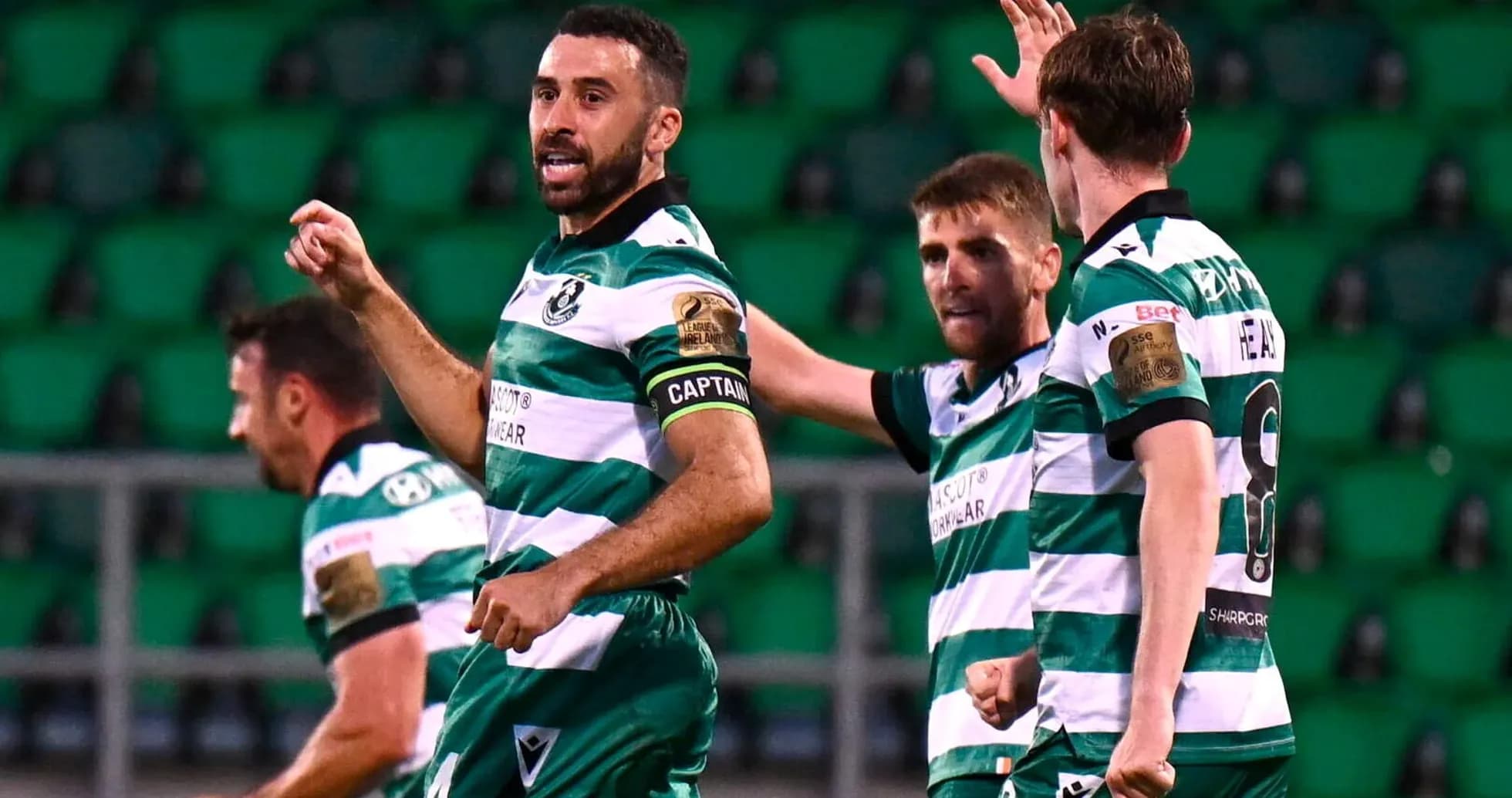
In possession, the same shape morphed into a 3-2-5. D. Watts and M. Healy acted as the double pivot, with one dropping between or beside the centre‑backs to help circulation while the other pushed slightly higher to connect with the front two. J. Byrne operated as the advanced midfielder, often finding pockets between Egnatia’s midfield and defence. This positioning became decisive after the break: his assist for R. Lopes’ 55th‑minute goal underlined how Rovers could drag Egnatia’s back line out of shape with central overloads, then attack the resulting gaps.
Up front, the pairing of G. Burke and A. Greene gave Rovers complementary profiles. Burke’s penalty conversion at 29 minutes reflected not just composure but his broader role as a roaming forward, dropping into midfield to create a temporary 3-6-1 in build-up. Greene, by contrast, provided depth and vertical threat, pinning Egnatia’s centre‑backs and opening lanes for late runs from midfield. When Greene was replaced by J. Afolabi (IN) at 58 minutes, Rovers retained that vertical reference but with fresher legs to press and run channels, preserving the tactical balance rather than changing it.
The turning point tactically came around half-time. At 1-1, both coaches reacted, but Bradley’s adjustments were more coherent. On the Shamrock Rovers side, the 46‑minute change of J. Mulraney (IN) for A. Brennan (OUT) sharpened their left side in possession; Mulraney offered more direct dribbling and inside movements, allowing Fitzgerald to hold width and stretch Egnatia’s right flank. This gave Rovers a more pronounced asymmetry in attack: overloads on the left with Mulraney and Byrne, while the right side, with Sobowale and Fitzgerald, provided balance and rest defence.
Nevil Dede’s triple change at 46 minutes for Egnatia Rrogozhinë — A. Albanese (IN) for I. Diabate (OUT), K. Loukili (IN) for I. Gruda (OUT), and J. Montenegro (IN) for D. Adjessa (OUT) — was a bold attempt to refresh the front and midfield lines, but it disrupted their earlier cohesion. The new attacking unit lacked the same pressing synchronisation, and Egnatia’s 3-5-2 began to resemble more of a stretched 3-4-3 in defensive transition, with the wing‑backs caught high and the half‑spaces exposed. Rovers capitalised by driving their attacks through central channels and second balls around the box.
The own goal by A. Yago at 57 minutes, credited to Shamrock Rovers, was the direct product of that territorial and positional pressure. With Rovers able to sustain attacks in the final third, Egnatia’s defensive line was forced deeper and narrower, increasing the likelihood of miscues under stress. Yago’s misfortune illustrated how Egnatia’s structure, once broken, could not easily recover its compactness.
The subsequent substitutions by Bradley further locked down control. At 69 minutes, D. Mandroiu (IN) for G. Burke (OUT) and N. Razi (IN) for Dylan Watts (OUT) refreshed both the attacking midfield role and one of the pivots. Mandroiu’s tendency to drift between lines maintained Rovers’ creative presence, while Razi’s energy helped sustain counter‑pressing in central areas. Later, J. O’Sullivan (IN) for J. Byrne (OUT) at 77 minutes added legs in the number‑10 corridor to close down passing lanes as Egnatia chased the game.
On the Egnatia side, the later defensive substitutions — N. Ajetovikj (IN) for Z. Aliyev (OUT) at 69 minutes and E. Ndreca (IN) for A. Yago (OUT) at 81 minutes — signalled an attempt to stabilise a back line that had been destabilised by Rovers’ pressure and by the own goal. However, by then Shamrock Rovers’ control of space and rhythm meant Egnatia were largely reacting rather than dictating. Their yellow cards to Ildi Gruda and Alessandro Albanese, both for “Foul”, reflected a team increasingly forced into late challenges as Rovers played through their lines.
With no reliable data on shots, possession, passing or goalkeeping saves, the tactical verdict rests on structure, substitutions and the scoreline. Shamrock Rovers turned a 1-1 half-time situation into a 3-1 full-time win by better exploiting the mirrored 3-5-2, winning the battle for central spaces, and using their bench to intensify, not dilute, their game model. Egnatia Rrogozhinë’s triple change at the break, followed by defensive reshuffles, never fully restored their earlier balance, and under sustained pressure their back line cracked at critical moments. In a two-legged European context, this was a performance that combined structural clarity with in-game adaptability.