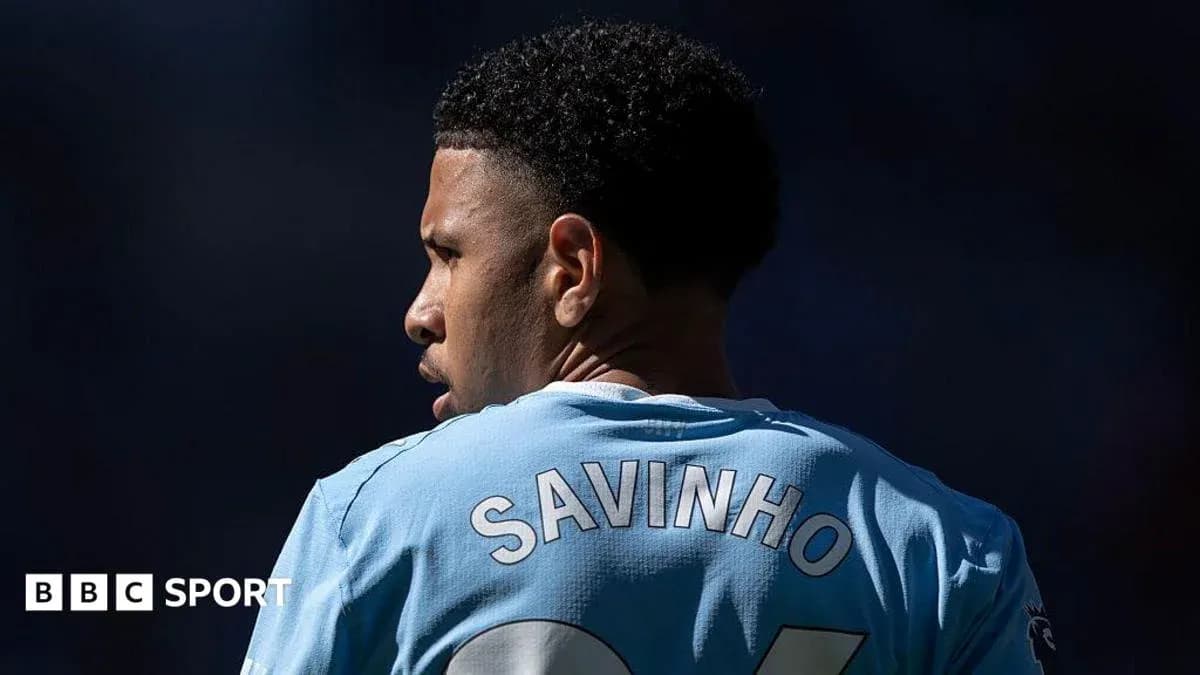
Savinho's Record Transfer: From Troyes to Tottenham
For the City Football Group, Savinho has become more than a winger with a sharp left foot. He is now a landmark line on a balance sheet.
Tottenham’s agreement to pay £75m, plus a possible £10m in add-ons, will make the Brazilian the most expensive sale in Manchester City’s history and a flagship deal for CFG’s global network of 12 clubs. In a sport where player trading increasingly underpins everything, this one reverberates.
From Troyes outcast to La Liga star
Savinho’s journey through the CFG web has been anything but straightforward.
Signed from Atletico Mineiro in 2022 as a record arrival for French side Troyes, he never kicked a ball for the club. At 18, he was shipped out to PSV for the 2022-23 season, then on to Girona for 2023-24. It was in Catalonia that his reputation caught fire.
He played 37 league games as Girona surged into the Champions League for the first time in their history, delivering nine goals and eight assists. His electric form carried him into the La Liga team of the year and, crucially, forced decisions in Manchester.
City moved quickly. They bought him from Troyes for £30.8m in 2024, a price that sparked debate over whether the internal deal reflected true market value after such a standout season in Spain.
City’s calculation pays off
On the pitch in England, Savinho never became a superstar. Two Premier League goals across two seasons is a modest return. But he created, and often. Across his debut campaign under Pep Guardiola, he made 48 appearances in all competitions, producing 16 goal contributions. His eight Premier League assists were the highest at the club that year.
That was enough for City to argue the sporting case. The financial case is unanswerable.
Turn an 18-year-old signing from South America into a £75m sale four years later, with the potential to climb towards a £70m profit once add-ons are met, and you have a model deal in modern football economics.
"It's a success story for the group," said Brian Marwood, CFG’s managing director of global football, speaking to BBC Sport. He framed the strategy plainly: the aim is to push players towards the “pinnacle” of the group – Manchester City – while accepting that some become assets to be cashed in.
Savinho has done both. He reached Guardiola’s first team. Now he leaves for a fee that resets City’s sales records.
Girona’s loss, Tottenham’s gamble
Girona knew what they had and tried to keep it.
"Our intention from the moment that we reached the Champions League was to try to get him to stay for another year," admitted director of football Quique Carcel. But once Pep Guardiola and director of football Txiki Begiristain signalled serious interest in bringing Savinho into City’s first-team squad, the outcome became inevitable.
There was a genuine debate inside the group: keep him in Spain to play Champions League football with Girona, or fast-track him to Manchester? City chose the latter, and Savinho had no doubts once the door to Guardiola’s dressing room opened.
Now Tottenham have kicked that door down with a huge bid. Some will insist they have overpaid. Others will point to his La Liga impact and age – 22 – and see a forward entering his prime.
The answer will arrive on the pitch in north London, not in spreadsheets in Manchester.
A machine that rarely stops
While Savinho grabs the headlines, this is not a one-off. City’s player-trading machine has been humming for years.
In January, BBC Sport highlighted how the club has turned academy and young-player sales into a major revenue stream. Morgan Rogers, Douglas Luiz, Cole Palmer, Liam Delap and Oscar Bobb are just a few of the names who passed through City before being sold on, many to direct Premier League rivals.
More than £250m has been recouped from young-player sales in the past five years alone.
"To find a balance between recruiting players for sporting success and ones that could become more of an asset in the future is difficult," Marwood admitted. Young signings are a gamble: some adapt, work, and thrive; others fade away.
He points to Oleksandr Zinchenko, Taty Castellanos and Jack Harrison as examples of those who turned potential into serious careers, whether at City or elsewhere.
City do not always get it right. The recent trajectories of Rogers and Palmer underline that.
Rogers left City for Middlesbrough in February 2024 for an initial £8m. Chelsea then paid £117m for him last month. Palmer, sold to Chelsea for £40m in 2023, would now command a similar figure if he left Stamford Bridge.
Sometimes City sell at the perfect moment. Sometimes they sell too soon. The model survives both outcomes.
The next wave already forming
Savinho’s exit does not close a chapter so much as clear space for the next names in the pipeline.
Inside the club, there are high hopes for 18-year-old Ryan McAidoo, who has already made his senior debut. Across the CFG network, scouts are locked onto 16-year-old Shin Miidera at Yokohama F. Marinos and American midfielder Cavan Sullivan, currently at Philadelphia Union and due to join City when he turns 18.
Vitor Reiss, who spent last season on loan at Girona from City, is another tipped to make the grade.
"In an ideal world you would love for them to stay with you from the beginning right through to the very end - but the reality is it's probably not going to happen," Marwood said. The real challenge, as he put it, is simple: "OK - Savinho's gone - but where is the next one?"
That question drives the entire operation. CFG wants a conveyor belt of talent, pushed through its global network, tested at different levels, then either kept for trophies or sold for profit.
The measure of success will not be found in just one blockbuster deal with Tottenham. It will be written in the next Savinho, and the one after that.