Saburtalo Defeats Larne 2–1: Tactical Battle Unveiled
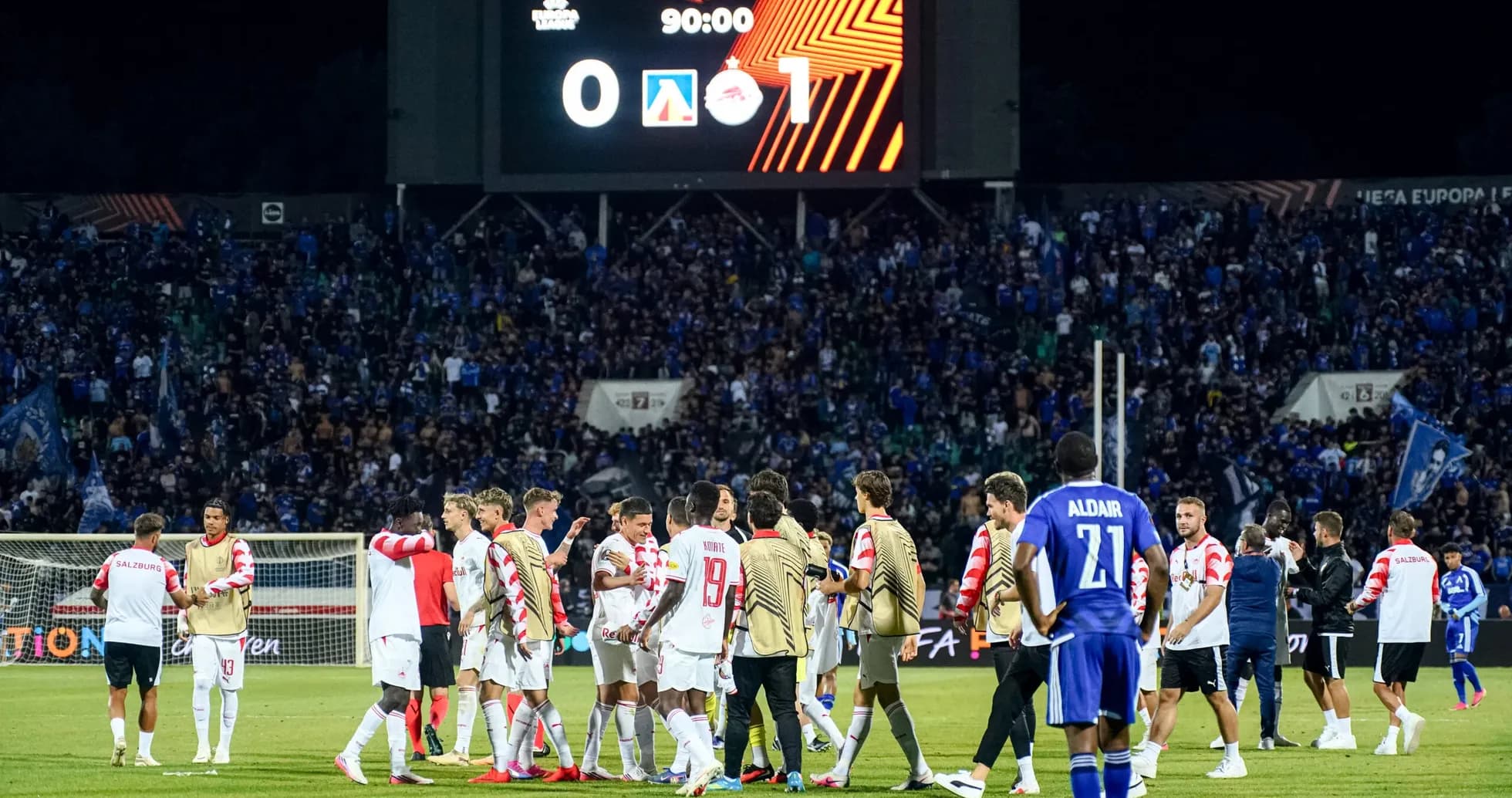
Saburtalo’s 2–1 after-extra-time win over Larne at Mikheil Meskhi Stadium was defined by structural control versus deep defensive resistance. Across 120 minutes, Saburtalo’s 4-3-3 under Andriy Demchenko imposed territorial dominance and ball circulation, while Gary Haveron’s Larne, also nominally in a 4-3-3, morphed into a compact, low-possession block built to survive and counter. The statistical split – 68% possession, 11 corners and 5 shots on goal for Saburtalo against Larne’s 32% possession, 1 corner and 1 shot on goal – underlines a game where the Georgian side dictated almost every phase, yet still had to go beyond 90 minutes to break Larne’s stubborn structure.
Tactical Overview
Tactically, Saburtalo’s 4-3-3 was ball-dominant and width-oriented. The back four of Jemali Giorgi Jinjolava, G. Kobuladze, A. Amisulashvili and V. Selimovic held a high line, enabling sustained pressure and allowing the three-man midfield of N. Dadiani, G. Kutsia and B. Kardava to operate almost exclusively in Larne’s half. With 8 blocked shots, Saburtalo repeatedly worked shooting positions around the edge of the box and half-spaces, only to find Larne’s defensive line and midfield screen throwing bodies in front of attempts. The front line, with N. Sikharulashvili and V. Bedoshvili supported by Z. Natchkebia, rotated positions to drag Larne’s defenders wide and open lanes for late midfield runs.
Larne’s 4-3-3, by contrast, was structurally conservative. The back four of A. Donnelly, M. Ridley, T. Cosgrove and S. Graham (before his later substitution) stayed narrow and deep, compressing the central lane. In front of them, the midfield trio of R. Doherty, C. Gallagher and D. Bent focused on screening rather than pressing high, accepting long spells without the ball. The attacking three of M. Gibson, M. Lusty and D. Sloan were often isolated, which explains Larne’s limited output of 1 shot on goal and 2 shots off goal. Their plan hinged on surviving pressure, winning fouls and set pieces, and hoping transitions or late substitutions could tilt the tie.
Key Substitutions
The substitutions around the 65–80 minute window were a key tactical hinge. Demchenko’s first change – A. Bartishvili (IN) came on for G. Kutsia (OUT) at 65' – freshened the interior midfield, adding more vertical running to attack the spaces Larne were leaving as they tired. Almost simultaneously, Larne reshaped their attacking structure: P. O'Neill (IN) came on for M. Gibson (OUT) at 65', and J. Simpson (IN) came on for R. Doherty (OUT) also at 65'. This shifted Larne towards a slightly more direct, transition-oriented setup, with Simpson providing a more advanced presence and O’Neill offering depth in behind.
Saburtalo’s breakthrough at 74' – V. Bedoshvili scoring from an assist by N. Sikharulashvili – was the product of this territorial and positional dominance. Sikharulashvili’s role, operating between the lines from the right side of the attacking trident, was to receive in pockets and combine quickly; his assist reflects Saburtalo’s intent to attack Larne’s box with runners rather than speculative crosses. Yet Larne’s immediate response at 76', when J. Simpson scored, showed how fine the margins were for a side living off rare attacking moments: Simpson, only on the pitch since 65', capitalised on one of Larne’s few forays forward to level the tie despite the overwhelming shot and possession deficit.
Late Game Adjustments
Demchenko reacted aggressively to the setback. At 77', A. Dzagania (IN) came on for V. Bedoshvili (OUT) and I. Alhassan (IN) came on for B. Kardava (OUT), injecting fresh legs into both the forward line and midfield. These changes were less about changing the system and more about maintaining intensity in the press and the volume of attacking runs as the game approached its final quarter. Larne mirrored this with their own energy-based switches: J. Ukek (IN) came on for M. Lusty (OUT) at 78', and J. McEneff (IN) came on for D. Sloan (OUT) at 78', trying to stabilise midfield and offer a counter-attacking outlet.
Extra Time Analysis
Extra time crystallised the tactical story. Larne’s foul count (27 to Saburtalo’s 19) and their 0 blocked shots show a team that defended almost exclusively inside their own box with last-ditch interventions and constant disruption rather than proactive pressure. Saburtalo, still in their 4-3-3 shape but with several fresh attackers, continued to pin Larne back. At 91', N. Bochorishvili (IN) came on for G. Kobuladze (OUT), a move that slightly rebalanced the back line but primarily ensured energy in the build-up from deep.
The decisive moment arrived at 102', when N. Sikharulashvili scored from a pass by N. Dadiani. Tactically, this encapsulated Saburtalo’s approach: a central midfielder stepping up into the final third to link play and a wide attacker attacking space between full-back and centre-back. Dadiani’s influence grew as Larne’s midfield tired; his ability to receive under pressure and still play forward was crucial in breaking the final line.
Haveron’s last adjustments – L. Wallace (IN) for T. Cosgrove (OUT) at 101' and C. McKendry (IN) for S. Graham (OUT) at 106' – were attempts to refresh the flanks and push full-backs slightly higher, but with only 1 corner and virtually no sustained possession, Larne lacked the structural platform to chase the game. Saburtalo’s late double substitution at 115', with S. Ende (IN) for N. Sikharulashvili (OUT) and E. Kuliyev (IN) for Z. Natchkebia (OUT), was about game management: preserving legs in the wide channels, maintaining pressing triggers, and ensuring the 4-3-3 remained intact defensively.
Discipline and Statistics
Discipline-wise, the pattern also aligned with the tactical story. Larne’s 3 yellow cards, including cautions for Sean Graham at 59', Jordan McEneff at 97' and Dan Bent at 107', reflected repeated late or desperate interventions as they tried to break Saburtalo’s rhythm. Saburtalo’s 4 yellow cards – to Jemali Giorgi Jinjolava at 63', Nika Sikharulashvili at 67', Amiran Dzagania at 84' and Nikoloz Dadiani at 112' – came more from aggressive counter-pressing and the risks taken to keep Larne penned in even after losing the ball.
Without recorded data on goalkeeper saves, passing totals or xG, the clearest statistical indicators are possession, fouls, corners and shots on goal. All point to a match where Saburtalo’s structure, rotations and bench management wore down a Larne side that defended bravely but could not generate enough attacking volume. The 2–1 after-extra-time scoreline mirrors the tactical balance: Saburtalo’s control eventually told, but Larne’s compact 4-3-3 and disciplined low block forced them to work to the very end.