Real Madrid Dominates Oviedo in Tactical Showdown
Under the Madrid lights at Estadio Santiago Bernabéu, this was a meeting of opposites: Real Madrid, second in La Liga with 80 points and a goal difference of 39, hosting bottom‑placed Oviedo, marooned on 29 points with a goal difference of -30. The script heading into this game was clear: a title-chasing giant with one of the league’s most explosive attacks against a side fighting, and largely failing, to keep its head above relegation waters. The 2–0 full-time scoreline felt almost conservative given the underlying profiles.
Real Madrid’s seasonal DNA is unmistakable. Overall they average 2.0 goals for and 0.9 against per match, but at home that climbs to 2.3 scored and just 0.8 conceded. Fifteen wins from 18 at the Bernabéu and 41 home goals tell of a side that suffocates visitors with volume and variety. Oviedo arrive as the inverse: in total they score just 0.7 goals per game and concede 1.6, and on their travels that defensive figure balloons to 2.2 goals against per match, with only 0.9 scored. Two away wins in 18 and 39 goals shipped underline the scale of the task.
Yet the team sheets added a layer of intrigue. Alvaro Arbeloa kept faith with a 4‑4‑2, but he did so while missing an entire shadow spine. Eder Militao, Ferland Mendy, Arda Güler, Dani Ceballos, F. Valverde, Rodrygo, D. Huijsen and Andriy Lunin were all ruled out – a cocktail of muscle problems, illness, head and knee injuries, and simple coach’s decision. It forced Real Madrid into a slightly improvised XI: Thibaut Courtois behind a back four of T. Alexander-Arnold, R. Asencio, David Alaba and A. Carreras; a midfield band of F. Mastantuono, Eduardo Camavinga, A. Tchouameni and Brahim Diaz; and a front two of G. Garcia and Vinicius Junior.
The shape, though, suited the club’s seasonal trends. Real Madrid have leaned most heavily on 4‑4‑2 this campaign, using it in 17 league matches, and it shows in their balance: a double pivot that protects transitions, wide midfielders who can step into half-spaces, and forwards who can both stretch and drop. With 13 clean sheets in total and only four matches all season where they failed to score, the structure is built for control at both ends.
Oviedo, under Guillermo Almada Alves Jorge, mirrored that with a 4‑3‑3 rather than their more habitual 4‑2‑3‑1 (used 24 times in the league). A. Escandell started in goal, behind a back four of N. Vidal, Eric Bailly, D. Costas and R. Alhassane. The midfield triangle of N. Fonseca, S. Colombatto and A. Reina was tasked with screening and sparking counters, while the front three of I. Chaira, F. Viñas and T. Fernandez carried the burden of a blunt attack. They, too, were undermanned: L. Dendoncker and B. Domingues were out injured, O. Ejaria sidelined, and both J. Lopez and K. Sibo suspended after red cards. For a squad already stretched by a season of struggle, those absences stripped away depth and defensive experience.
The disciplinary backdrop mattered. Oviedo’s season-long card profile is volatile: 23.38% of their yellow cards arrive between 61–75 minutes and 16.88% between 76–90, while 40.00% of their red cards are shown in that same 76–90 window. This is a team that frays late, precisely when Real Madrid’s bench can introduce fresh pace and incision. Real’s own yellow-card peak sits between 61–75 minutes as well, at 22.06%, suggesting that the hour mark is the game’s emotional tipping point – but their red cards are more evenly distributed and, crucially, they have the technical security to manage those phases.
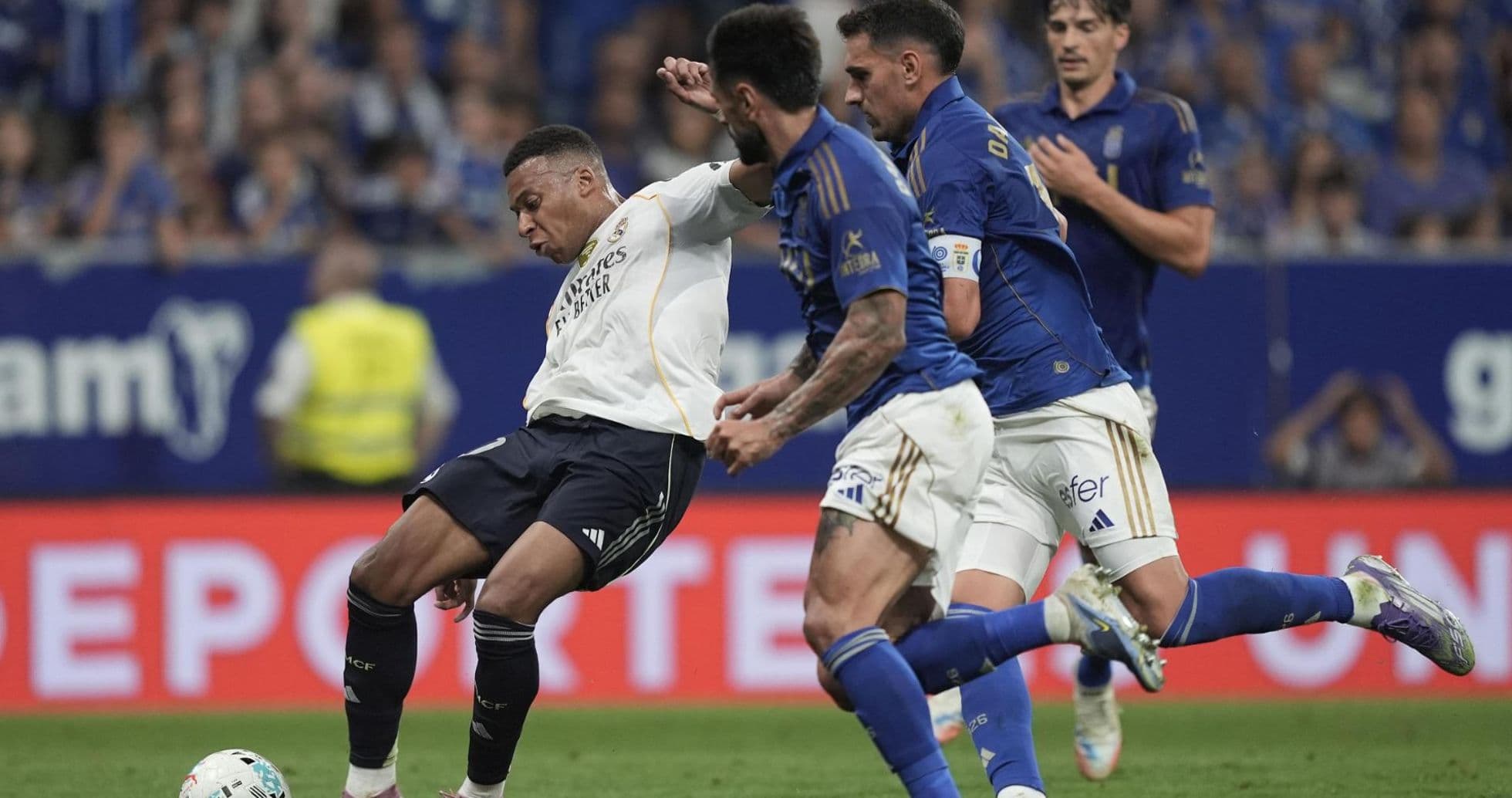
The “Hunter vs Shield” duel is almost cruelly lopsided. Kylian Mbappé, even starting on the bench, enters this fixture as La Liga’s leading scorer with 24 goals and 5 assists. His profile is that of a volume predator: 102 shots in total, 61 on target, and 141 dribbles attempted with 76 successful. He has already won 4 penalties and converted 8, though he has missed 1 from the spot – a reminder that Real’s perfect 100.00% team penalty record (12 scored from 12) does carry one individual blemish. Alongside him in the wider squad, Vinicius Junior has 15 league goals and 5 assists, 73 shots with 45 on target, and a league-leading dribble engine with 190 attempts and 86 successes. Together, they define an attack that relentlessly attacks the half-spaces and back-post channels.
Set against that is Oviedo’s defensive reality away from home: 39 goals conceded in 18 away matches, at an average of 2.2 per game, and only 1 away clean sheet. The Shield is brittle. Even with Bailly’s physicality and D. Costas’s positional sense, the back line is used to defending deep and often late. F. Viñas, Oviedo’s main attacking outlet with 9 goals and 1 assist, is also their most combustible presence: 5 yellow cards, 1 yellow-red, 2 straight reds. He leads the press, draws 67 fouls and commits 45, but his aggression can quickly become a liability against a side as technically secure as Real Madrid.
In the “Engine Room”, Real Madrid’s advantage is more nuanced but just as decisive. Camavinga and Tchouameni provide a double pivot that can both break and build: they sit in front of a defence that concedes only 0.8 goals per game at home, recycling possession and shutting down counters before they form. Around them, Diaz and Mastantuono drift into pockets, linking with Vinicius between the lines. Oviedo’s trio of Fonseca, Colombatto and Reina must cover enormous horizontal distances simply to stay compact, and with their squad’s fatigue and disciplinary record, that is a structural risk as the minutes tick past 60.
Statistically, the xG balance for a fixture like this would be expected to lean heavily towards Real Madrid. Their shot volume, home scoring average of 2.3, and the presence of elite finishers such as Mbappé and Vinicius suggest a multi-goal home xG, while Oviedo’s total average of 0.7 goals for – and frequent failures to score (19 matches in total) – points to a limited attacking threat, especially under sustained pressure. Defensively, Real’s 33 goals against overall, and only 14 at home, underline a solidity that should keep Courtois relatively protected, particularly with Oviedo forced to rely on transitions rather than structured possession.
Following this result, the 2–0 scoreline feels like a logical expression of the underlying numbers: Real Madrid’s structure, depth and attacking talent steadily overwhelming an Oviedo side whose resistance is brave but statistically fragile. The tactical story is one of inevitability – a top-tier Hunter, backed by an organised Shield, eventually breaking down a weary, card-prone underdog that has been living on the edge all season.