Qarabag vs CSKA Sofia: Tactical Analysis of Goalless Draw
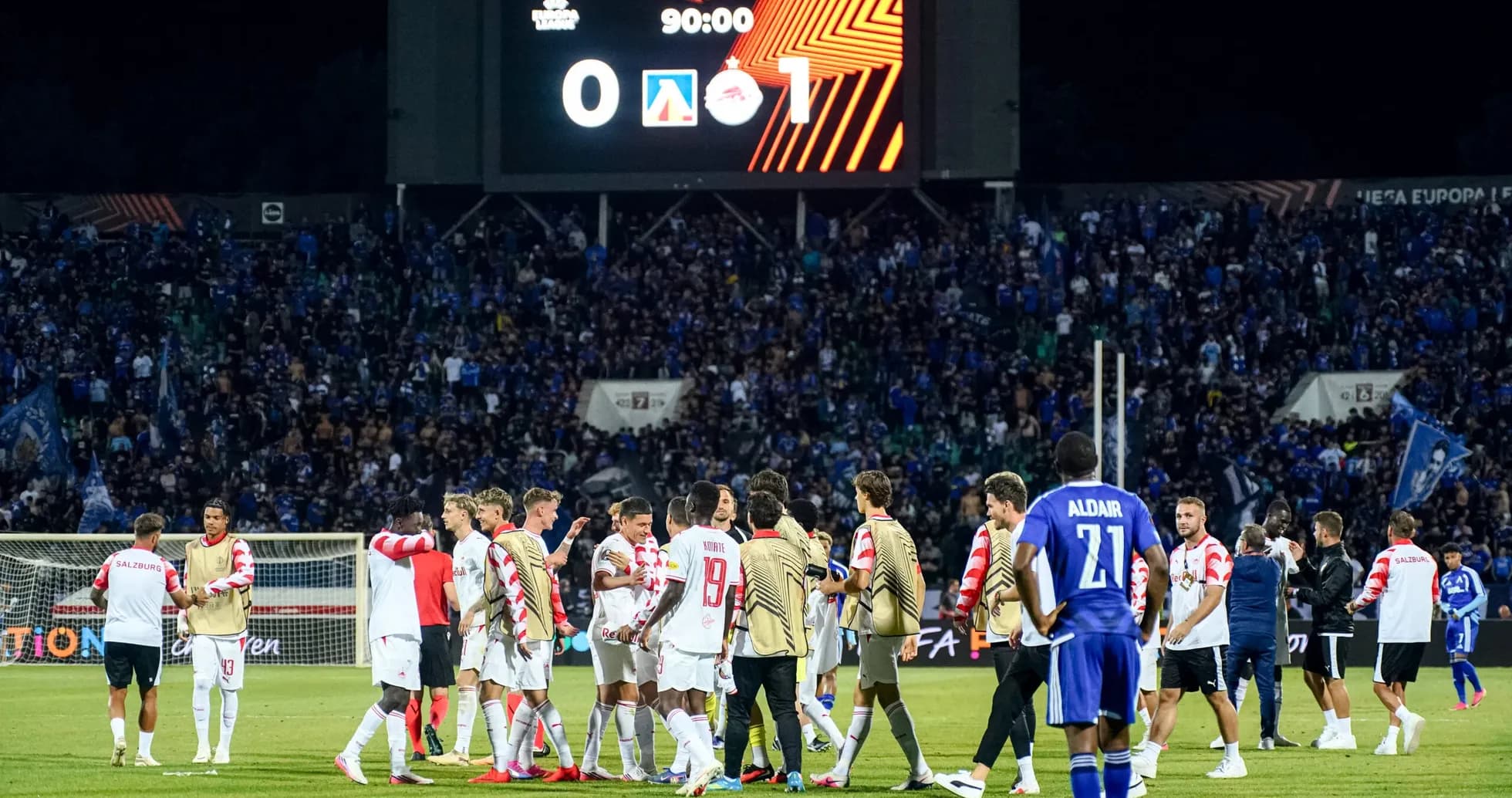
The goalless draw at Azərsun Arena was anything but passive. Qarabag and CSKA Sofia produced a tactically tight UEFA Europa League 2nd Qualifying Round first leg that hinged on structure, rest defence and risk management rather than volume of chances, with the 0-0 reflecting two well-drilled systems cancelling each other out.
Qarabag's Formation
Qarabag lined up in a 4-2-3-1 under Qurban Qurbanov, with M. Kochalski in goal behind a back four of Matheus Silva, B. Huseynov, B. Varkonyi and B. Langa. The double pivot of Pedro Bicalho and Marko Janković provided the platform for a fluid band of three — O. Kashchuk, Kady Borges and A. Zoubir — supporting lone forward Z. Sawo. The structure was recognisably Qurbanov: full-backs providing width, the No. 10 drifting into half-spaces, and wide players coming inside to overload central lanes.
CSKA Sofia's Response
CSKA Sofia, coached by Hristo Yanev, responded with a compact 4-4-2. F. Lapoukhov started in goal, shielded by a back four of Pastor, F. Rodriguez, T. Ivanov and A. Martino. The midfield line of M. Ebong, J. Gbamin, B. Jordao and S. Sensi sat behind the front pairing of L. Godoy and I. Pittas. On paper it was a traditional 4-4-2, but in practice it morphed into a 4-4-1-1 out of possession, with one striker often dropping to screen Qarabag’s pivots.
Possession and Tactical Features
Possession was almost evenly split — 52% to CSKA Sofia, 48% to Qarabag — but the territorial story was more nuanced. Qarabag’s 4-2-3-1 aimed to progress through Kady Borges between the lines, using Janković and Bicalho as circulation hubs. However, CSKA’s front two worked in tandem to block central access, forcing Qarabag to funnel attacks wide. That explains Qarabag’s slight edge in total shots (12 to 11) and a clear advantage in corner kicks (8 to 2): they were the side more consistently pinning the opposition back, but often from wide and less optimal angles.
CSKA’s 4-4-2 block was the defining tactical feature. The wide midfielders, Ebong and Sensi, were diligent in tracking Qarabag’s full-backs, preventing easy 2v1s on the flanks. J. Gbamin’s presence as a deeper central figure gave the visitors a quasi-holding midfielder in front of the centre-backs, allowing the back four to hold a relatively high line without being dragged out by Kady Borges’ movements. The result was that Qarabag, despite their structural ambition, found it hard to create clear central shooting positions.
Shot Profile
The shot profile underlines this balance. Qarabag registered 12 total shots with 5 on goal; CSKA Sofia produced 11 shots with 4 on goal. The near-parity in both volume and accuracy speaks to two teams that managed to reach the final third but were met by well-organised low-to-mid blocks. With blocked shots at 0 for both, most efforts were allowed through but from positions that goalkeepers could read and handle, rather than desperate last-ditch defending.
Discipline and Cards
Discipline was controlled but not absent. CSKA Sofia collected two yellow cards — one for Leandro Godoy on 35 minutes and another for Facundo Rodríguez on 77 minutes — while Qarabag’s Marko Janković was booked on 37 minutes. With no additional info provided for the card reasons, the picture is simply of tactical fouls and duels in key zones rather than emotional loss of control. The card timings fit the game’s rhythm: Godoy’s caution arriving as Qarabag’s possession spell grew, Janković’s in response to CSKA transitions, and Rodríguez’s later as Qarabag pushed in the final phase.
Substitutions and Tactical Layers
The substitutions around the hour and into the final quarter added further tactical layers. On 56 minutes, Qurbanov made a double change: R. Cephas (IN) came on for M. Janković (OUT), and E. Cafarquliyev (IN) came on for B. Langa (OUT). Removing a pivot for a more direct attacking option in Cephas tilted Qarabag towards a 4-1-4-1 or even a 4-2-4 in certain phases, with more vertical running and threat in behind rather than patient build-up. Cafarquliyev’s introduction for a full-back suggested a desire for more attacking thrust down the flank, likely asking the replacement to push higher and pin CSKA’s wide midfielders deeper.
CSKA Sofia’s response at 73 minutes was equally telling. J. Zwarts (IN) came on for L. Godoy (OUT), and I. Solet (IN) replaced M. Ebong (OUT). Zwarts brought fresh legs and depth running to stretch Qarabag’s back line, while Solet added energy and ball-carrying in midfield. Yanev’s double change was about refreshing the pressing and preserving the 4-4-2’s compactness as Qarabag increased the tempo.
Qarabag’s next wave of changes at 74 and 78 minutes further emphasised attacking intent: J. Mouaddib (IN) came on for O. Kashchuk (OUT), C. Makreckis (IN) for B. Huseynov (OUT), and later J. Montiel (IN) for A. Zoubir (OUT) on 78 minutes. Swapping a centre-back for a midfielder in Makreckis hinted at a back-three-in-possession or a riskier back line, pushing extra bodies into midfield and the half-spaces. Mouaddib and Montiel added fresh creativity between the lines, trying to unpick CSKA’s tiring block.
CSKA's Late Defensive Adjustments
CSKA’s late defensive adjustments — T. Ouorou (IN) for A. Martino (OUT) on 84 minutes, then at 90+1 minutes M. Brahimi (IN) for Pastor (OUT) and P. Panayotov (IN) for S. Sensi (OUT) — were about game management. Rotating full-backs and a central midfielder in added time helped preserve concentration and legs in the defensive shell, ensuring the clean sheet was protected as Qarabag chased a late breakthrough.
Match Statistics
Statistically, the match paints the picture of two evenly matched sides leaning on their core identities. Qarabag’s 8 corner kicks to CSKA’s 2 underline their territorial pressure, especially after the attacking substitutions. Yet the inability to turn that into a decisive volume of high-quality shots — only a marginal 5 to 4 edge in shots on goal — reflects how well CSKA’s 4-4-2 block protected the central corridor.
Conversely, CSKA Sofia’s slight possession edge (52%) in an away European tie, combined with an almost equal shot count and disciplined defensive shape, suggests a game plan executed with maturity: absorb, counter selectively, and ensure the tie remains finely poised for the return leg. With no red cards, no goals and a balanced statistical profile, this was a first leg defined by tactical respect and structural discipline rather than chaos — leaving everything open for the second match.