Premier League Transfer Market: The Rise of Domestic Deals
The old saying used to be that English players came with a premium. Now the mark-up sits somewhere else: simply being a Premier League footballer is enough.
This summer, as English clubs smashed yet more spending records, the gap became stark. The average fee for a player signed from another Premier League side hit £39.4m. For those arriving from abroad, it was £20.2m. Same sport, same window, two very different markets.
Kieran Maguire, professor of football finance at the University of Liverpool, has a neat name for it: “a Premier League tax”.
Clubs are not just paying for talent. They are paying for the certainty that comes with a player already proven in the division – and for the accounting advantages that follow.
The boom in domestic blockbusters
Premier League clubs have grown far more relaxed about selling to each other, even to direct rivals. The numbers at the top end of the market show how far that shift has gone.
Deals worth £40m or more have exploded. In 2024-25 there were 13 such transfers. This summer there were 27.
Two years ago, seven of those big-money moves were with clubs on the continent and six were between Premier League sides. This year, the European tally nudged up only slightly to nine.
Inside England, though, the picture changed completely. Those £40m-plus domestic deals jumped from six to 18. The total spend on transfers between English clubs more than doubled.
The Premier League has become its own trading floor.
The ‘algorithm kids’ and the new talent pipeline
The story is not just about headline fees. It is about who does the first buy, and who cashes in later.
English clubs now scour foreign markets with forensic detail. Many of the best young players arrive earlier, develop in mid-table or upwardly mobile sides, and are then flipped to the elite.
“We’ve got a new tranche of clubs, sort of the algorithm kids, who are recruiting from the international markets,” Maguire told BBC Sport. “They’re bringing players to the Premier League, and then the Big Six clubs are signing the best players.”
Carlos Baleba is the model. Brighton picked him up from Lille three years ago for £23m. Last week they sold him to Manchester United for £70m.
Maguire likens it to a “petri dish” for overseas talent. Clubs like Brighton test whether a player can handle the league; if he can, the superclubs pay the premium. Everyone along the chain takes a cut.
But some transfers feel like they belong to a different universe entirely.
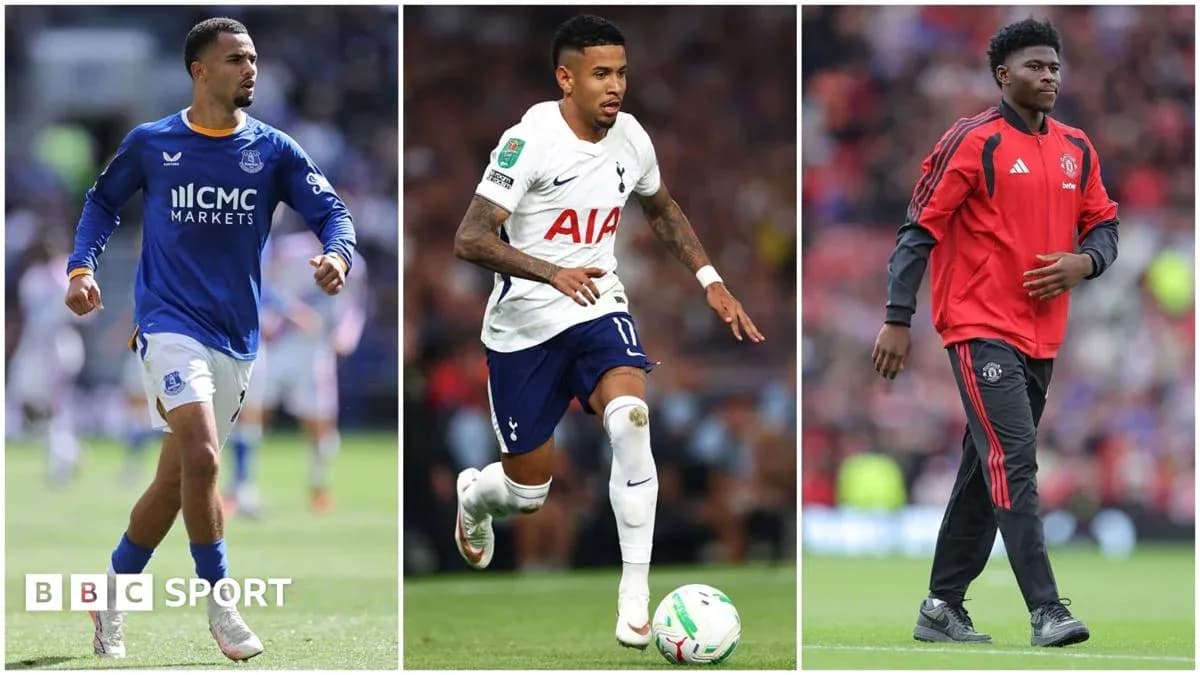
Would any European club have handed Manchester City the £75m that Tottenham paid for Savio? Would Everton have found a buyer on the continent willing to spend £65m on Iliman Ndiaye? Or West Ham a club outside England ready to drop £85m on Mateus Fernandes, as Spurs did?
The answer lies in the rest of Europe’s activity. Across the continent this summer, there were only seven deals of £40m or more between European clubs – and every one of them involved Barcelona, Bayern Munich or Paris St-Germain.
‘A bubble of its own’
Trevor Watkins, the former Bournemouth chairman and now sports lawyer, sees an ecosystem cut off from the rest.
“The revenues dwarf what other leagues generate,” he told BBC 5 Live Breakfast. “And what you see this year is a lot of deals between clubs in England.
“A lot of money going down to lower leagues, but also between Premier League sides because, to be honest, they’re probably the only ones that will pay the wages or pay the fees.”
The market has become a spreadsheet game. Players are not only judged on their pressing, their passing, their goals. They are judged on what they do for the balance sheet.
In some cases, the profit on a transfer matters more than the player’s on-pitch output. Profit keeps clubs within the rules and allows them to reinvest.
Inside the numbers: why profit beats price
Take Elliot Anderson. Nottingham Forest paid Newcastle £35m for him and later sold him to Manchester City for £116m. On the surface, that looks like an £81m gain.
The accounts tell a different story.
The original £35m fee is spread – amortised – over the length of Anderson’s Forest contract. When he moved to City, around £21m of that cost was still on Forest’s books. Against a £116m sale, that produces an accounting profit of roughly £95m.
Under the Premier League’s new squad cost ratio (SCR) rules, that £95m is then spread over three years, counting as £31.67m per season for Forest’s calculations.
The days of selling one player for a huge one-off boost are gone. Clubs cannot simply cash in to fix a single window or dodge a looming breach of financial regulations. Profits are smoothed, and so is the impact.
That makes it even more important to push transfer fees as high as possible. A bigger sale means a bigger average profit for SCR, which itself is calculated over a season.
And that structure, unsurprisingly, favours the heavyweights.
Big Six power, and everyone else’s gamble
The ‘Big Six’ – Arsenal, Chelsea, Liverpool, Manchester City, Manchester United and Tottenham – operate on a different financial plane. This summer, they spent £1.658bn on players.
“Those clubs have future-proofed themselves by trying to generate more income,” Maguire said. “Spurs is a classic example. Spurs now have a multi-function, multi-sport stadium, of which the football club is the biggest part.
“It is a reward for those clubs that have expanded their stadiums, or thought outside of the box in terms of trying to generate additional revenues.”
For the other 14 clubs, who still collectively spent £1.833bn, player trading is not a luxury. It is the business model.
Aston Villa and Newcastle alone completed five deals worth £40m or more. They could only do that after banking hundreds of millions in sales.
As more money circulates within England, less of it seeps out to the rest of Europe. Yet the ripple effect is still felt across the continent, and not in a way that comforts rival leagues.
Europe watches the inflation spiral
La Liga’s corporate general director Javier Gomez did not mince his words on Wednesday. He attacked what he called a “loss-making model which is an issue exclusive to the Premier League”.
“It has other consequences,” Gomez said. “It inflates the entire sector – it inflates the Premier League, the Bundesliga, the French League, and eventually us as well.”
Some of Europe’s traditional powers already know they cannot go toe-to-toe with the Premier League’s top end.
“With the exception of some of the global brands within football, and I think you’d look at Real Madrid, Barcelona, PSG and Bayern Munich, the Premier League can outspend anyone and everyone,” Maguire said.
The latest Deloitte Money League underlined that dominance, with 14 Premier League clubs in the 30 biggest teams in world football. Real Madrid, Barcelona, PSG and Bayern Munich took the top four spots, but Liverpool led six English sides that filled out the top 10.
Andre Villas-Boas, now president of FC Porto, has felt the shift from the other side of the table.
“For Porto, it means we are competing for talent not with Man City or Liverpool but with (the likes of) Coventry and Brentford, without any disrespect,” he told BBC Sport.
“The fact that they have this spending power makes it difficult for us.
The Premier League is set apart from all the rest, which means English clubs are becoming more and more dominant of European competitions.”
That dominance is already visible. Aston Villa and Crystal Palace won the Europa League and Conference League last season. Arsenal reached the Champions League final, only to be beaten by PSG.
The transfer bubble around England shows no sign of bursting. The question now is not whether it will pop, but how much bigger it can grow before European football’s balance tilts beyond repair.