Plazma Youth Sport Games: A Celebration of Young Talent in Split
On a raised platform above the Adriatic, 20 children sit in a circle, locked in concentration. They are not playing each other. They are taking on Nigel Short.
The grandmaster shuffles awkwardly from board to board, making a single move at each stop. The kids – the best young chess talents from across the Balkans – are no easy marks. Yet the real curiosity lies just behind them. Each child can turn to a “celebrity coach” for help. So Short’s opponents are being guided not only by former French Open champion Ana Ivanovic and ex-Burnley manager Sean Dyche, but also by rightwing tech billionaire Peter Thiel.
It is a surreal little tableau, but it captures the essence of the Plazma Youth Sport Games.
The “Davos of sport” on the Dalmatian coast
Split is celebrating 30 years of the Plazma Youth Sport Games (YSG) this month. The event has been described by some of its heavyweight guests as “the Davos of sport”, and it feels like it. Every summer, big names from sport and politics descend on the Dalmatian coast. The real stars, though, are the kids.
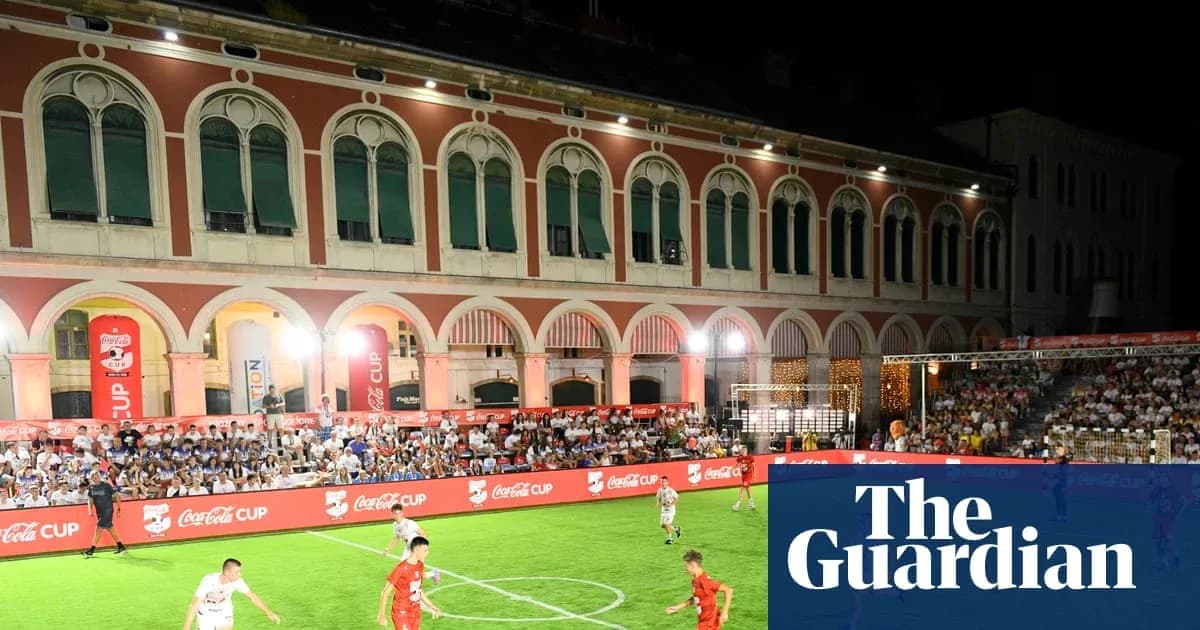
The YSG is now the biggest amateur sports event for children in Europe. Just under half a million young people from Croatia, Bosnia and Herzegovina, Serbia, Slovenia and North Macedonia took part in qualifying this year. Over one week in Split, they converge for finals in 10 sports – from chess to 3v3 basketball.
Competition is only half the story. The Games are framed as a “social project”, with organisers pushing themes of teamwork, collaboration and, crucially, putting phones away. The message has resonated. A growing cast of athletes, politicians and media figures have signed on as ambassadors, from Zlatan Ibrahimovic to Alastair Campbell.
Visitors tend to leave converted. Dyche is one of them. He calls the Games “a brilliant, brilliant initiative”, and he lingers on the girls’ mini-football final as a standout moment. “It was terrific, they were playing good football; getting properly stuck into each other, properly playing,” he said. “You could feel that they felt free and were being supported in that environment.”
Dyche, though, doubts whether something on this scale could have emerged in the UK. “It seems to me that every time you try and get an initiative off in England, there’s a million rules and regulations that make it difficult,” he said. “I know how hard it can be to get funding too and times are tough for people.”
Born out of crisis, aimed at real life
The Plazma Games themselves were forged in hard times. Founder Zdravko Maric launched them in the aftermath of the breakup of Yugoslavia and the Bosnian war. His primary concern was not reconciliation. It was drugs.
Croatia’s young people were facing serious problems with substance abuse. Sport, he believed, could offer a way out.
“It’s a lifetime project and we live with it every day,” says his brother, Slaven Maric, who has worked on the Games since the beginning. “But when Zladko started it we didn’t have an idea that it would develop into this. It’s not about sport or the results, its about social life, it’s about being together. There were many issues with drug abuse [then], now it’s about bringing the kids to spend sometime together in real life.”
That last phrase – “real life” – has become a central theme. Getting kids off their phones is a key message for the 2026 edition. Esports brands have already tried to muscle in. Maric says they have been turned away.
Split, a small city with a giant sporting shadow
By bringing the Games to Split, the Maric family tapped into a remarkable sporting tradition. The city’s population sits at around 160,000, yet its roll call of champions could belong to a metropolis ten times the size.
Goran Ivanisevic and Bernard Vukas headline the list in tennis and football respectively – Vukas was considered Croatia’s greatest footballer before Luka Modric. The city’s reach stretches across disciplines: Branko Cikatic, one of the greatest kickboxers; Toni Kukoc, a three-time NBA champion; Stipe Bozic, a renowned mountaineer.
Split even celebrates its success with its own Olympic “walk of fame”, honouring 73 medal winners in Hollywood style. It has even created its own sport, picigin, a kind of hand-played hackysack in the shallows of the Adriatic.
The bond between the YSG and the city is obvious. Locals talk about the event with a mixture of pride and protectiveness. Slaven Bilic, another son of Split and a former Premier League player and manager, is now an ambassador for the Games.
“I’m not objective because I’ve known Zdravko for more than 30 years but it’s great that at a time when there’s a lot of negativity in the world that this can exist,” Bilic said. “Especially in this part of the world that is supposed to be unstable.”
Billionaires, brands and a bigger map
Three decades in, the natural question hangs in the air: what next?
One ambition is clear – expansion. North Macedonia took part for the first time this year. Ukrainian teams were invited as guests. Talks have been held with six other countries about joining in the future.
The commercial side is growing too. Coca-Cola is now a partner, as are Topps and leading Croatian telecom firm Telemach. Behind them, a cluster of ultra-wealthy backers has formed. There are now 11 billionaires associated with the Games, several of whom have put money into its growth.
Among them is Peter Thiel, the PayPal and Palantir founder and mentor to US vice-president JD Vance. He is understood to be an investor in the YSG. Asked by the Guardian why he had chosen to back the project, Thiel declined to answer and continued down the riviera flanked by his security detail.
For Aleksander Ceferin, the Uefa president, the Games represent something else again: a case study in how elite sport should use its wealth. Uefa helps fund the YSG, and Ceferin is an enthusiastic supporter.
“I think that top sport, and the money that you get with top competition, should be used for the development of sport and this is the development of sport,” he said in Split. The line invited an obvious comparison with Gianni Infantino’s attempts to sell a stake in the World Cup to private investors – a battle Ceferin was reluctant to discuss directly while in town, but one that hovered over his praise.
A star-studded kickabout to close the week
The Games signed off on Friday night with their own take on Soccer Aid. On one side, a YSG selection. On the other, an all-star XI featuring Claude Makélélé, Pavel Nedved and Zlatan Ibrahimovic. On paper, it was a mismatch. In the dugout, though, the local youngsters had Dyche.
It was a fitting final image: world and European greats sharing a pitch with teenagers, a Premier League manager barking instructions, a crowd roaring for both sides. Bridges being built. Memories being etched in. Tackles flying in with no regard for reputation.
For a 30th birthday, it felt about right. The real intrigue now is how big this “social project” dares to become – and how long it can hold on to that sense of freedom that first drew the kids in.