PAOK's Tactical Struggles Against Anderlecht in Europa League
PAOK’s 4-2-3-1 at Toumba Stadium was built to dominate territory and the ball, and it did: 65% possession, 5 corners to 1, and a 14-shot volume (3 on goal, 11 off) against an Anderlecht side content to defend deep in a 4-3-3 that often flattened into a 4-5-1. Yet the entire tactical story was skewed by the opening minute: M. Cvetkovic’s goal, assisted by E. Llansana, gave Anderlecht a 1-0 lead after just 1’, allowing Vitor Bruno’s team to immediately drop into a compact, low-to-mid block and play the game on their terms.
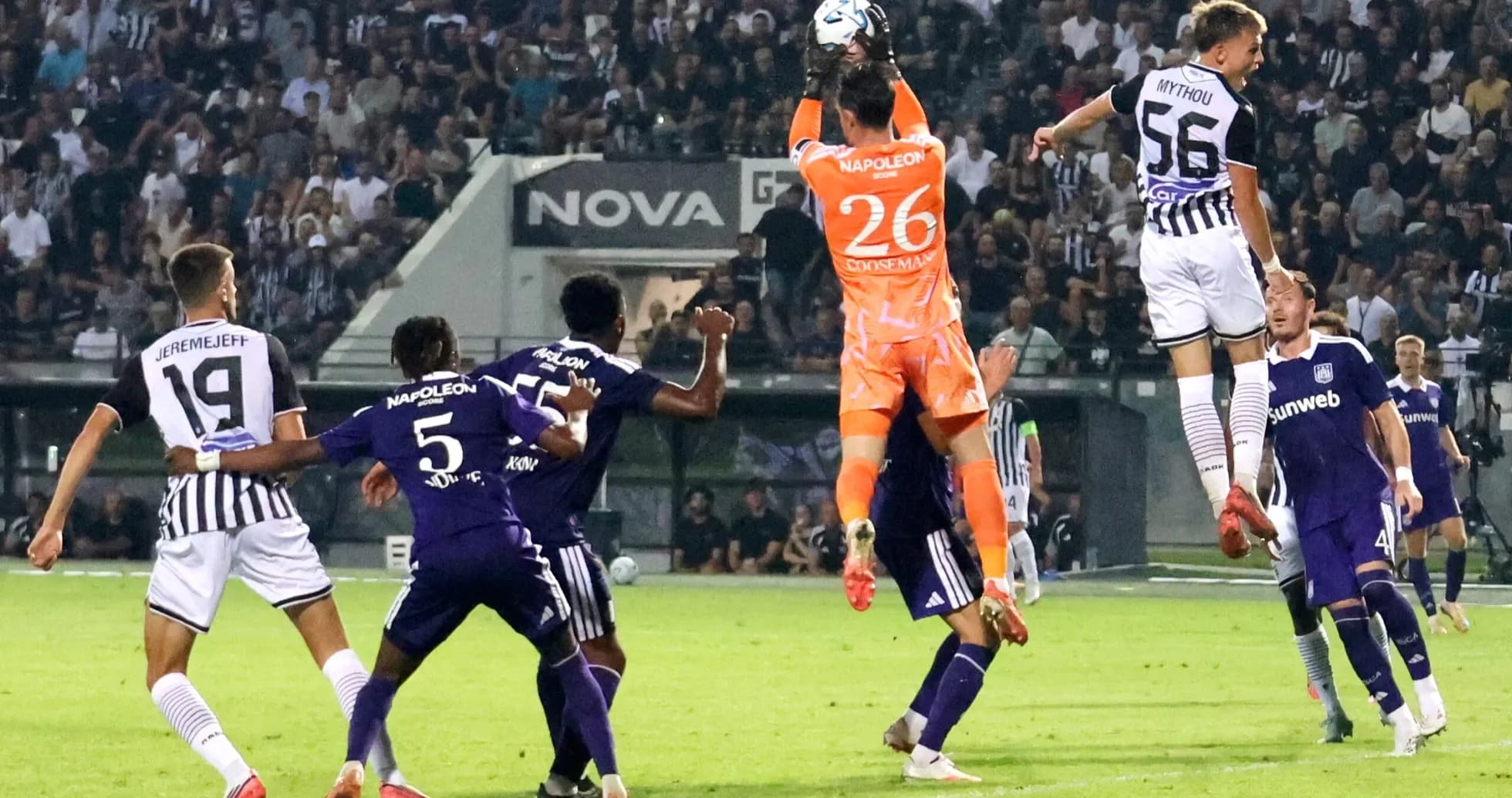
Alessio Lisci’s structure for PAOK was clear. With J. Pavlenka behind a back four of J. Kenny, P. Hatzidiakos, G. Michailidis and Jogo, the hosts tried to build through double pivot B. Santamaria and C. Zafeiris, freeing a creative line of A. Zivkovic, G. Konstantelias and Taison behind lone forward A. Mythou. The idea was to overload central zones with Konstantelias between the lines while Zivkovic and Taison rolled inside from the flanks, leaving full-backs to provide width. The shot profile reflects this: lots of attempts, many from imperfect positions, and a lack of clean, central finishes despite territorial control.
Conceding so early forced PAOK to chase the game, but the tempo of their possession was often too predictable against Anderlecht’s narrow midfield trio of E. Llansana, L. Ambros and M. Kana. Anderlecht’s 4-3-3 without the ball became a 4-1-4-1 or even 4-5-1, with J. Onia Seke and M. Cvetkovic dropping alongside the midfield to clog passing lanes into Konstantelias. D. Sikan stayed high as an outlet, occupying centre-backs and threatening transitions, which helped keep PAOK’s full-backs from committing completely reckless numbers forward.
The first key tactical adjustment came at half-time. P. Hatzidiakos, who had been booked at 38’, was withdrawn for A. Elustondo at 46’. This was a classic risk-management move: with PAOK needing to push higher and defend large spaces in transition, leaving a booked centre-back on the pitch would have been dangerous. Elustondo’s introduction allowed PAOK’s line to step up more aggressively, but Anderlecht’s discipline in their shape meant that the increased pressure translated more into volume than quality.
Anderlecht’s substitutions were all about refreshing legs in the block and maintaining defensive intensity. At 57’, O. Antman (IN) came on for J. Onia Seke (OUT), giving fresh energy on the flank to track PAOK’s full-backs. At 71’, N. Saliba (IN) replaced L. Ambros (OUT), and T. Degreef (IN) came on for M. Cvetkovic (OUT). Removing the goalscorer for Degreef signalled Anderlecht’s complete shift into game-management mode: the priority was no longer transitions through the front three, but preserving compactness and resisting PAOK’s waves of pressure.
Lisci responded with a more aggressive reshaping. At 63’, A. Baba (IN) came on for Jogo (OUT), adding a more attack-minded full-back on the left, and G. Taylor (IN) replaced B. Santamaria (OUT), altering the double pivot profile and pushing PAOK’s structure closer to a 2-4-4 in possession. At 71’, A. Jeremejeff (IN) replaced Taison (OUT), adding penalty-box presence and a more traditional target to attack Anderlecht’s central defenders with crosses and second balls. Finally, at 83’, D. Pelkas (IN) came on for A. Mythou (OUT), a move that traded a pure striker for another technical attacking midfielder, essentially flooding the half-spaces and looking for late combination play rather than direct finishing.
Despite these changes, the underlying pattern remained: PAOK dominated the ball but struggled to convert that into clear chances. Their 3 shots on goal from a high overall shot count underline the issue of shot selection and Anderlecht’s box protection. The visitors, with only 2 shots on goal and 2 off, were extremely economical but did not need more; the early strike allowed them to sit in and foul aggressively when needed. The foul count — 23 for Anderlecht against 15 for PAOK — is a tactical metric here: Anderlecht repeatedly broke up rhythm with contact, accepting three yellow cards (Moussa Ndiaye at 56’, Enric Llansana at 58’, Danylo Sikan at 90+1’) as the cost of disrupting PAOK’s combinations.
PAOK’s two bookings — Pantelis Hatzidiakos at 38’ and Aritz Elustondo at 86’ — also speak to the risks of playing a high line while chasing. Both centre-backs were drawn into defensive interventions with large spaces behind, a direct consequence of PAOK committing numbers forward and Anderlecht seeking counters through Sikan and the wide players.
Without recorded goalkeeper saves, we cannot quantify individual shot-stopping, but the structural story is clear. Anderlecht’s back four of A. Maamar, L. Petrot, G. Biancone and M. N’Diaye, shielded by a compact midfield, forced PAOK’s attackers to shoot from less favourable angles and distances, while clearing crosses and limiting second-ball chaos in the box. PAOK’s own defensive unit, after the early concession, largely locked the game down, but the damage from 1’ proved decisive.
Statistically, the match reads as a classic “possession versus pragmatism” European tie in the UEFA Europa League 3rd Qualifying Round. PAOK’s 65% possession, 5 corners and heavy shot volume indicate territorial dominance and structural control, but the lack of efficiency in the final third and the inability to create a higher number of shots on goal undermined their plan. Anderlecht, with 35% possession and minimal attacking output, nonetheless executed their game model perfectly: score early, compress space, foul when necessary, and manage the rhythm through substitutions.
The disciplinary profile — PAOK 2 yellow cards, Anderlecht 3, total 5 — mirrors the tactical edges: PAOK’s cards tied to the strain of recovery defending, Anderlecht’s to deliberate disruption of PAOK’s tempo. In a two-legged European context, this 0-1 home defeat leaves PAOK with the knowledge that their structure can control games, but also with a clear tactical lesson: territorial dominance must be paired with sharper chance creation and more incisive occupation of central finishing zones, or compact, disciplined opponents like Anderlecht will continue to exploit efficiency over volume.