Pafos' Tactical Superiority Over Hajduk Split in 2-0 Victory
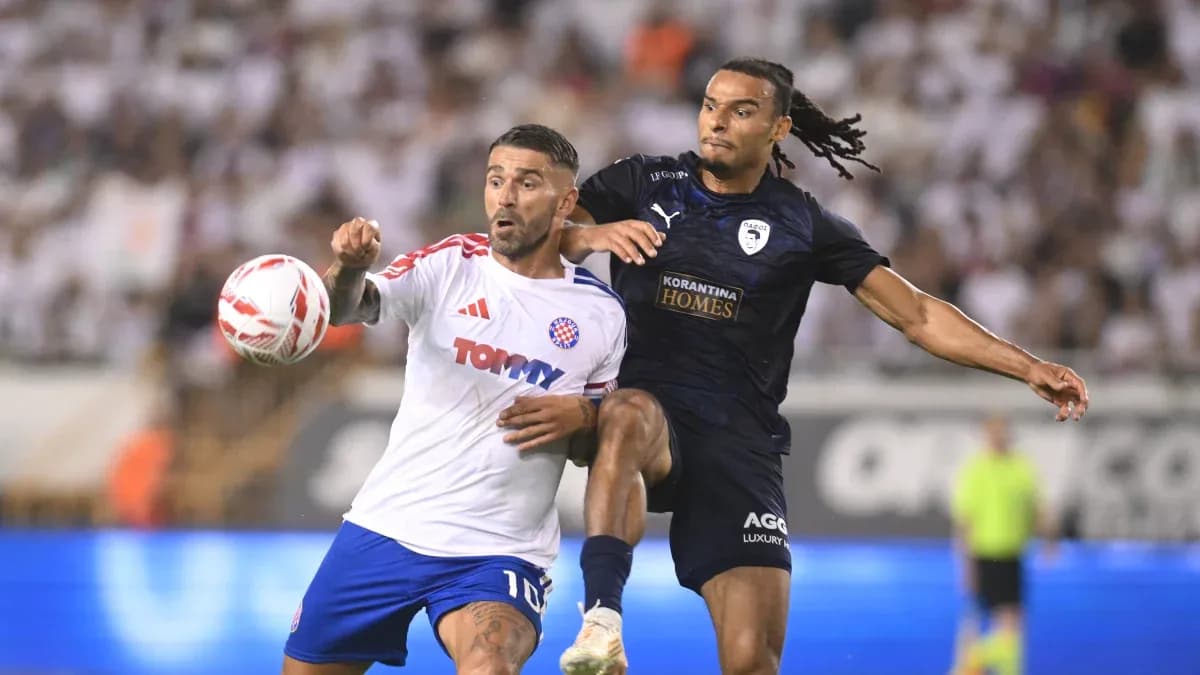
Pafos’ 2-0 victory over HNK Hajduk Split at Alphamega Stadium, sealed after extra time, was built on clear structural superiority rather than statistical dominance, because almost all numerical metrics beyond cards are absent. What does emerge from the data is a picture of a Pafos side that controlled space and game-state through their 4-3-3, gradually wearing down Hajduk’s 4-2-3-1 until the Croatian side collapsed in the final half-hour, conceding three goals in open play across regulation and extra time.
Pafos’ 4-3-3 was constructed to dominate central corridors and half-spaces. With David Luiz and D. Goldar as the central defensive pairing and N. Ioannou and Bruno as full-backs, the back four had a natural playmaking axis on the left (David Luiz–Ioannou) and a more conservative, stabilising profile on the right. Ahead of them, the midfield trio of Guga, I. Sunjic and D. Quina offered a clear division of labour: Sunjic as the screening pivot, Guga as the box-arriving interior, and Quina as the more creative, connective eight. That balance is underlined by the event data: Guga scores the opener on 40' and later receives a yellow card for “Elbowing” at 45+4', a classic indicator of an aggressive, high-impact interior operating on the edge.
The wide and advanced roles also fit the 4-3-3 logic. Biel and Jaja, listed as forward and midfielder but deployed on the top line, flanked Lele as the central reference. This front three stretched Hajduk’s back four horizontally, creating interior lanes for Guga and Quina to arrive late. The first goal, Guga’s strike on 40', is the clearest tactical reward for that pattern: with Hajduk’s double pivot occupied and their back line pinned by three forwards, the interior eight could step into shooting zones from the second line.
Hajduk’s 4-2-3-1, by contrast, was set up more conservatively. The back four of S. Hrgovic, A. Van Hoorenbeeck, D. Maresic and M. Acapandie had a naturally defensive profile, while the double pivot of A. Pajaziti and R. Pukstas was tasked with screening and distribution. Ahead of them, A. Guram, D. de Almeida and D. Melnjak supported lone forward M. Sego. On paper, this structure should have allowed Hajduk to crowd central zones and break through the three advanced midfield/forward bands. In practice, the event flow suggests they struggled to disrupt Pafos’ rhythm without fouling: Pajaziti’s yellow card for “Roughing” at 50' and Pukstas’ “Tripping” booking at 96' show a midfield chasing the game and increasingly late into duels.
Substitution patterns further illuminate the tactical battle. Pafos’ first change is proactive and attacking: at 45+2', V. Dragomir (IN) came on for Jaja (OUT). Dragomir later assists Goldar’s 90' goal, underlining the intent behind the switch – fresh legs and extra creativity between the lines to keep pushing Hajduk back. On 71', J. Correia (IN) replaced D. Quina (OUT) and Pepe (IN) came on for Guga (OUT), a double change that refreshed both the controlling and the attacking interior roles. This is crucial: the second and third Pafos goals come from players directly involved in those midfield rotations – Goldar scoring from a Dragomir assist at 90', Biel scoring at 93', and J. Correia finishing from a Pepe assist at 117'. Celades effectively turned midfield energy and bench quality into late-game penetration.
Defensively, Pafos’ card profile tells its own story. Three yellow cards – D. Goldar for “Tripping” at 12', Guga for “Elbowing” at 45+4', and I. Sunjic for “Holding” at 68' – all arise from duels in central zones. This suggests an aggressive, front-foot defensive block: centre-back stepping out to engage early (Goldar), an interior pressing high and sometimes over-committing (Guga), and the pivot using tactical fouls to slow transitions (Sunjic). The absence of any red cards indicates that, despite the intensity, the risk was managed.
Hajduk’s substitutions underline a reactive, increasingly desperate approach. At 53', A. Sanyang (IN) came on for A. Guram (OUT), followed at 63' by N. Sigur (IN) for M. Acapandie (OUT) and M. Livaja (IN) for S. Hrgovic (OUT). These moves collectively shift the balance towards more attacking profiles and greater risk down the flanks, but they also weaken the defensive stability of the back line. Later, A. del Moral (IN) replaced A. Pajaziti (OUT) at 85', A. Sutalo (IN) came on for D. de Almeida (OUT) at 98', and M. Skelin (IN) replaced D. Maresic (OUT) at 106'. The pattern is clear: Hajduk cycled through central and wide options, but never found a configuration capable of breaking Pafos’ structure, and in the process they repeatedly altered their defensive spine.
Pafos’ late-game substitutions, meanwhile, were as much about energy management as they were about maintaining tactical clarity. At 82', K. Sema (IN) replaced N. Ioannou (OUT) and M. Mammadov (IN) came on for I. Sunjic (OUT), refreshing both full-back and pivot roles without changing the 4-3-3’s basic geometry. At 103', A. Brito (IN) replaced Biel (OUT), again maintaining the front-three shape with fresh pressing and depth. Even deep into extra time, Pafos looked structurally coherent, which helps explain their ability to score again at 117' rather than simply protecting the lead.
Without possession, shot or passing data, the statistical verdict must rest on discipline and game-state. Pafos collected 3 yellow cards, Hajduk 2, with no reds for either side. The nature and timing of those cards suggest Pafos were the aggressors in central spaces, while Hajduk’s bookings were more reactive, coming as they tried to halt Pafos’ momentum. The 2-0 scoreline after extra time, combined with three open-play goals and no concessions, implies that Pafos’ 4-3-3 outperformed Hajduk’s 4-2-3-1 both in creating high-value central runs and in sustaining defensive compactness across 120 minutes. In tactical terms, this was a controlled, structurally consistent home performance that gradually overwhelmed an increasingly improvised visiting setup.