
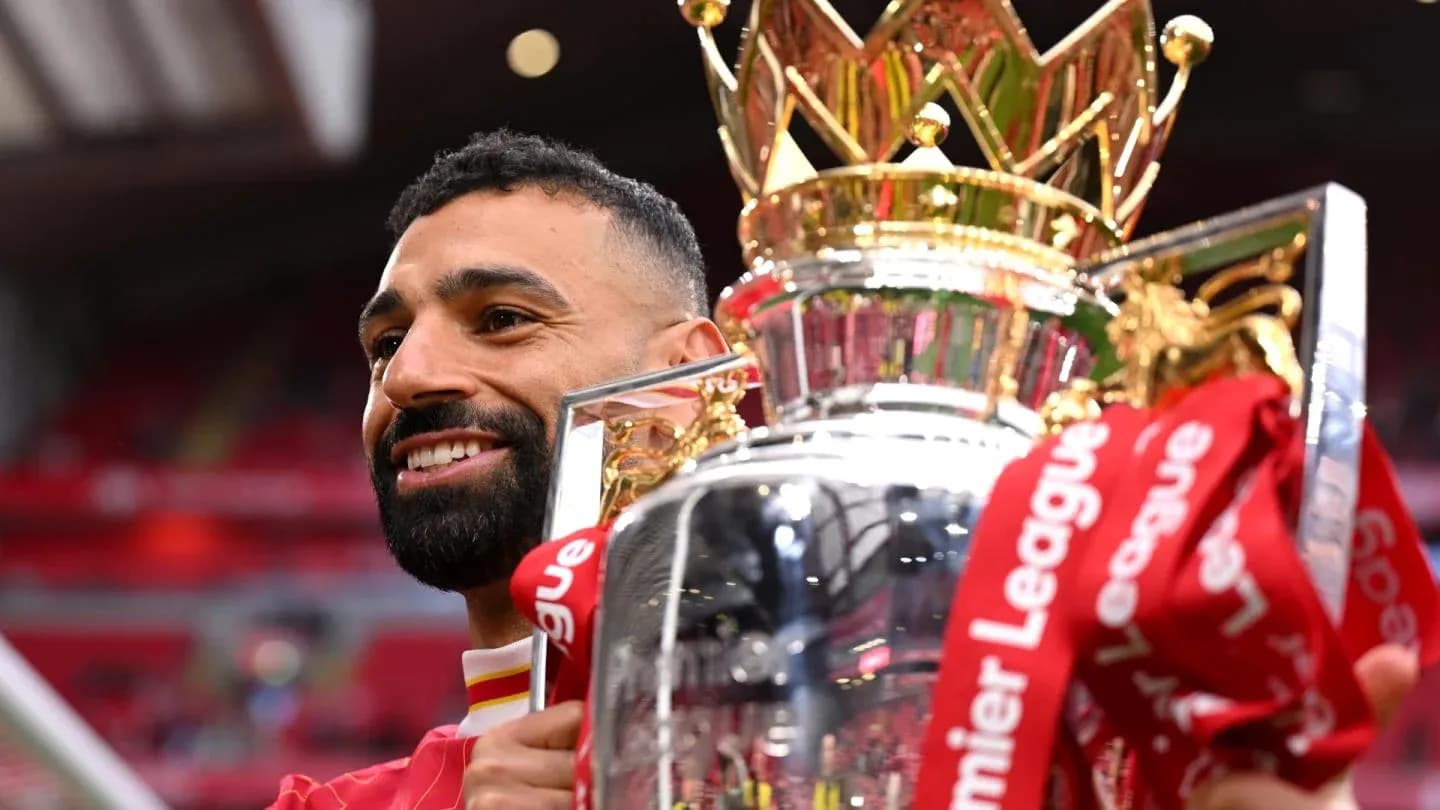
Mohamed Salah's Legacy at Liverpool: A Once-in-a-Generation Player
On Sunday at Anfield, a chapter closes. Mohamed Salah, the man who dragged Liverpool into a new era of glory and refused to let their standards drop for nearly a decade, will pull on the red shirt there for the final time.
Nine years. Two Premier League titles. A Champions League. A mountain of goals – 257 of them, making him the third-highest scorer in the club’s history. But the numbers only scratch at what he has been.
Those who shared the dressing room with him know it better than anyone.
A once‑in‑a‑generation force
Virgil van Dijk has spent years watching Salah from 30 yards behind him, with the best seat in the house.
“There are so many words that can be said about him. He’s been an incredible football player, so influential. Absolute special player. Once-in-a-lifetime player, in my opinion,” the captain says.
Van Dijk lists the goals, the assists, the devastating triangle with Sadio Mané and Roberto Firmino, the relentless work without the ball. For him, Salah has been a “leader by example” and “a big part of the successes that we have.”
Alisson Becker, another pillar of this Liverpool side, puts Salah where he believes he belongs – at the very top of the club’s history.
“I think he’s one of the most important players of the history of this club. He’s on the top with so many others,” the goalkeeper says. The records, the goals, the assists – and then the part fans never see. The hours in the gym. The obsessive routine. The standards.
“Someone that works really hard, doesn’t rely only on his qualities but improves his qualities on the pitch, in the gym, at home,” Alisson explains. For him, Salah leaves behind more than medals and memories. He leaves a blueprint.
“Mo leaves here a legacy as well about standards. He’s someone that you can tell your kids, ‘Look to this guy. If you want to be someone good you can follow him on the things that he does.’”
The professional’s professional
Players who arrived at Liverpool with glittering CVs still found themselves learning from him.
Thiago Alcantara, schooled at Barcelona and Bayern Munich, thought he had seen it all. Then came Salah.
“Suddenly, a guy with a similar age of mine, you learn a lot,” Thiago says. Not just about tactics or combinations, but about hunger, behaviour, the human behind the superstar. “Amazing human being, amazing professional. Keeps you hungry as well all the time. One of the best teammates I ever had.”
Alex Oxlade-Chamberlain goes further, calling what he witnessed “obsession.”
“I’ve never seen anyone do what Mo does – every hour of the day,” he admits. “To the point where I straight up look at him and think, ‘I don’t think I could do that and fair play, you deserve everything you do.’ It was obsession.”
Milos Kerkez, one of the newer faces to share a training pitch with Salah, came away stunned by the sheer detail of his preparation.
“What really put him [apart] from everyone is how professional he is, it’s unbelievable. I don’t see that in any player,” he says. The gym work, the diet, the focus – all designed so he can “perform his best on the pitch.”
Pepijn Lijnders, the long-time assistant on Merseyside, distils it into a single line.
“I never met a guy – a player but also a human being – who is more committed to the life of being a professional football player.”
Standards, leadership and the dressing-room pulse
Salah’s influence has never been limited to the penalty area.
James Milner, a standard-setter himself, saw another leader in the No.11.
“You need different types of leaders and Mo was a big leader,” Milner says. “The standards he set every day – not only in training, in the gym, off the field – he led, for sure, by example.”
For young players, the message was clear: this is what a Liverpool player looks like.
“When you see someone doing so well on the pitch and seeing what they’re doing every day, and you have young players coming through and players signing, it’s like, ‘This is what it is to be a top player, this is what it is to be a Liverpool player.’”
Harvey Elliott felt that impact up close. The teenager who grew into a first-team regular did so with Salah’s voice in his ear.
“[Salah] was giving me pointers like what I needed to do, how I needed to do things, the philosophy of how we play, and what the manager wants,” Elliott recalls. Over time, that guidance turned into something deeper. “Even to this day, me and him have a really close connection now. And I’d say it’s more of a friendship than him just trying to help me out.”
Jordan Henderson, who captained Salah for most of his Liverpool stay, draws the line between greatness and something even rarer.
“He wanted to be the best player. He probably wanted to break all those records, but he wanted the win for the team as well,” Henderson says. “There’s a difference between being the best player, and being the best player and the best human being – and I feel like Mo is both of those.”
Roberto Firmino, the man who dovetailed with Salah in one of the most feared front threes in Europe, talks of a player adored in the dressing room as much as in the stands.
“He’s a good guy that everyone likes, that everyone admires a lot,” Firmino says. On the pitch, he watched Salah “build the history and legacy he is leaving”. Off it, he saw “a beautiful heart.”
Luis Diaz, a more recent arrival, found himself inspired in the same way.
“He always wants to win titles and give his best for the club,” Diaz says. Sharing those moments, seeing that joy and drive up close, “was incredible”. The Colombian admits Salah “left a profound mark on me.”
The relentless pursuit of more
If there is a single thread that runs through every tribute, it is his refusal to settle.
Trent Alexander-Arnold has watched that mindset daily since breaking into the side.
“A relentless drive to be better and to be the best,” the right-back says. “There wasn’t a day in training or anything where he didn’t want to be the best. Every single day he had a drive to keep getting better and better. He was never satisfied. Even with every record that he shattered, there was always something else he was chasing. Incredible.”
Daniel Sturridge, who shared a dressing room with Salah in those early, explosive seasons under Jürgen Klopp, recognises the trait all great forwards share – and how strongly it burned in the Egyptian.
“One of the great attributes of attackers is to always feel like you want to help the team with numbers,” Sturridge says. For the truly elite, that desire becomes something more. “With the truly great ones it’s an obsession that you have to have. I think he has that and had it in abundance.”
Sturridge is clear: no one outside Salah himself truly foresaw this level.
“I don’t think anybody ever thought he would be what he’s become, besides himself. It’s testament to his attitude, to his drive, to his will, to his dedication.”
Arne Slot, who has worked with Salah in this final act of his Liverpool story, saw the same intensity from day one.
“To show that hunger every three days, that professionalism, that commitment to the club, to the team, to wanting to score again, always wanting to play – when you take him out three minutes before the end, he’s like, ‘Maybe I could have scored one extra!’ – that is what stands out for me,” the head coach says.
“Everything he’s done for the club, but the moment I started working with him I knew it after one day, let alone after a few weeks or months, that it isn’t a coincidence that he’s been so influential in the last 10 years in football.”
Greatness recognised by greats
Salah’s impact stretches beyond Liverpool, beyond even the Premier League.
Steven Gerrard, the club’s iconic former captain, places him among the game’s untouchables. Gerrard remembers his own peak, when he felt he could compete with anyone – yet still saw a handful of players as operating on another planet: Ronaldinho, Cristiano Ronaldo, Lionel Messi, Zinedine Zidane, Xavi, Andres Iniesta.
“Salah’s in that level, Salah is in that level,” Gerrard insists. “Don’t let anyone else tell you any different – he’s in that level.”
Fernando Torres, another Anfield idol, echoes that sentiment.
“For me, [he is a] top player and one of the best players in the last 10 years,” Torres says. He goes further still: “[he is] my favourite player [and] I put him among the best players in the world in the last 10 years.”
Robbie Fowler, once the benchmark for Liverpool goalscorers in the Premier League era, looks at the numbers and shakes his head.
“I think he’s been an astonishing player for Liverpool. His numbers, his games, his performances, his record have been outstanding,” Fowler says. For him, Salah is not just a Liverpool great but “one of the Premier League greats.”
“So not only will the Liverpool fans miss him, but I think fans of the Premier League will miss Mo Salah as well.”
Ian Rush, the club’s record scorer, sees more than a finisher.
“Not just a goalscorer but the way he plays, he’s got a great football brain in there,” Rush says. When Salah surges down that right flank, Rush sees something “absolutely incredible”. “All Liverpool fans will love him and be sad to see him leave.”
Klopp’s pride and a legacy beyond goals
Jürgen Klopp has built his Liverpool around Salah’s gifts and mentality. The manager knows exactly what the club is losing.
“We will realise – I think we know already, we have a sense – we saw greatness. And that’s what he is,” Klopp says. “He’s an all-time great, he’s an incredible football player, he’s an incredible guy.”
Klopp also points to Salah’s role as a symbol far beyond football, an “incredible ambassador for the whole Arabic world, in a difficult time we are living in.”
“You have this guy who shows like, yeah, here we go, we’re all the same, we’re all together, we love the same things, we fight for the same things, all these kinds of things. That’s what he shows. And, yeah, I couldn’t be prouder of him.”
Joe Gomez, one of the longest-serving teammates in this era, knows he has watched history unfold from a few yards away.
“One of the greatest to ever wear the shirt,” Gomez says. “It’s been a pleasure having the countless hours watching your greatness first-hand in so many ways. Everyone knows about your mentality and work ethic – the numbers just cement your legacy forever.”
For Andy Robertson, the left-back who has spent years feeding passes into Salah’s path and celebrating from the opposite flank, the verdict is simple.
“Watching you become the best at what you do and become one of the best to ever have worn the Liverpool shirt has been a joy to watch and be part of,” Robertson says. “Your mentality is second-to-none and a lot of people could take note.”
He calls it a privilege to share the pitch with him and, more importantly, to call him a friend.
“You deserve a send-off that reflects your status at LFC – the greatest. Second-to-none.”
On Sunday, Salah will walk out at Anfield one last time as a Liverpool player. The goals are already written into the record books. The trophies already sit in the cabinet.
What remains is the roar, the farewell, and the question that will echo long after he has gone: how do you replace a once-in-a-lifetime player who never stopped chasing one more goal?





