Miami’s Messi-era Reality Check: Problems Behind the Genius
Nashville didn’t just beat Miami on Saturday night. They stripped the gloss off the project.
A 4-1 defeat, the kind that looks bad on the scoreboard and somehow worse on the pitch, laid everything bare. Miami hogged the ball, yet every turnover felt like an invitation. Nashville accepted, again and again, slicing through a team that had no interest — or ability — in defending transitions.
Hany Mukhtar, one of MLS’ most ruthless No.10s, toyed with them. Two goals, constant menace, and a reminder that this league still belongs to the runners and the ruthless. Sam Surridge added another. Andy Najar, a right back in name only on this evidence, roared forward to score as Miami’s “defensive shape” became more concept than reality.
In midfield, Eddi Tagseth and Matthew Corcoran didn’t just win the battle. They ran Miami into the ground. It was a miserable night, but more than that, it was a blueprint.
Keep Messi quiet, and the rest collapses
The formula is out in the open now. Limit Lionel Messi, and the whole thing creaks.
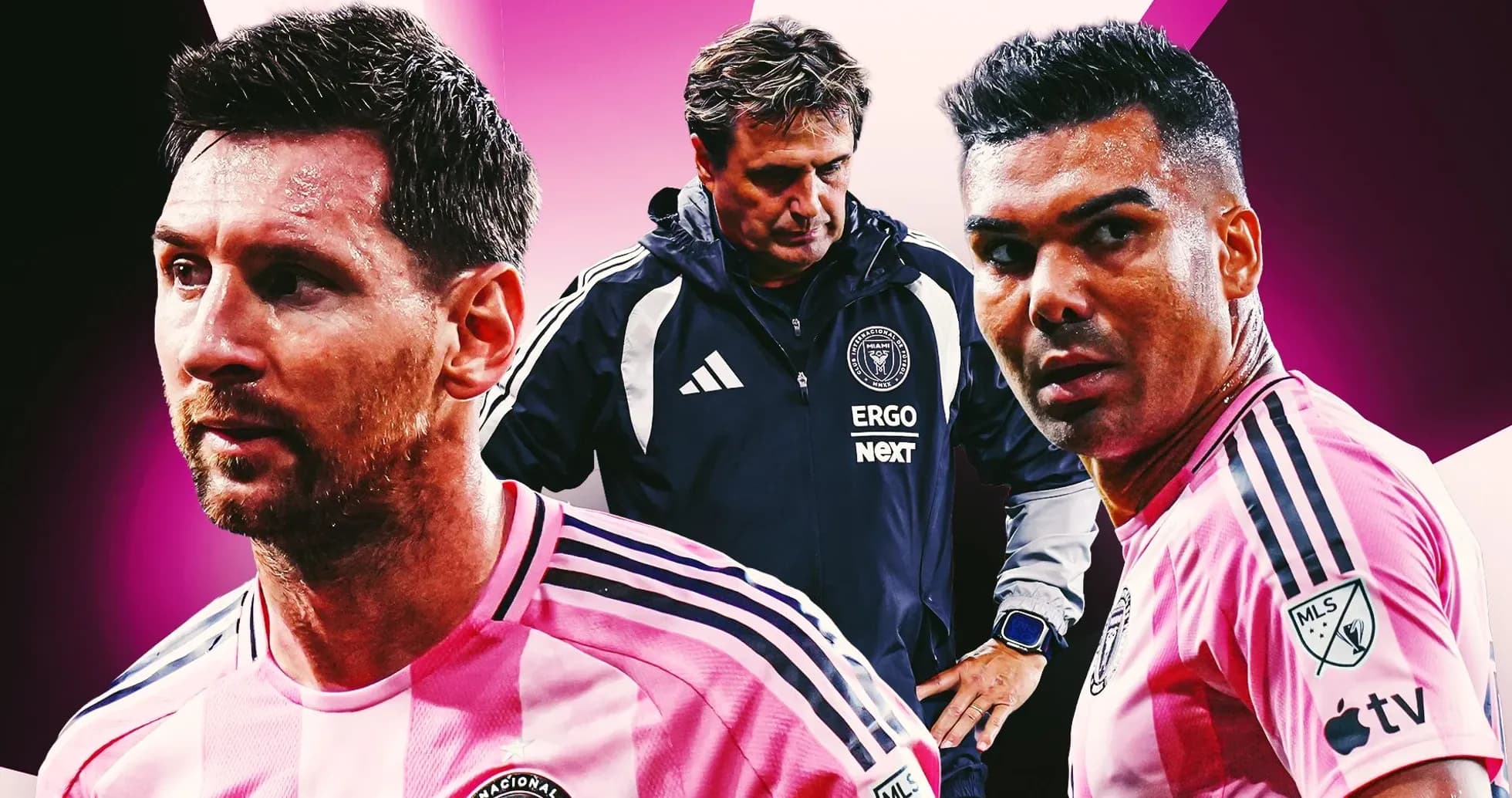
Messi doesn’t defend. Luis Suarez, 39 and still straining every sinew, simply can’t get around the pitch. Rodrigo De Paul covers ground on the right, but in the middle Casemiro looks like he’s running in mud. That’s before you get to the drop-off at left back: from Jordi Alba, whose understanding with Messi is almost telepathic, to Sergio Reguilón, who hasn’t played regular football since 2022.
There’s no clever tactical tweak that fixes this. This is a roster problem, a legs problem, a balance problem. Right now, Miami are an average playoff team being hauled upward by one extraordinary player.
On paper, you can fix that. Identify the gaps, recruit smarter, build a more coherent side. Miami have already shown they can bend MLS’ restrictive salary rules without quite breaking them, pulling off the financial gymnastics needed to land stars.
Yet the gaps are obvious and still unfilled. They lack running power up front and energy in central midfield. Elite No.8s and No.6s don’t just appear, and they rarely choose MLS in their prime. But there is a world where N’Golo Kanté arrives instead of Casemiro. There is a world where the $15 million spent on German Berterame — a forward without a defining, elite skill — goes elsewhere.
There’s also a world where Benjamin Cremaschi is nurtured, not alienated. Instead, after feeling misused by Javier Mascherano — something he has openly admitted — Miami risked losing a young, dynamic midfielder who could have been a central pillar for the future.
A squad built for one man
Strip away the romance and it’s simple: this team is built to keep Messi happy.
The pattern goes back to 2023. Sergio Busquets and Alba arrived in part to lure him to South Florida. De Paul has admitted that playing with Messi and staying sharp for the World Cup drove his move from Atletico Madrid; he and Messi were reportedly putting in extra training sessions before Qatar.
Even Casemiro, a long-time rival from the Clasico wars, framed his move in those terms.
“For me, without a doubt, I am coming only to play with the best player of all time,” he said at his unveiling. “I want to enjoy, I want to help him to keep winning because he is a winner. Another player is joining who wants to win, who wants to compete.”
Whether Messi is the one placing the calls or simply the gravitational force around which everything orbits almost doesn’t matter. The outcome is the same. This is a squad constructed in service to him, not in service to long-term, sustainable winning.
And that’s the looming problem Miami can’t ignore.
The clock is ticking on the Messi project
MLS is about to change. The switch to a fall-spring calendar in 2027-28 will align the league more closely with the global transfer market. Owners have already listened to proposals about loosening salary rules and allowing greater spending.
That’s when the league can start to get serious. Or at least act like it.
Messi is under contract through the end of the 2028 season. That covers next year’s shortened “sprint season” and the first full fall-spring campaign. On paper, Miami have time: what’s left of this season, one abbreviated year, and at least one full campaign with their star.
But if he walks earlier, say at the end of this year, the picture turns bleak in an instant.
Miami would be left with expensive Designated Players who don’t quite fit together. De Paul is tied down on DP money through 2029. So is Berterame. Casemiro isn’t currently a DP, but Miami have already shown a willingness to structure deals creatively, starting players on lower numbers before bumping them up.
That’s the nightmare scenario: a post-Messi roster full of big contracts, aging legs and no clear face of the franchise.
What Miami need next is not just another great player. They need someone who can be the sporting and commercial centerpiece — the heir to the idea of Messi, if not the legend himself.
The Alvarez fantasy — and the American Plan B
Alvarez ticks every box. Quality at the highest level. Young enough to build around. Argentine. Tireless. Marketable. He wouldn’t replicate Messi’s global pull — nobody can — but he could anchor a serious succession plan on and off the pitch.
The problem: reality.
Atletico Madrid paid an initial €75 million, plus up to €20m in add-ons, to sign him from Manchester City in 2024. This summer, they reportedly turned down a €150m offer from Real Madrid. For Miami to even get to the table, they’d need a transfer package that dwarfs anything MLS has ever contemplated, then somehow sort out a salary that keeps him in South Florida and not back in Europe.
Right now, Alvarez is more fantasy than solution.
If that dream dies, the next logical route is an American star. Christian Pulisic and Weston McKennie are the only two that truly fit the bill. Pulisic is the most recognizable active American player. McKennie offers personality, quality, and a profile that would resonate domestically.
Both could be foundational pieces for the next version of Inter Miami. Neither comes close to Messi’s global magnetism. They’d help fill the gap on the field. They can’t replace the phenomenon.
And that’s the core of Miami’s dilemma.
A club built on one man’s shadow
Messi is not just a player here. He is the business model.
His presence fuels sponsorships, ticket demand, global interest. A stand at Nu Stadium carries his name. His compensation reportedly includes ownership shares. This is not a standard DP deal; it is a partnership. Messi is the foundation of the project, sporting and commercial.
Miami have yet to show how they rebuild when that foundation is gone.
The recent past offers a warning. Before Messi, Miami were one of the league’s worst teams. They had signed big names before — Blaise Matuidi, Gonzalo Higuain — but neither shifted the club’s trajectory. Attendance sat in the bottom third of MLS. By July 2023, when Messi arrived, they were effectively out of the playoff race and still trophy-less. Phil Neville had already been sacked. The roster was full of holes. The project felt directionless.
The risk is obvious: once Messi leaves, they tumble straight back into that pattern.
The transition is inevitable and will be brutal to manage. The club’s identity, on and off the pitch, orbits around Messi. The Argentine, naturally, controls the timing of his own exit. That leaves Miami with precious little room to shape what comes after.
There is still a version of this story where Messi summons one last Herculean run and drags Miami to another trophy. He’s done it before, for club and country, against logic and time.
But nights like the 4-1 defeat in Nashville hint at how steep that climb will be with this incomplete, unbalanced team.
For now, Miami walk off behind their No.10 after each bruising result, staring at the tunnel and the figure disappearing into it, and wondering: what will be left when that walk is for the last time?