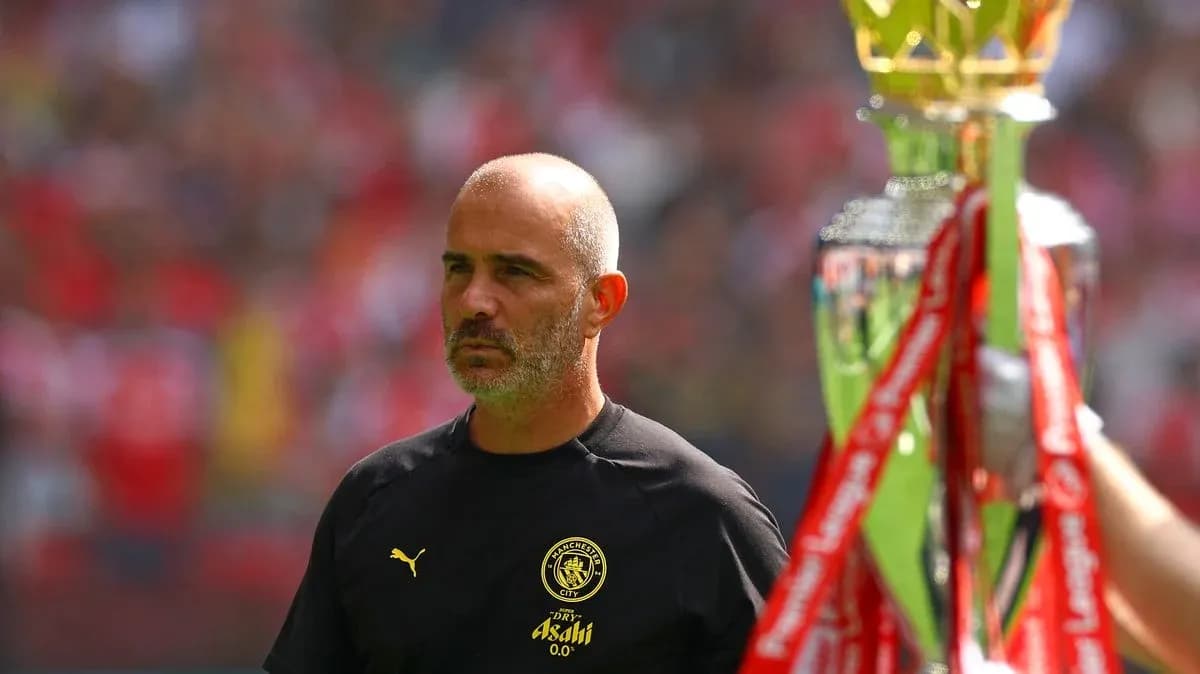
Manchester City's Community Shield Defeat: A Jarring Performance
Manchester City’s Community Shield defeat to Arsenal was jarring not just because they lost, but because it barely resembled the Enzo Maresca team that had been taking shape all summer.
For weeks, City’s pre-season had sketched out a clear picture: structured build-up, defined roles, a sense that the post-Pep Guardiola era might at least begin with clarity. Then Wembley happened. The performance was disjointed, the selections surprising, and the overall impression was of a side suddenly far less than the sum of its expensive parts.
Yes, Arsenal were a level above anything City had faced on their Asia tour. That matters. But it doesn’t explain why a team that had looked so coherent in July appeared so muddled in August.
Maresca’s big gamble
The first eyebrow-raiser came with the team sheet. Erling Haaland, Elliot Anderson, Nico O’Reilly and Jeremy Doku – four of City’s most important attacking players – all thrown straight into the starting XI after only a handful of training sessions.
It looked like a manager desperate to win his first piece of silverware in charge. Why else rush them back when fitter, more tactically drilled options were available?
Maresca’s explanation afterwards told a different story. This, he insisted, was about Bournemouth and the Premier League, not about a shield and a photo on the steps.
“Sometimes players prefer to start doing the proper warm up and start from the beginning,” he said. The plan, he added, had always been to haul them off after 45 to 60 minutes. In other words, Wembley was being used as a live-fire fitness exercise, a way to fast-track key players towards full sharpness for the opening league fixtures.
That logic makes sense on a whiteboard. On the pitch, it made City look undercooked and out of sync.
Anderson out of place, Kovacic exposed
No decision underlined the confusion more than Anderson’s role. Only days earlier, Maresca had been crystal clear: the former Nottingham Forest man is a No.6 or a No.8. Central. Involved. Dictating.
At Wembley, he was shunted out to the right in a loose, floating position that helped nobody. Anderson looked uncertain, caught between lines, while Mateo Kovacic was left isolated as the lone holding midfielder and duly swamped by Arsenal’s movement.
There were flashes from Anderson – two excellent deliveries from the right, one for Haaland and one for Doku – reminders of his attacking quality. But they were moments, not a pattern. The set-up never looked natural, either for him or for the midfield as a whole.
Then came the other glaring omission: Matheus Nunes. All summer, City have treated Nunes as their first-choice right-back, to the point that plans to recruit competition in that position have been parked. Yet in this first real test, he was nowhere to be seen.
Instead, Abdukodir Khusanov endured a difficult afternoon as part of a back line that never quite settled. With Anderson miscast and Nunes absent, City made life far easier for Arsenal than it needed to be.
Those calls raised legitimate questions about Maresca’s in-game judgement. But they also felt so out of step with his pre-season blueprint that they may prove more outlier than omen. A City side with Anderson restored to a central role and Nunes reinforcing the defence should look very different.
Grealish back in the shop window
The second half brought another twist: Jack Grealish.
Twelve months ago he was at Everton on loan. This summer he missed the tour altogether, with City open to moving him on before the window shuts. On that basis, his introduction at Wembley was unexpected.
His minutes might have been more valuable for someone like Rayan Ait-Nouri in pure tactical terms. But from a market perspective, Grealish’s outing made sense. Any club weighing up a move for a £100m talent will have taken note of a player who, at the very least, still looks capable of affecting games at the top level.
If Sunday accelerates a sale, City may yet view those minutes as well spent.
Flunked test, or part of a longer game?
As a first major examination for Maresca, this was a fail. The performance left doubts about how quickly he can impose his ideas, and whether those ideas will stand up when the stakes rise in the Premier League and Champions League.
Yet it’s also true that some of his choices were so uncharacteristic of his summer work that they hint at a manager playing a longer game. Using the Community Shield as a controlled environment to build fitness and test combinations is a risk. It just looked a lot uglier than he would have liked.
The temptation, after a showpiece defeat, is to declare sweeping verdicts on “Maresca’s City”. The reality is more mundane and more important: it was 90 erratic minutes in August, not a manifesto for the season.
The real judgement starts when Bournemouth arrive and there are no more free hits.