Mahmoud Bentaieb's Potential Switch to Egypt: What the Law Says
Mahmoud Bentaieb, the Zamalek defender who has already broken into the Morocco senior side, is actively exploring a dramatic international switch to represent Egypt – but the law may stop him long before any coach does.
His name has dominated headlines in Cairo and Casablanca in recent days. Egyptian outlets reported that the 26-year-old wants to wear the Pharaohs’ shirt instead of Morocco’s. Moroccan media pushed back, insisting there was no such intention. Then his agent spoke – and blew the story wide open.
Agent confirms Egypt option on the table
Youssef Massaad, Bentaieb’s representative, told Moroccan newspaper “Al-Omk” that the player is indeed weighing up a change of sporting nationality after being overlooked by Morocco coach Mohamed Ouahbi in the latest squad.
For Bentaieb, that omission stung. For his camp, it raised a question: if the national team of his birth country does not see him as a priority, should he listen to the voices in Egypt who do?
Massaad revealed that officials in Egypt have floated the idea of Bentaieb joining the Egyptian national team. The defender, who had always placed Morocco first, is now studying the possibility seriously.
He has not stopped at idle reflection either. According to press reports, Bentaieb has already contacted FIFA to ask about the legal feasibility of changing his sporting nationality and is now waiting for a formal response.
What the rulebook actually says
To cut through the noise, Lebanese legal expert Ralph Charbel laid out the framework. Speaking to Kooora, he explained that FIFA imposes strict conditions before it allows any player to switch international allegiance.
In cases where a player has never represented a country at any age level and wants to play for another national team, he must first obtain that new nationality and then satisfy at least one of these criteria:
- He was born in the relevant country.
- His father or mother was born there.
- His grandfather or grandmother was born there.
- He has lived continuously in that country for at least three years if he moved there before turning ten, or at least five years if he arrived after the age of ten.
Here, the complications begin for Bentaieb.
He was born in Casablanca to Moroccan parents. No Egyptian parent, no Egyptian grandparent. His connection to Egypt is personal rather than ancestral: he is married to an Egyptian woman, the daughter of Zamalek board member Ahmed Suleiman.
His residency case is also thin, at least for now. Bentaieb has been in Egypt only since his move from Saint-Étienne in the summer of 2024. That gives him roughly two years on Egyptian soil – well short of the five-year threshold required for players who arrive after the age of ten.
Even if he eventually clears the residency hurdle by staying longer, another, more stubborn obstacle stands in his way.
Arab Cup caps tighten the noose
Charbel underlined an extra layer of restriction: for a player to be allowed to switch, he must not have played more than three matches for his current senior national team, and at least three years must have passed since his last appearance.
On paper, that sounds like a lifeline. In practice, the 2025 Arab Cup shuts most of that door.
Bentaieb never played for Morocco at youth or junior level. His first and only involvement came directly with the senior team at the Arab Cup in Qatar last year.
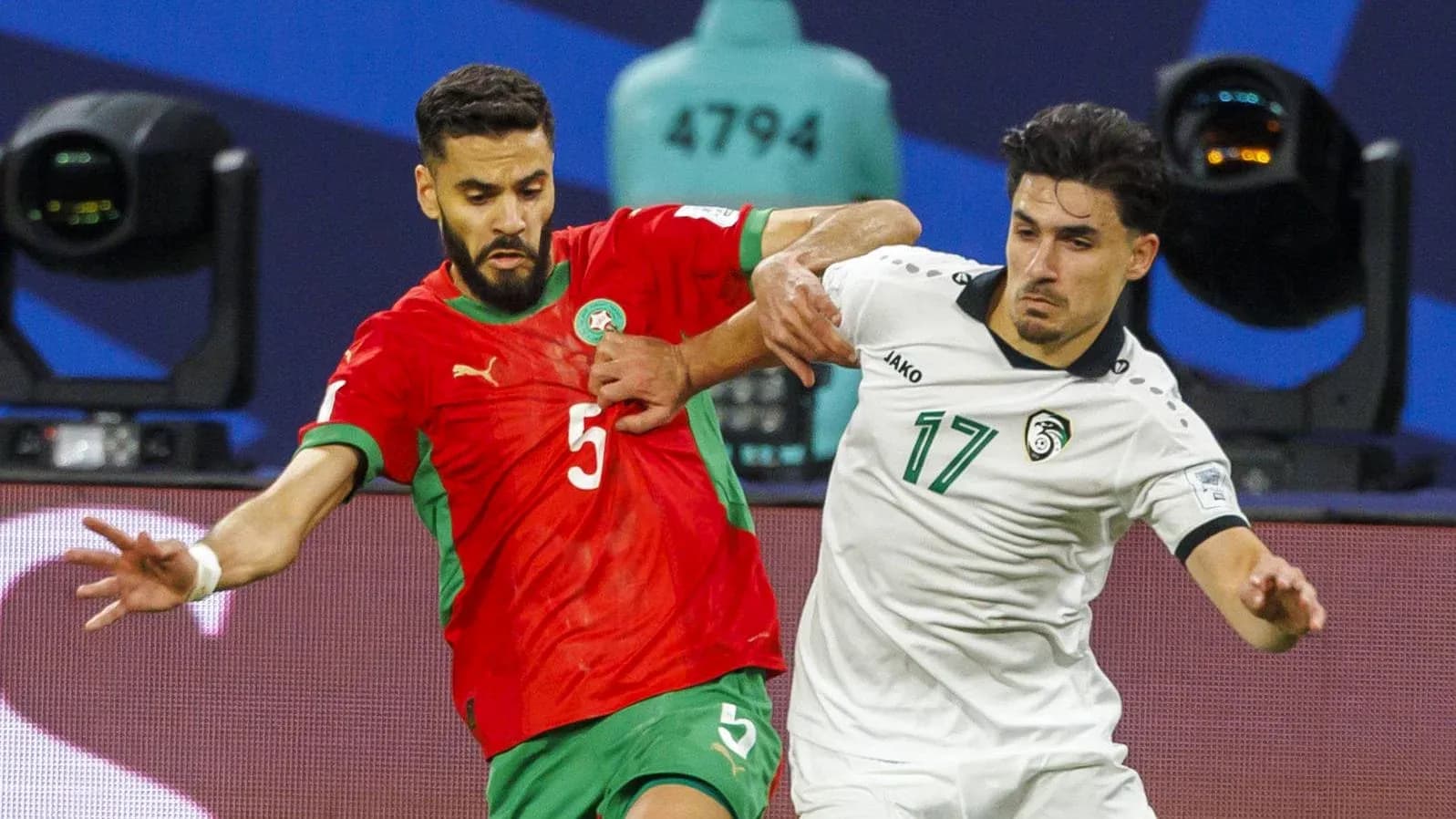
There, he appeared in four matches, all as a substitute, against Saudi Arabia, Syria, the UAE and Jordan. Morocco won every one of those games. He also sat on the bench in the opening two fixtures, against Comoros and Oman, which both ended in draws.
Those four caps mattered. They helped Morocco, coached by Tarik Sektioui – now in charge of the Oman national team – lift the Arab Cup trophy. They also pushed Bentaieb past a critical FIFA threshold.
Charbel stressed that since 2021, FIFA has officially recognised the Arab Cup as a competition under its umbrella. That recognition gives full international weight to Bentaieb’s appearances, regardless of the fact that Morocco fielded a second-string squad without their Europe-based stars.
The consequence is brutal in its simplicity: he has already played four times for Morocco’s senior side in an official FIFA-recognised tournament. The limit for a potential switch is three.
A narrow crack in a closing door
On the face of it, the case looks bleak for those in Egypt hoping to see Bentaieb in a red shirt. Charbel, weighing the facts, described the chances of a successful nationality change at this moment as “difficult”.
Yet he stopped short of calling it impossible. The international lawyer admitted he cannot be certain FIFA will reject the request, because he does not know the full legal argument Bentaieb’s camp might submit.
So the defender waits. Morocco have already capped him. Egypt are circling, intrigued but constrained. FIFA’s legal machinery will eventually deliver a verdict that could shape the rest of his international career.
For now, Bentaieb’s story sits in limbo: a Moroccan champion of the Arab Cup, a Zamalek pillar in Cairo, and a player caught between the country of his birth and the country where his career – and his family life – are taking root.